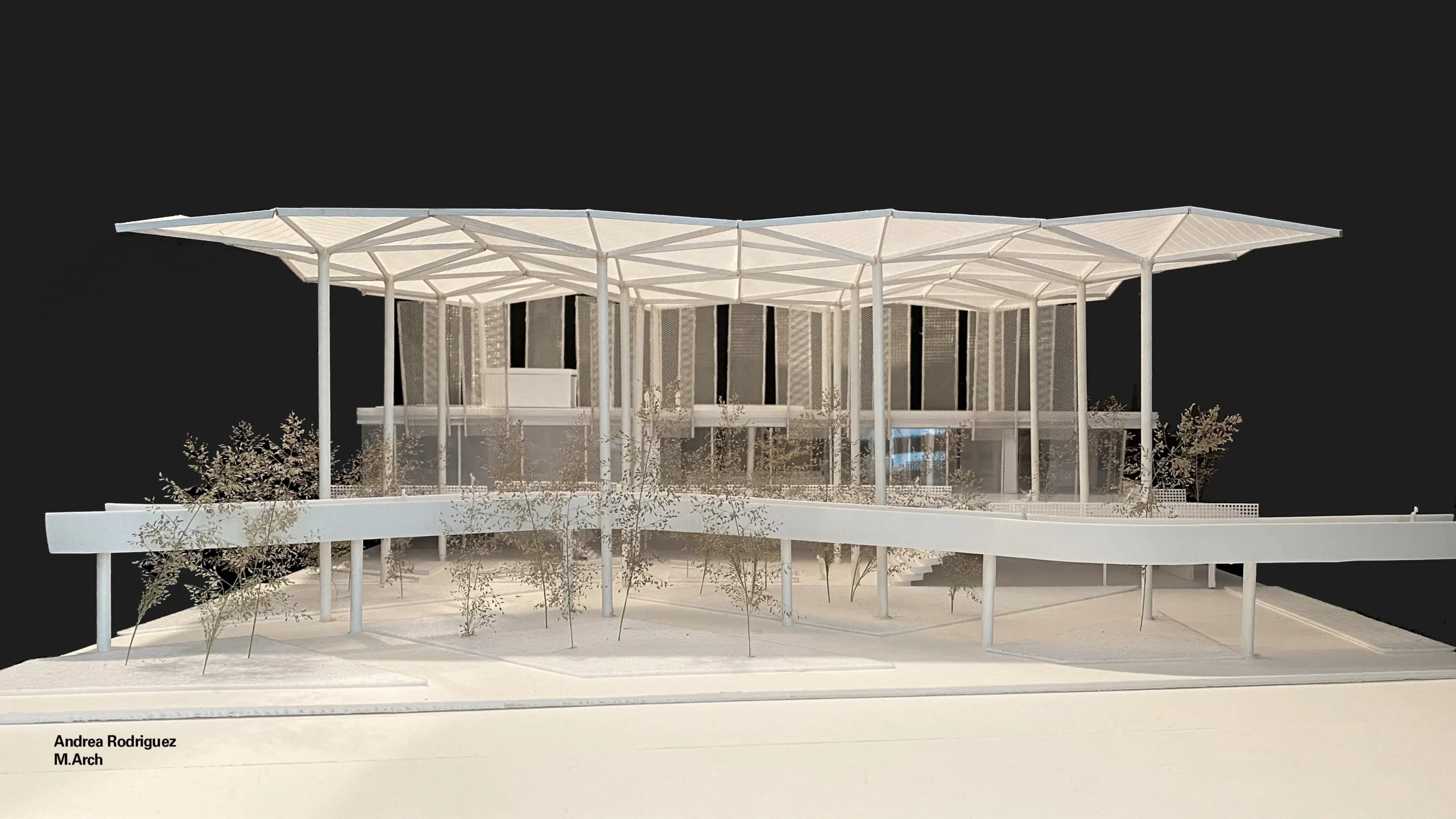

Advanced Architectural Design, Track 2 is a Master Degree program offered by Academy of Art University in San Francisco, CA. The program takes 60 units to complete, with a total tuition of $93,060.
Program Overview
The Master of Arts in Advanced Architectural Design (MA) Track 2 is for students with undergraduate degrees in disciplines unrelated to Architecture. Track 2 students will join Track 1 students after completing 24 credits.
Hone your design skills, dive deep into research-based design methodologies, specialize in an area of your interest within contemporary architectural developments, design theory, or emerging technology. With guidance from faculty who are practicing architects, develop expertise to design, visualize, and construct sustainable environments.
In California, the MA degree offers a modified path to architectural licensure. This program is not NAAB-accredited and may not be accepted as meeting architectural licensure requirements in other U.S. states.
As a student, you’ll explore the future of architecture through forward-looking design work. You’ll collaborate across disciplines, experiment with emerging technologies, and practice sustainable methods in fabrication labs. Our international community gives you a global perspective, preparing you to lead, innovate, and shape a better world.
On campus and online, studio culture challenges and inspires you. By graduation, you will have built a portfolio that proves you are ready for your career.
What sets this Program apart
Imagine yourself working alongside passionate peers under the mentorship of practicing architects in our NAAB-accredited STEM programs. The School of Architecture is a progressive design lab—where conceptual thinking meets hands-on problem-solving.
You’ll balance theory with practice, gaining a strong foundation in architectural design principles while exploring the expansive history and technical depth of the profession. In studio classes, you’ll work one-on-one with distinguished architects, sharpening your critical thinking, artistic vision, and leadership skills.
If you are interested in becoming a licensed architect, our B. Arch and M.Arch programs integrated with IPAL are the shortest path to architectural licensure in the states that accept the IPAL program. You can simultaneously complete requirements for Education, Experience, and Examination by accruing work experience in architecture and taking licensing exams while enrolled.
Admission Requirements and Process
The Academy requires graduate applicants to demonstrate their ability and intent to complete a Master of Arts (MA), Master of Fine Arts (MFA) or Master of Architecture program (M. Arch.). After submitting the application form and application fee, graduate applicants must submit a statement of intent, a résumé, college transcripts showing completion of at least a Bachelor’s Degree or equivalent, and a portfolio/reel. Upon receiving all application requirements, the department will review and will recommend that the student be accepted, not accepted or allowed to enroll in Graduate Preparatory Coursework.
NOTE: Architecture and Art History students must submit official college transcripts.
General Requirements
- Bachelor’s degreeTranscripts must show completion of at least a Bachelor’s Degree or equivalent; you must submit official or unofficial transcripts from the institution from which you graduated.
- Application and feeSubmit the graduate application form and the $50 non-refundable application fee.
- Statement of IntentSubmit an explanation of Graduate School goals and desired outcomes of the graduate degree in a one page, typed essay.
- RésuméSubmit an itemized list of educational and professional experience.
- Portfolio/ReelA body of work representing the chosen discipline is required for class placement in the graduate program; additional materials may be required by the specific departments.
- Department reviewUpon receiving all application requirements, the department will review and will recommend that the student be accepted, not accepted or allowed to enroll in Graduate Preparatory…
Application Process
- 1Meet with an Admissions SpecialistSchedule a meeting with one of our admissions specialists. They’ll guide you to the school and program that best fits your goals and help you navigate the application process.
- 2Apply for admissionSubmit the graduate application form and the $50 non-refundable application fee.
- 3Send your supporting documentsSubmit your Statement of Intent, résumé and college transcripts showing completion of at least a Bachelor’s Degree or equivalent.
- 4Submit your portfolio/reelSubmit a body of work representing your chosen discipline; registration for the appropriate classes is based on the skills demonstrated in the portfolio/reel.
- 5Department reviewThe department reviews your application and recommends that you be accepted, not accepted or allowed to enroll in Graduate Preparatory Coursework.
- 6File the FAFSAComplete the FAFSA online at studentaid.gov and use Academy of Art University’s Federal School ID Number: 007531.FAFSA Code for San Francisco Campus: 007531
Program Schedule
Start dates. Spring 2027 semester starts 2/3/2027 (application deadline 1/25/2027); Summer 2027 starts 6/21/2027 (deadline 6/14/2027); Fall 2027 starts 9/8/2027 (deadline 8/30/2027).
Graduate students must carry a minimum study load of 9 units to be considered as full-time students. Students are expected to attend summer semesters to meet their scheduled completion date.
On-site classes are offered Monday through Saturday in time blocks of 8am-11am, 11am-2pm, 2pm-5pm and 5pm-8pm, with Saturday classes from 9:30am-12:30pm and 1pm-4:30pm.
- February 03rd, 2027
- June 21st, 2027
- September 08th, 2027
Cost of Attendance and Financial Aid Information
Tuition. Graduate & Art Teaching Credential tuition for Fall 2026–Summer 2027 is $1,551 per unit for domestic students ($1,857 per unit for international students); tuition is the same for both on-campus and online classes. This 60-unit program’s tuition is $93,060 for domestic students.
Fees.
- Application Fee: $50 (one-time, nonrefundable)
- Registration Fee: $50 per semester (nonrefundable after the cancellation period)
- Enrollment Fee: $95 for first-term domestic students, charged in lieu of the $50 registration fee ($100 for international students)
- Student Activity Fee: $30 per semester, on-site only; waived for students taking all courses online
- Student Tuition Recovery Fund: $0
- Course fees vary by course; fees may be different for on-campus sections and online sections
- Materials/Supplies: $545 average per semester
Estimated total program cost for a full-time, onsite, domestic student (effective fall semester 2026): application fee $50, enrollment fee $95, registration fees $250, student activity fees $180, estimated course fees $2,141–$5,154, for an estimated $95,776–$98,789 due for the entire program.
Payment options. Academy of Art offers many different ways to help you structure your payments, including interest-free installment plans and pre-payment options. The installment plan enables students to pay their tuition in four separate payments during Fall and Spring and two separate payments for Summer.
Financial aid. Federal aid available to Academy of Art University graduate students includes Federal Work Study, Direct Stafford (unsubsidized) Loans and Direct Graduate PLUS Loans. Complete the FAFSA using Academy of Art University’s Federal School ID Number: 007531.
Military and veterans. The Academy processes the Post-9/11 GI Bill® (Chapter 33), the Yellow Ribbon Program, Montgomery GI Bill® (Chapters 30 and 1606), Veteran Readiness & Employment (Chapter 31), DEA (Chapter 35), Military Tuition Assistance and MyCAA.
Net Price Calculator. Estimate your cost with the Academy of Art University Net Price Calculator: https://npc.collegeboard.org/student/app/academyart
Living expenses. The cost of attendance budget includes the costs of tuition and fees, books, supplies, monthly allowances for room and board, transportation to and from school, and personal expenses such as clothes. Estimates of (Monthly) Living Expenses, 2026-2027:
- Food & Housing: $1,393 (student living with parents); $2,729 (student not living with parents); $4,133 (student living on campus, avg.)
- Personal Expenses: $507; $634; $441
- Transportation: $134; $184; $154
Federal student loan debt. From the program’s School Performance Fact Sheet:
- Most recent three year cohort default rate, as reported by the United States Department of Education: 2023: 0%; 2024: 0%.
- The percentage of enrolled students in 2023/2024 receiving federal student loans to pay for this program: 2023: 0%; 2024: 0%.
- The percentage of graduates in 2023/2024 who took out federal student loans to pay for this program: 2023: 0%; 2024: 0%.
- The average amount of federal student loan debt of 2023/2024 graduates who took out federal student loans at this institution: 2023: $14,395; 2024: $14,864.
Curriculum
Master of Arts (MA Track 2) Degree – Major Classes.
This program is available online and on campus.
Unit Requirements.
- Major: 42 units
- Major by Advisement: 9 units
- Electives: 9 units
- Total: 60 units
MA Advanced Architectural Design Degree Requirements.
- Successful completion of Final Thesis Project
- Minimum 2.0 cumulative GPA
- Minimum grade of C in all required 60 units
- Track 1 and Track 2 Placement
- The Master of Arts in Advanced Architectural Design (MA-ARH I Track 1 and MA-ARH II Track 2) program allows students to specialize in a particular area of interest. Dedicated to advanced architectural design investigations immersed inside a large and vibrant art and design university, the program has an exceptional profile. Students develop their own interest covering diverse fields that mediate between contemporary architectural developments, design theory, and emerging technology. Through a curriculum lead by inspiring faculty, we enable our students to become responsible leaders in their field, possessing the skills to envision, design and construct a desirable and viable future, and therefore actively contribute towards the evolution of society and culture.
- Applicants who graduate from a NAAB-accredited 5 year B.ARCH program or equivalent are eligible for MA-ARH I (36 units). Final placement will be determined after portfolio review.
- Applicants who graduate from a 4 or 5 year non-NAAB-accredited Bachelor’s program in Architecture, Environmental Design, Interior Design, Landscape Architecture, Urban Design and Engineering are eligible for MA-ARH I (36 units). Final placement will be determined after transcripts and portfolio review.
- Applicants who graduate with an unrelated undergraduate degree will be placed into the MA-ARH II (60 units).
- Applicants interested in Architectural licensure in the United States should consider the NAAB-Accredited M.Arch program. This might also apply to international students when their country of origin requires a professionally accredited degree (NAAB or equivalent) in order to obtain an architecture license in this country.
- Note for English as a Second Language Students: All placement into architecture classes is pending ESL evaluation, ESL 603 placement necessary to start advanced architectural design classes.
Program Learning Outcomes.
Graduate students will meet the following student performance criteria:
Design
- Demonstrate development of design exploration and understanding throughout the program
Visual Communication
- Visually communicate ideas through multiple representation methods
- Visually communicate ideas through architectural drawings: site plan, plan, section, elevation, and 3D representation
- Produce accurate physical models of design ideas
Written Communication
- Effectively summarize the project and process in a well-crafted proposal and thesis book
Presentation Skills
- Professionally present the thesis proposal and final project
Building Systems, Materials and Methods
- Demonstrate understanding of material systems and construction methods necessary for the thesis project
- Demonstrate understanding of the general structure of the project
Thesis Proposal Development
- Demonstrate development of a clear area of focus for the duration of the program
- Clearly define the mission of the thesis project
- Present research in relation to the project
- Demonstrate the relevance of the thesis project to the field of architecture
Required Courses
| Subject # | Name | Credits |
|---|---|---|
Career Outcomes
Graduate with the design skills, technical knowledge, and professional insight to step directly into the field. You will be prepared to shape the built environment and move confidently toward licensure or related career paths.
- City and Urban Planner
- Construction Manager
- Design Consultant
- Project Architect
- Self-employed Architect
- Sustainable Design Consultant
Program performance. From the program’s School Performance Fact Sheet filed with the California Bureau for Private Postsecondary Education (calendar years 2023 & 2024, revised November 25, 2025):
- On-Time Completion Rate: 2023: 0% (0 of 1 students available for graduation); 2024: 0% (0 of 2 students available for graduation).
- Placement Rate % Employed in the Field: 2023: 0% (0 of 0 graduates available for employment); 2024: 0% (0 of 2 graduates available for employment).
- License Examination Passage Rates: Not Applicable.
Graduation and retention rates (university-wide).
- Graduate Students (Full-time): % of all incoming full-time students (503) in Fall 2019 graduated in 5 years: 75%.
- Retention Rates – 2024 Cohort: All incoming full-time graduate students (199) in Fall 2024 re-enrolled in Fall 2025: 81%.
Professional licensure.
The Bachelor of Arts in Architecture (BA), the Master of Arts in Advanced Architectural Design (MA) Track 1, and the Master of Arts in Advanced Architectural Design (MA) Track 2 programs are not accredited by NAAB and may not be accepted as meeting architectural licensure requirements in many U.S. states.
What to expect as a Academy of Art University student
Guest Speakers
On campus or online, you’ll hear directly from architects and leaders around the world. Guest speakers show how architecture addresses today’s biggest challenges. They’ll answer your questions about the field, careers, and the paths into practice.
Real-World Impact
Here in San Francisco, in our B-LAB studio class, you’ll have the chance to volunteer your skills on active projects. It’s real work with real impact—strengthening your portfolio while giving you the satisfaction of shaping a better world, even before graduation.
Campus Address
Why Accreditation Is Important
Academy of Art University is institutionally accredited by the WASC Senior College and University Commission (WSCUC), currently on warning; its accredited status continues during the Warning period.
This program is not NAAB-accredited and may not be accepted as meeting licensure requirements in many U.S. states.
Approved to operate by the California Bureau for Private Postsecondary Education (BPPE).
- A reliable indicator of quality
- Approved program of study
- Qualified instructors
- Recognition by employers nationwide
Accreditations
Student Demographics
These are demographics for all students at the San Francisco Campus (IPEDS, 2024).
Percentages are of total fall enrollment. 910 students whose race or ethnicity was not reported are included in that total but shown as no category, so the figures above come to 83.4% rather than 100%.
Testimonials




Images