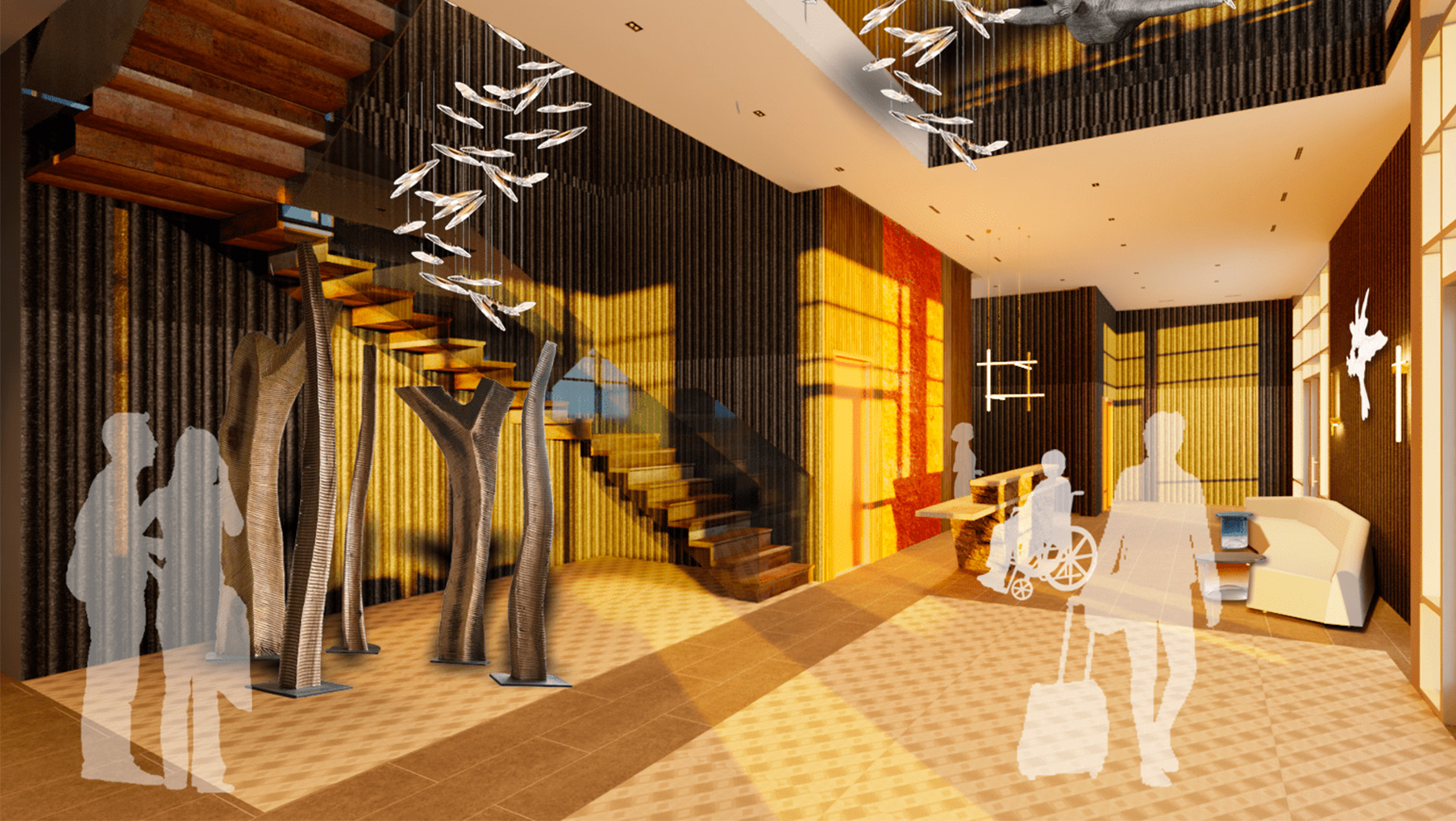

Interior Architecture & Design is a Bachelor Degree program (100% Online) offered by Academy of Art University in San Francisco, CA. The program takes 120 units to complete, with a total tuition of $163,920.
Program Overview
The School of Interior Architecture & Design's BFA curriculum integrates theory, design, and technology in tandem with the standards of the industry. Our students develop the requisite intellectual, artistic, and ethical abilities necessary for professional practice.
The interior design program leading to the Bachelor of Fine Arts [BFA] in Interior Architecture & Design is accredited by the Council for Interior Design Accreditation, [a href="https://protect-us.mimecast.com/s/ckuqCOYEJEcp80qwfYOjcF?domain=accredit-id.org"]www.accredit-id.org
, 206 Grandville Avenue, Suite 350, Grand Rapids, MI, 49503.
The CIDA-accredited program prepares students for entry-level interior design practice, for advanced study, and to apply for membership in professional interior design organizations. The Bachelor of Fine Arts [BFA] in Interior Architecture & Design granted by Academy of Art University meets the educational requirement for eligibility to sit for the National Council for Interior Design Qualification Examination (NCIDQ Exam). For more information about NCIDQ Exam eligibility visit: https://www.cidq.org/eligibility-requirements.
Here, learning is hands-on from day one. You’ll tackle 2D and 3D design challenges—sketching, modeling, and presenting scaled concepts that push ideas into reality.
Projects fuse conceptual vision with practical application, giving you real-world skills you’ll carry from studio to job site. Guided by faculty who are active in the industry, you’ll sharpen your craft across aesthetics, business strategy, and advanced tools like visualization and BIM.
Whether you want to lead design teams, craft immersive experiences, or reimagine what interiors can be, this program is your launchpad. This isn’t just design school, it’s the beginning of your career.
What sets this Program apart
Create dynamic interiors using innovative approaches to space, materials, and light. Beginning with your first semester in our STEM-designated, CIDA-accredited program, you’ll create spaces that change the way people live, work, and connect.
You’ll move from design fundamentals into full commercial projects, developing research-driven solutions. Along the way, you’ll gain fluency in the design process: concept development, documentation, presentation, and execution.
Sustainability is built into the curriculum. You’ll explore environmentally conscious design, learning how to conserve resources, choose non-toxic materials, and design for harmony with the natural world.
Online Learning Program. [img data-src="https://bpiqpjsgebtv-u1573.pressidiumcdn.com/wp-content/uploads/2025/04/UXUIonline.webp"]
Admission Requirements and Process
Academy of Art University maintains an inclusive admissions policy for all undergraduate programs. Previous experience with art and design is not required for admission, and students of all skill levels are encouraged to apply. Academy of Art University requires undergraduate applicants to have a high school diploma from an accredited or state-approved high school, or its equivalent. The university does not require or administer an ability-to-benefit examination for admission.
State authorization for online education.
Online education providers are required to seek authorization by many U.S. states and territories to enroll their residents and those physically located in their jurisdictions. Academy of Art University restricts enrollment for applicants in and from areas where online programs are not approved. Current and prospective students are encouraged to consult the university’s State Authorization for Distance Education Status Table to determine whether the Academy is authorized to offer their degree programs in the state where they will be located while taking online courses.
General Requirements
- High school diploma or equivalentAcademy of Art University requires undergraduate applicants to have a high school diploma from an accredited or state-approved high school, or its equivalent.
- Proof of secondary school completionSubmit an official or unofficial high school transcript indicating graduation or GED documentation, a transcript showing a conferred Associate or Bachelor’s degree, a signed Home…
- Application and feeComplete the undergraduate application and pay the $50 non-refundable application fee, which is required to process an application.
- Transcript deadlineTranscripts and/or diplomas must be received by the start of the student’s first semester at Academy of Art University.
- No portfolio requiredPrevious experience with art and design is not required for admission, and students of all skill levels are encouraged to apply.
- Transfer creditTransfer evaluation transcripts must be submitted by the end of the student’s first semester; coursework presented for transfer must be completed with a letter grade of "C" or…
Application Process
- 1Meet with an Admissions SpecialistSchedule a meeting with one of our admissions specialists. They’ll guide you to the school and program that best fits your goals and help you navigate the application process.
- 2Apply for admissionComplete the undergraduate application and pay the $50 non-refundable application fee. Provide your social security number on your admissions application so your financial aid can be processed.
- 3Submit proof of high school completionSend your high school transcript, GED documentation or other accepted proof of secondary school completion; it must be received by the start of your first semester.
- 4File the FAFSAComplete the FAFSA online at studentaid.gov and use Academy of Art University’s Federal School ID Number: 007531.FAFSA Code for San Francisco Campus: 007531
- 5Complete your financial aid planMeet with Student Financial Services to review your financial options, then accept or decline your financial aid awards in the Student Portal.
Program Schedule
Start dates. Spring 2027 semester starts 2/3/2027 (application deadline 1/25/2027); Summer 2027 starts 6/21/2027 (deadline 6/14/2027); Fall 2027 starts 9/8/2027 (deadline 8/30/2027).
Undergraduate students must carry a minimum study load of 12 units per semester to be considered as full-time students. Students are expected to attend summer semesters to meet their scheduled completion date.
Our online programs offer immersive classroom experiences both in real time and on demand.
- February 03rd, 2027
- June 21st, 2027
- September 08th, 2027
Cost of Attendance and Financial Aid Information
Tuition. Undergraduate tuition for Fall 2026–Summer 2027 is $1,366 per unit for domestic students ($1,682 per unit for international students); tuition is the same for both on-campus and online classes. This 120-unit program’s tuition is $163,920 for domestic students.
Fees.
- Application Fee: $50 (one-time, nonrefundable)
- Registration Fee: $50 per semester (nonrefundable after the cancellation period)
- Enrollment Fee: $95 for first-term domestic students, charged in lieu of the $50 registration fee ($100 for international students)
- Student Activity Fee: waived for students taking all courses online
- Student Tuition Recovery Fund: $0
- Course fees vary by course; fees may be different for on-campus sections and online sections
- Materials/Supplies: $545 average per semester
Estimated program charges for a domestic student taking all courses online: tuition $163,920, application fee $50, enrollment fee $95, registration fees $550, for $164,615, plus course fees. Course fees vary by course, and fees may be different for on-campus sections and online sections (see the Course Fees & Prerequisites list). The university’s published Total Program Cost estimates are for full-time, onsite students.
Payment options. Academy of Art offers many different ways to help you structure your payments, including interest-free installment plans and pre-payment options. The installment plan enables students to pay their tuition in four separate payments during Fall and Spring and two separate payments for Summer.
Financial aid. Aid available to undergraduates includes Cal Grants for eligible California residents, Pell Grants (eligible undergraduate students, first AA/BA/BS/BFA, and eligible education certificate candidates), FSEOG, Federal Work Study, Direct Stafford Loans and Direct Parent PLUS Loans. Complete the FAFSA using Academy of Art University’s Federal School ID Number: 007531.
Military and veterans. The Academy processes the Post-9/11 GI Bill® (Chapter 33), the Yellow Ribbon Program, Montgomery GI Bill® (Chapters 30 and 1606), Veteran Readiness & Employment (Chapter 31), DEA (Chapter 35), Military Tuition Assistance and MyCAA.
Net Price Calculator. Estimate your cost with the Academy of Art University Net Price Calculator: https://npc.collegeboard.org/student/app/academyart
Living expenses. The cost of attendance budget includes the costs of tuition and fees, books, supplies, monthly allowances for room and board, transportation to and from school, and personal expenses such as clothes. Estimates of (Monthly) Living Expenses, 2026-2027:
- Food & Housing: $1,393 (student living with parents); $2,729 (student not living with parents); $4,133 (student living on campus, avg.)
- Personal Expenses: $507; $634; $441
- Transportation: $134; $184; $154
Federal student loan debt. From the program’s School Performance Fact Sheet:
- Most recent three year cohort default rate, as reported by the United States Department of Education: 2023: 0%; 2024: 0%.
- The percentage of enrolled students in 2023/2024 receiving federal student loans to pay for this program: 2023: 56%; 2024: 55%.
- The percentage of graduates in 2023/2024 who took out federal student loans to pay for this program: 2023: 40%; 2024: 46%.
- The average amount of federal student loan debt of 2023/2024 graduates who took out federal student loans at this institution: 2023: $14,395; 2024: $14,864.
Curriculum
Bachelor of Fine Arts (BFA) Degree – Core Classes.
This program is available online and on campus.
Unit Requirements.
- Core: 24 units
- Sophomore Portfolio: 3 units
- Junior Portfolio: 3 units
- Senior Portfolio: 6 units
- Major: 33 units
- Liberal Arts: 42 units
- Electives: 9 units
- Total: 120 units
BFA Interior Architecture & Design Degree Requirements.
- Minimum grade of C- in all core courses, major courses, LA 226, and LA 229.
- Minimum 2.0 GPA and the following general education requirements:
- 2 Art Historical Awareness: Western Art courses
- 1 Interior Architecture History: Traditional course
- 1 Interior Architecture History: Contemporary course
- 1 Employment Communications and Practices course
- 1 Art & Design Communication course
- 1 Written Communication: Critical Thinking course
- 1 Historical Awareness course
- 1 Quantitative & Human Factors course
- 1 Cultural Ideas & Influences course
- After above general education requirements are met, take Liberal Arts electives as needed to fulfill the Liberal Arts unit requirement.
Program Learning Outcomes.
Undergraduate students will meet the following student performance criteria:
Human & Global Centered Design
- Apply interior solutions that consider users’ cultural and social needs
- Apply interiors solutions that consider users’ physical needs
- Apply interiors solutions that consider ecological and sustainable principles
Design Process & Conceptual Thinking
- Develop appropriate programming documents that identify user needs through the gathering and analysis of information
- Produce schematic design solutions that meet programmatic requirements and conceptual intent
- Create refined design solutions culminating in design development presentations
- Produce construction documentation of interior buildings and FF & E specifications
Furnishings & Materiality
- Furniture and fixtures are appropriate to the programming needs and design intent
- Textiles are appropriate to the programming needs and design intent
- Interior construction materials are appropriate to the programming needs and design intent
Integrated Design
- Develop design solutions that consider major construction types and construction systems, such as, electrical, mechanical, energy, security, and acoustics through design decisions
- Demonstrate an understanding of lighting systems by creating lighting solutions that address aesthetics, function, and energy conservation
- Demonstrate an understanding of federal regulations impacting accessibility and universal/inclusive design principles through the application of these professional standards in design solutions
- Demonstrate an understanding of the laws and codes impacting life safety through application of these professional standards on design solutions
Fundamentals of Design
- Apply the elements and principles of two and three-dimensional design, across all platforms, in design solutions and visual communications
- Apply color principles and theories, across all platforms, in design solutions and visual communications
- Demonstrate an understanding of movements and traditions in interior design, architecture, furnishings, and the visual arts and consider their relationship in current design
Oral, Written & Visual Literacy
- Describe how design solutions support the project requirements and design intent in written analysis
- In an oral presentation, describe a design project while defining how the design solutions support the project requirements and design intent
- Communicate ideas and solutions through freehand & digital drawing and drafting, three-dimensional models, renderings, ideation sketching, and comprehensive visual presentations
Professional Practice & Collaboration
- Demonstrate knowledge of professional practice, business and contract procedures, and business ethics
- Collaborate with other disciplines in the development of interior environments
- Produce a portfolio and identity system to qualify for an entry position in interior architecture and design
Required Courses
| Subject # | Name | Credits |
|---|---|---|
Career Outcomes
In our CIDA-accredited program, you’ll create spaces that transform how people live, work, and connect. With sustainability as a core value and high-impact projects as your proving ground, you’ll graduate ready to lead and redefine the future of design.
- AutoCAD/BIM Designer
- FF&E Designer
- Job Captain
- Project Designer
- Visualization Specialist
Program performance. From the program’s School Performance Fact Sheet filed with the California Bureau for Private Postsecondary Education (calendar years 2023 & 2024, revised November 25, 2025):
- On-Time Completion Rate: 2023: 10% (18 of 184 students available for graduation); 2024: 5% (15 of 304 students available for graduation).
- Placement Rate % Employed in the Field: 2023: 11% (2 of 18 graduates available for employment); 2024: 4% (1 of 23 graduates available for employment).
- License Examination Passage Rates: Not Applicable.
- Annual salary and wages reported for 2023 graduates employed in the field (2): $35,001 - $40,000: 1; $45,001 - $50,000: 1.
- Annual salary and wages reported for 2024 graduates employed in the field (1): $50,001 - $55,000: 1.
Graduation and retention rates (university-wide).
- 2026 Graduation Rates: Of the 437 students who entered the University during the fall 2019 semester as first-time, full-time freshmen in either the Bachelor, Associate, or Certificate programs, 146 or 33% completed the entire program within 150% of the normal time.
- Retention Rates – 2024 Cohort: All full-time first-time undergraduate students (134) in Fall 2024 re-enrolled in Fall 2025: 56%.
Professional licensure.
Our Bachelor of Fine Art and Master of Fine Art in Interior Architecture & Design are professional degree programs accredited by the Council for Interior Design Accreditation (CIDA) and meet the educational prerequisites for the following jurisdictions with regulations that require certification and registration to practice interior design: Florida, Louisiana, Nevada, New York, Oklahoma, Puerto Rico, Washington DC. Other jurisdictions do not require a professional degree from CIDA-accredited programs for licensure.
As eligibility for licensure is often based on both education and experience, we encourage all prospective and enrolled students to contact the Council for Interior Design Qualification (https://www.cidq.org/) for complete and current information on licensure requirements specific to the state or territory where they plan to work.
What to expect as a Academy of Art University student
Academy Award winners. Tech founders. Creative directors. CEOs. They join us live and on Zoom from around the world. They speak from experience. About the work. The risk. The path forward. No theory. Just real stories from people who’ve done it.
Every student is welcome. On campus or online. To listen. To ask questions. To make connections. These are conversations, not lectures.
Student Clubs
Whether you are an on-campus or online student you are welcome to join our student clubs. You’ll meet up, share ideas, and create art together. Sometimes it’s a quick sketch. Sometimes it turns into something big, a collaboration that lasts a lifetime. It’s always fun.
Campus Address
Why Accreditation Is Important
Academy of Art University is institutionally accredited by the WASC Senior College and University Commission (WSCUC), currently on warning; its accredited status continues during the Warning period.
The BFA and MFA Interior Architecture & Design programs are accredited by the Council for Interior Design Accreditation (CIDA).
Approved to operate by the California Bureau for Private Postsecondary Education (BPPE).
- A reliable indicator of quality
- Approved program of study
- Qualified instructors
- Recognition by employers nationwide
Accreditations
Student Demographics
These are demographics for all students at the San Francisco Campus (IPEDS, 2024).
Percentages are of total fall enrollment. 910 students whose race or ethnicity was not reported are included in that total but shown as no category, so the figures above come to 83.4% rather than 100%.
Testimonials




Images