Barber is a Diploma program offered by The Adrian H. Wallace Barber Academy in Pensacola, FL. The program takes 900 clock hours — 26 academic weeks full time (35 hrs/week) to complete, with a total tuition of $15,000.
Program Overview
Barber Program, 900 clock hours. The Barber Program is designed to train the student in the basic manipulative skills, safety judgments, proper work habits, business skills, and desirable attitudes necessary to obtain licensure and for competency in job entry-level positions in Barbering or a related field. Upon the successful completion of the 900 hour Barber Program, the student receives a diploma.
Objectives. Upon completion of the course requirements, the determined graduate will be able to perform the basic manipulative skills in the areas of haircutting and styling, hair shaping, hair coloring, texture services and scalp and hair conditioning; perform basic analytical skills to advise clients in the total look concept; and apply academic learning, technical information and related matter to assure sound judgements, decisions and procedures. To ensure continued career success, the graduate will continue to learn new and current information related to skills, trends and methods for career development in barbering and related fields.
Professional standards. The program outline asks students to project a positive attitude and a sense of personal integrity and self-confidence; project professionalism, visual poise and proper grooming; communicate effectively and interact appropriately with colleagues, supervisors and clients; and respect the need to deliver worthy service for value received in an employment environment.
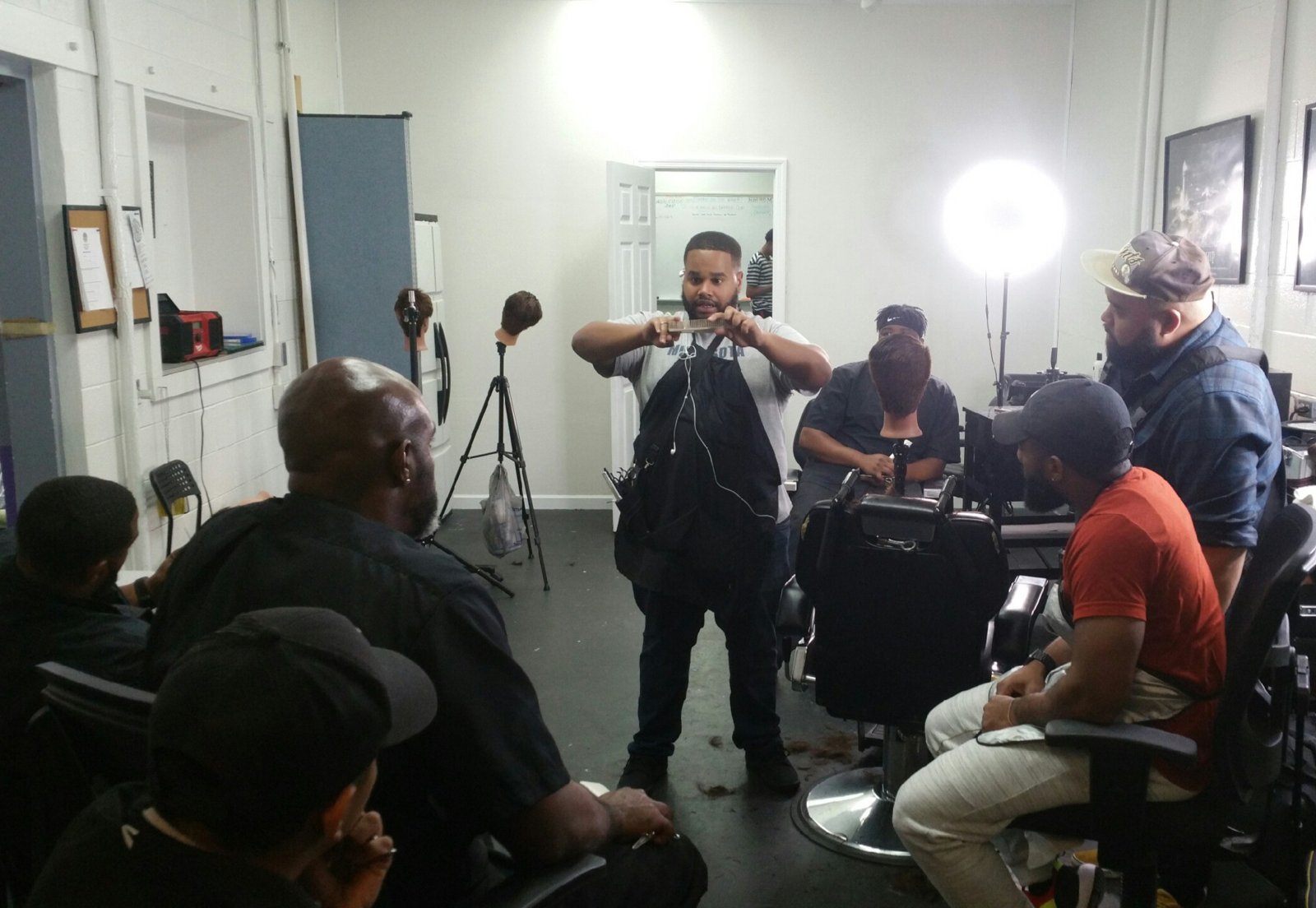
Instructional methods. The clock hour education is provided through a sequential set of learning steps which address specific tasks necessary for the state board preparation, graduation and job entry level skills. Clinic equipment, implements and products are comparable to those used in the industry, and the course is presented through comprehensive lesson plans. Subjects are presented by means of interactive lecture, demonstration, cooperative learning, labs, student salon activities and student participation; audio-visual aids, guest speakers, field trips, projects and activities are also used.
What sets this Program apart
Barbering is a very profitable, high demand industry, and The Adrian H. Wallace Barber Academy teaches Master Barber secrets that will enable you to compete at the highest level. Haircuts and trends change, but fundamentals do not: at the AHW Barber Academy you are taught these fundamentals and principles in addition to how to cut specific haircuts like mohawks, tapers and designs. Upon completion of the program, you will be able to confidently display your talents in any shop and match or exceed the expectation of a recent barber school graduate.
- Weekly starts. Beginning dates for enrollment are continuous: all courses have open enrollment, and students start on Tuesday of each week.
- Fades, tapers and flat tops. Hair Cutting (135 clock hours) covers taper cuts, fades, flat tops and standard haircuts using shear over comb, clipper over comb and freehand techniques.
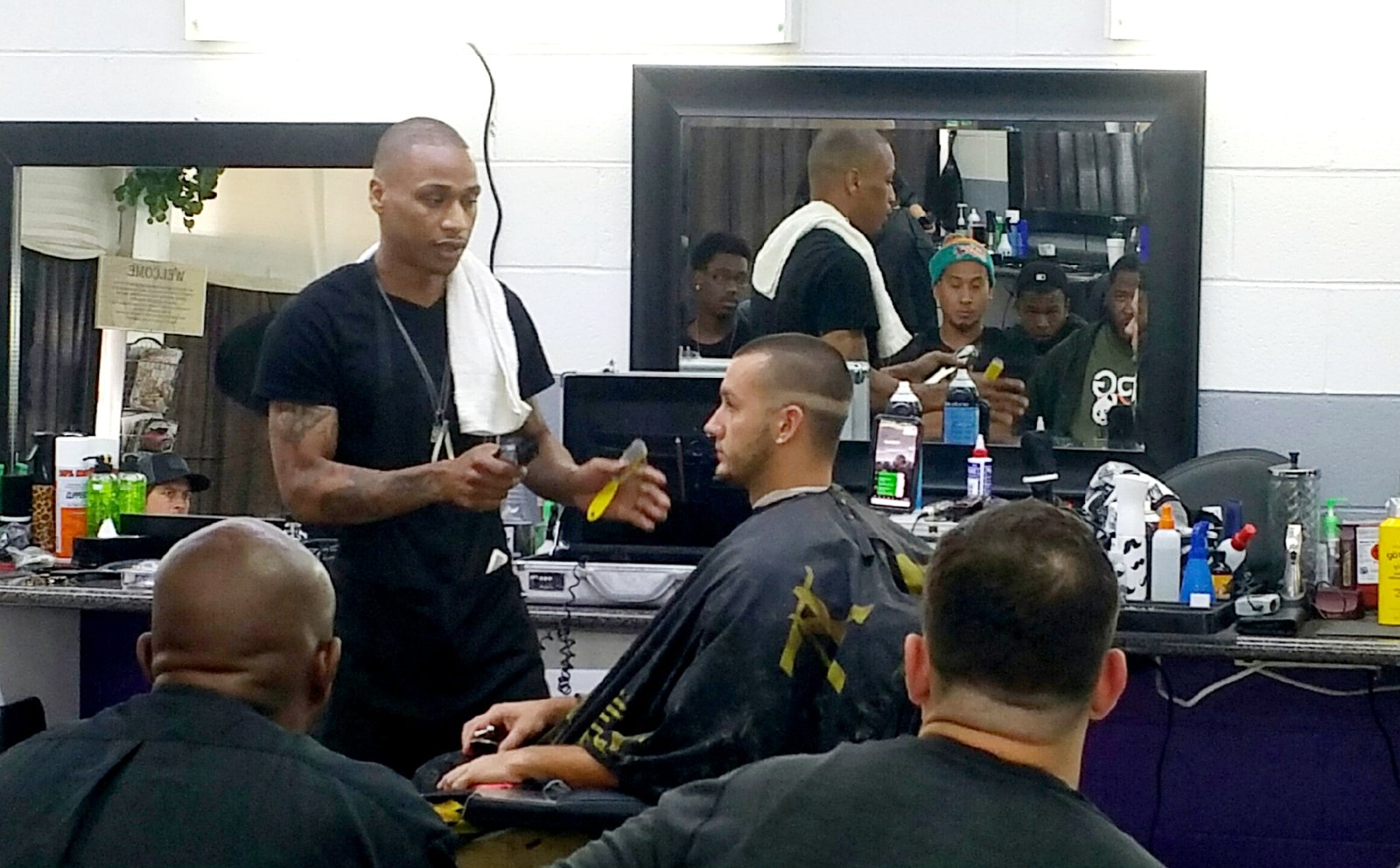
- Serving the public under supervision. The practical classroom is furnished with student stations for students to practice and perform the techniques to the public under the direct supervision of a licensed instructor.
- Florida state board preparation. Florida State Laws and Rules (225 clock hours) covers the Florida Barber licensing laws, state board rules and inspections, and prepares students to take state board exams.
Admission Requirements and Process
Admission requirements. The Barber Academy considers each applicant based on ability, character, and recommendation by references. To be admitted and enrolled, candidates must provide a current driver’s license or state issued photo identification and a high school diploma or a recognized equivalent of a high school diploma, such as a home-schooled certificate by the state where the student resided during home school or a GED, and must be at least 16 years of age. Should an enrolling student provide a foreign high school diploma, the institution will work with the student to obtain an English translation of the document along with confirmation, from an outside agency qualified to translate documents and confirm academic equivalence, that the education received is equivalent to a U.S. high school diploma.
Fee and acceptance. A non-refundable fee of $150.00 is due at the time of registration; the catalog calls it a registration fee and the website’s Admissions page calls it an application fee. Final acceptance of the applicant is made by the school’s owner. Applicants are notified of their acceptance and return to complete the Enrollment packet and begin the orientation process.
Ability to Benefit. Applicants who do not have a high school diploma or equivalent can enroll under the Ability-to-Benefit policy: the academy requires the prospective student to pass a TABE test at an 8th grade level or higher prior to admission or, after enrollment, to satisfactorily complete 225 clock hours. A student who does not satisfactorily complete 225 clock hours will not be allowed to continue. Students who enroll on an Ability-to-Benefit basis are not eligible for federal financial aid.
Transfer students. The acceptance of transferring hours and services is at the discretion of the academy. Transfer students receive credit for previous training from an accredited barber school with proper documentation of hours, services and tests, after being evaluated in both theoretical and practical abilities. No more than 75% of the program will be transferred in, courses must carry a grade of “C” or higher on an official transcript sent directly to the academy, and the Barber Program educational costs will be adjusted.
Re-entry. A student who has been terminated or withdrawn may reapply. A student who re-enrolls within 180 days enters in the same status as when they were withdrawn; after 180 days the student also needs a new contract and a new satisfactory academic progress schedule based on transfer hours. Returning students are charged a $150 re-entry fee.
General Requirements
- Photo identificationProvide a current driver’s license or state issued photo identification.
- High school completionProvide a high school diploma or a recognized equivalent, such as a home-schooled certificate from the state where you resided during home school, or a GED.
- Minimum ageYou must be at least 16 years of age.
- Foreign diplomasA foreign high school diploma needs an English translation and confirmation that it is equivalent to a U.S. high school diploma, from an outside agency qualified to do both.
- Ability to BenefitWithout a diploma or equivalent, you may enroll by passing the TABE at an 8th grade level or higher, or by satisfactorily completing your first 225 clock hours.
- Registration feeA non-refundable fee of $150.00 is due at the time of registration.
- Physical demandsThe barbering profession requires standing for long periods of time, with shoulder, arm and hand muscle movements, so consider your physical limitations before entering this field.
Application Process
- 1Request informationAsk about the Barber Program, its weekly Tuesday starts and its schedule through Request Information.
- 2ApplyComplete The AHW Barber Academy Application: personal information, admission information, the person to notify in an emergency, and two references.
- 3RegisterProvide a current driver’s license or state issued photo ID and proof of high school completion, and pay the $150.00 non-refundable fee due at registration.
- 4Apply for financial aidComplete the FAFSA, listing federal school code 042874; the Financial Aid office requires an entrance interview with all prospective students.FAFSA Code for Pensacola: 042874FAFSA at studentaid.gov
- 5Enroll and attend orientationAfter the owner’s final acceptance, complete the Enrollment packet; orientation is held after enrollment but on or before the first day of class.
Program Schedule
Starts. Beginning dates for enrollment are continuous. All courses have open enrollment; students start on Tuesday of each week and are allotted a 1 hour break.
Hours and length. The institution operates the program on a schedule of 900 hours per academic year of instruction, to be completed in 26 academic weeks full time at 35 hours a week. The maximum time allowed is 39 weeks (1,350 scheduled hours) for full-time students; for part-time and transfer students it is based on 67% of the scheduled contracted hours. The application offers a part-time schedule, for which the catalog publishes no weekly hours. A clock hour is a minimum of 50 minutes of supervised instruction with a 10 minute break.
Days and holidays. The catalog lists the academy as open Tuesday through Saturday, 10:00 am – 6:00 pm; the website lists Tuesday to Saturday, 10 AM–4:30 PM. It is closed on Sunday, Monday, Martin Luther King, Jr. Day, Memorial Day, Independence Day, Labor Day and Thanksgiving Day, and for a winter break from Christmas Day through New Year’s Day.
Attendance and progress. Students must attend a minimum of 67% of the hours scheduled and maintain a written grade average of 75%; satisfactory academic progress is evaluated at 450 and 900 clocked hours. A student arriving 15 minutes after instruction has begun is tardy, and three tardies are recorded as one unexcused absence. A leave of absence, requested in writing, may not exceed 180 days in any 12-month period. A grace period of approximately ten percent is added to the contract period; training beyond it is billed at $250 per week, payable in advance until graduation.
Required Courses
| Subject # | Name |
|---|---|
Campus Location
Why Accreditation Is Important
Attending an accredited school means its training has been reviewed against independent standards that protect students.
This school: The Adrian H. Wallace Barber Academy is accredited by the National Accrediting Commission of Career Arts & Sciences (NACCAS) and licensed by the Commission for Independent Education, Florida Department of Education.
- A reliable indicator of educational quality
- Reviewed against independent standards
- Recognized by employers and licensing boards
Accreditations

Cost of Attendance and Financial Aid Information
| Barber Program | Amount |
|---|---|
| Non-Refundable Registration Fee | $150.00 |
| Tuition | $15,000.00 |
| Books and Kit | $1,300.00 |
| Total Price | $16,450.00 |
Books and kit. The kit includes Milady’s CIMA interactive eBook and learning path, a carry-all case, barber jacket, mannequin, basic and blending shears, two adjustable clippers, detachable clippers (model 10), two Wahl Hero trimmers, cordless trimmers, a close shaver, Oster 76 blades, Speed-O-Guide guards, combs, brushes, a blow dryer, a cutting cape and sanitation supplies. The kit may not be removed from the campus without permission, students are responsible for replacing lost, missing or broken items, and some items are not returnable.
Paying for school. All prices for the program are printed in the catalog. There are no carrying charges, interest charges or service charges, and contracts are not sold to a third party. Tuition may be paid in full when registering or in monthly installments of cash, credit card or money order, and all monies owed must be paid in full before graduation unless other arrangements have been made. State licensing and exam fees are a separate cost from any fees listed in the catalog.
Financial aid. Financial aid is available to those who qualify, and the Financial Aid office requires an entrance interview with all prospective students. The academy participates in the Federal Pell Grant, FSEOG and Federal Stafford Loans (subsidized and unsubsidized); to apply, the student completes the FAFSA (federal school code 042874) and furnishes the documentation required for verification. The academy is also approved for training grants from vocational rehabilitation and Veteran’s training, and students using Post-9/11 GI Bill® or Veterans Readiness & Employment benefits are protected while VA payment is pending.
Cancellation and refunds. An applicant who is not accepted, or who cancels in writing within three business days of signing the enrollment agreement or before starting classes, receives all monies paid except the $150 non-refundable registration fee. After classes begin, refunds are calculated pro rata on scheduled hours up to 50% of the program; a student scheduled for more than 50% owes 100% of the tuition. Students who withdraw prior to completion are charged a $100.00 administrative fee, and refunds are made within 30 days.
Curriculum
Three modules, 900 clock hours. The total hour requirements in each category must be met by each student for the earned hours to be accepted by Florida’s Barber Board for examination. Module I is Safety, Sanitation and Sterilization; Module II covers hair structure and chemistry, hair cutting, shampooing and chemical services; Module III covers shaving and Florida state laws and rules. The catalog counts 500 practical services across the program. The marked theory units of study (study skills, the history of barbering, professional image, microbiology, infection control and safe work practices, implements, tools and equipment, the skin, hair and scalp, and shaving and facial hair design) and the hands-on classes (introduction to the clinic floor, tool kit, drape, and regular haircuts, fading and tapering) must be completed and tested satisfactorily before a student can participate in student clinic activities, i.e. cutting hair and performing other services to the public.
Grading. Academic learning is evaluated after each unit of study. Practical assignments are evaluated as completed and counted toward course completion only when rated as satisfactory or better, and at least two comprehensive practical skills evaluations are conducted. Grades: A = 93%–100% (Excellent), B = 85%–92% (Very Good), C = 75%–84% (Satisfactory), D = 74% and below (Unsatisfactory).
Textbook. CIMA by Milady and Milady Professional Barbering, 6th Edition (Milady, 2017).
Requirements of completion. Achieve a cumulative grade point average of 75% or higher; attend all 900 hours required by the State Board; complete all designated tests, laboratory hours and client services; and satisfy all financial obligations to the institution or fill out a payment plan approved by the owner.
Required Courses
| Subject # | Name | Total |
|---|---|---|
Career Outcomes
2023 NACCAS annual reporting outcomes. The academy reports a graduation rate of 84.44%, a placement rate of 93.55% and a licensure rate of 87.10%. NACCAS counts a graduate as placed when employed in a position within the beauty and wellness industry that directly relates to their field of training, after graduation and before November 30 of the cohort year.
Placement assistance. Although the academy does not make any guarantees of employment or salary upon graduation, it provides placement assistance: identifying employment opportunities and advising students on appropriate means of attempting to realize them. Students receive training in professionalism and job search skills, and the curriculum places a great deal of emphasis on how to obtain and retain employment after graduation. The school maintains a network of relationships with professionals and employers who provide mentoring to students while they are in school, and job referrals are made known to interested graduates as available.
Getting licensed. To receive a Florida barber license, the graduate submits a barber examination application, a certificate of completion of a board-approved two-hour HIV/AIDS course and the applicable fees to the department, then schedules the barber examination with Pearson VUE; a license is issued and mailed upon successful completion of the examination.
What to expect as a The Adrian H. Wallace Barber Academy student
The academy. The Adrian H. Wallace Barber Academy, also known as The AHW Barber Academy, was founded in November 2013. Its mission is to provide a quality post-secondary barber education in practical skills necessary for licensure and employment success.
The campus. The campus is conveniently located in the Fairfield and 9th Ave. Plaza, just a few minutes away from Cordova Mall, and can easily be accessed via I-110. It occupies approximately 2,400 square feet of floor space with ample free parking, and consists of a reception area, admission office, a classroom, break area, student clinic and supply storage, all completely air conditioned. Instructors teach in the classroom through lectures, audio and video presentations, and demonstrations in the student clinic, whose practical classroom has student stations, computers with internet access and treatment tables.
Student services. The academy provides orientation, academic advising and career counseling to all students, and academic tutoring for students who need further assistance. It keeps a student/teacher ratio that does not exceed 30 students in attendance per instructor. It does not provide housing, but it is local to city bus access.
Conduct. Students are expected to conduct themselves in a manner appropriate to a professional work environment: a smock is worn at all times, with belts and no sagging pants; cell phones are not used in the classroom; all rules of sanitation, sterilization and overall cleanliness are followed; and loud music and headphones are not permitted during class or while servicing customers.
Images