Electrician is a Diploma program offered by Advanced Training Institute in Las Vegas, NV. The program takes 42 weeks to complete, with a total tuition of $18,575.
Program Overview
ATI's Electrician program prepares students for entry-level residential and commercial electrician positions. Through this program, students will gain a basic understanding for properly using various tools and equipment of the trade, the ability to read and interpret building plans, and apply basic math, as well as a fundamental knowledge of electricity, including Ohm's law, magnetism, AC and DC current, multi-phase power and electrical motors. Students will learn to describe the types of electrical motors and their power connections, know the general principles of motor control, including how to assemble, disassemble, and connect wiring to equipment.
A student will be able to understand, identify, install, and repair various types of luminaries, lighting ballast, and three-way and four-way switches. Also the student should be able to locate and identify various requirements in the National Electrical Code ("NEC"), and be able to draw and design circuit requirements after performing electrical load calculations. Additionally, students will study solar photovoltaic system design, implementation and installation.
The student will be able to discuss OSHA safety requirements; know and install metal and non-metallic conduit, connectors and fittings; be able to discuss NEC requirements for flexible conduits and cables; perform and install bends in rigid metal and non-metallic conduit; and perform wire-pulling techniques. Successful completion of this program will prepare you for entry-level work with: electrical contractor, warehouses, building maintenance, installation, and electrical part houses, as well as solar panel installers.
What sets this Program apart
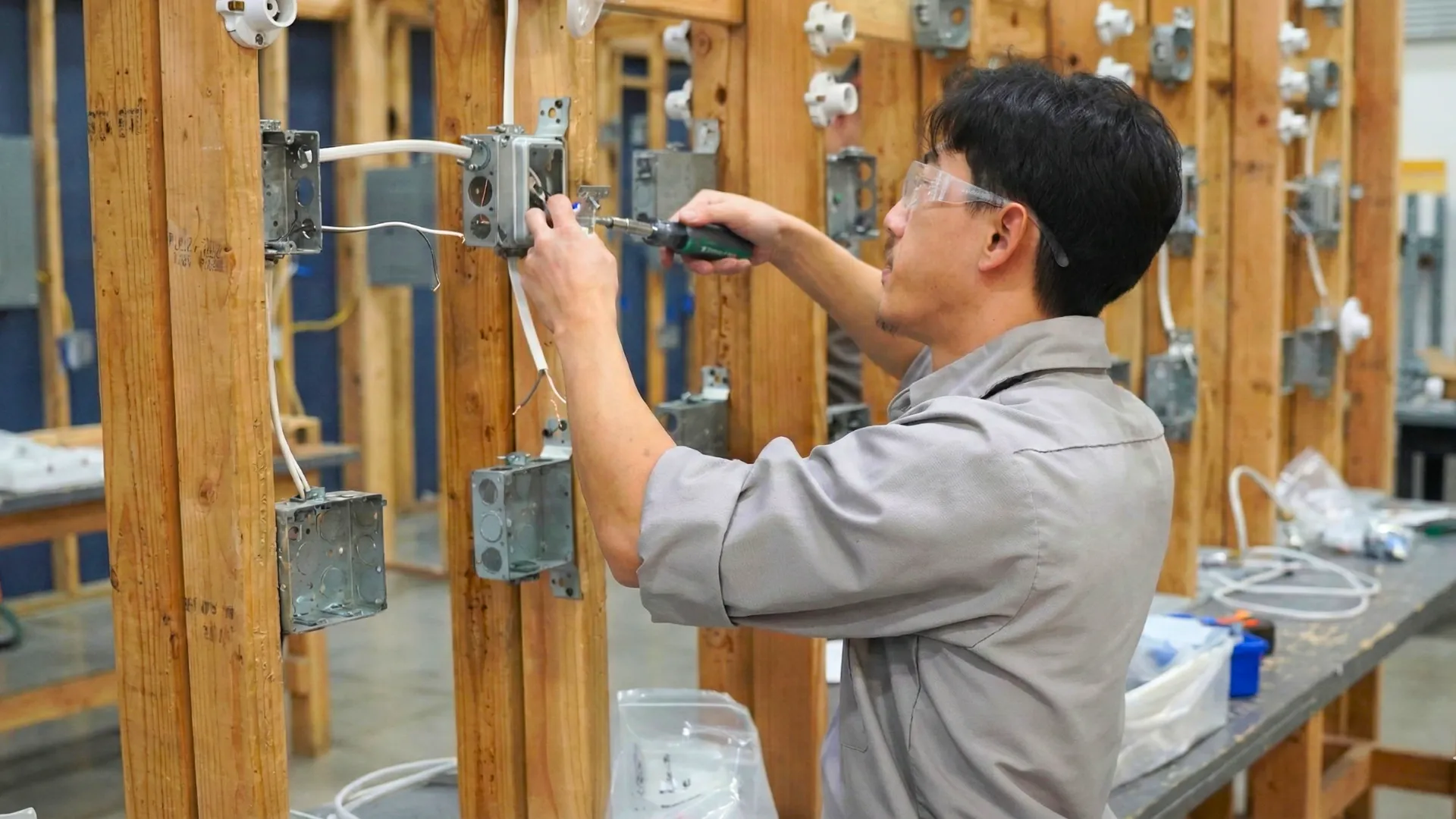
Solar photovoltaic training. This updated 840 clock hour version of the Electrician program adds EL-507 Solar Photovoltaic System Design and Implementation and Installation, preparing graduates for entry-level work that includes solar panel installers. Students train on a complete solar trainer and 2x4 solar panels as well as a residential house, motor control lab, low and high voltage trainers and a networked computer lab.
Safety credentials. ATI has made passing the 10 Hour OSHA Construction Safety course a requirement for successful completion of its Electrician program; students also receive Lockout/Tagout training for controlling hazardous energy while servicing electrical equipment.
Tool kit at graduation. Each student enrolled in the Electrician program will receive a starter tool set at the time of graduation, specific to the student's chosen program.
Admission Requirements and Process
The admission procedure requires an exchange of information between the applicant and the school, which maintains a staff of representatives for this purpose. These representatives conduct a personal interview with each prospective applicant before any decision is made to submit an application for admission. During the interview, the representative will discuss the School's educational programs in relation to the applicant's career preferences, training needs, and individual motivations.
ATI administration will review the information and inform the applicant in writing whether they have been accepted for enrollment. If an applicant is not accepted, all monies paid by the applicant are refunded. Admissions representatives are available for day and evening appointments; high school applicants should be accompanied by a parent or legal guardian.
Students enrolling in the Electrician program must provide evidence that they have a valid, current driver's license.
General Requirements
- High school diploma or equivalentApplicants must provide documentation of high school graduation, a GED® or the equivalent, such as a high school diploma, a final transcript showing the award date, a…
- Minimum ageApplicants must be at least 18 (or 17, with written parent or guardian approval, and must turn 18 before their expected ATI graduation date or before beginning any required…
- EduReady Admissions AssessmentAll applicants must take and pass the EduReady Admissions Assessment with a minimum score of 75; up to three re-tests may be given within three months, and the exam is waived for…
- Interview and campus tourEach applicant must visit and tour the School and be interviewed by an Admissions Representative, who discusses the School's programs in relation to the applicant's career…
- Enrollment paperwork and registration feeApplicants complete an enrollment agreement and other required enrollment paperwork, attend a financial aid interview, complete required financial aid paperwork and pay a…
- Nevada immunization requirementsProspective students under the age of 23 must provide proof of immunity to tetanus, diphtheria, measles, mumps, rubella and Neisseria meningitides, as required by the Nevada State…
- Valid driver's licenseStudents enrolling in the Automotive Technology, Electrician and HVAC/CR Technologies programs must provide evidence that they have a valid, current driver's license, because…
Application Process
- 1Request InformationComplete our online inquiry form or call 702-344-2149 to speak with an admissions representative.
- 2Meet with an Admissions RepresentativeAn admissions representative will conduct an interview, discuss your career goals, and review program options.
- 3Tour the CampusVisit our approximately 78,000 square foot facility with classrooms, laboratories, a student lounge, and a Learning Resource Center.
- 4Complete Entrance Assessment & Provide DocumentsProve academic readiness by achieving the required test score(s) for your intended program and submit required documentation.
- 5Sign Enrollment Agreement & Financial AidUpon acceptance, complete an enrollment agreement. Financial aid is available for those who qualify; students apply by completing the FAFSA at studentaid.gov (ATI federal school code 041710).
- 6Start TrainingApplicants are informed of their acceptance status within 15 days after all required information is received. Attend orientation and begin your career training!
Program Schedule
All students will have a weekly time commitment of 20 hours of lecture and lab on one of the following schedules: AM 7am-12 noon, AFT 12:15pm-5:15pm or EVE 5:30pm-10:30pm, Monday through Thursday (5 hours per day). The course outline for each module will explain the specific lab and lecture schedule for that module.
Orientation is scheduled for the Thursday prior to the first week of class; all newly admitted students are required to participate.
Upcoming start dates. The catalog's 2026 course schedule lists remaining starts on November 2, 2026 and December 14, 2026.
- December 14th, 2026
Cost of Attendance and Financial Aid Information
Tuition and fees. Per the 2026-2028 catalog Tuition and Fee Schedule, the Electrician program costs:
- Tuition: $18,575.00
- Registration Fee: $75.00
- Books: $649.00
- Uniforms: $200.00
- Total: $19,499.00
Books. Required books for Electrician (840 Clock Hours) (Website Published Book List effective 6/26/2026): National Electrical Code 2023; Delmar's Standard Textbook of Electricity, 8th edition; Electrical Wiring Residential, 21st Edition; Electrical Wiring Commercial, 18th Edition; Electrical Wiring Industrial, 18th Edition; and The Guide to Photovoltaic System Installation, 1st Edition, for an ATI student price of $649.00 (retail $720.95). Per the catalog, the cost of original course books is included in the price for the Electrician program; additional or replacement books are available for a fee.
Payment plans. Tuition, fees, and book and supplies charges are due and payable in full at registration; accepted methods of payment include cash, personal check and credit card. Arrangements may be made for students to pay the portion of charges not met by financial aid, scholarships, or other sources on an installment basis. If one of the primary financing options does not fully cover the student's program costs, the School offers institutional payment plans; the first payment is due 30 days from the day the student begins school and the interest rate is fixed throughout the term of the note/contract.
Federal financial aid. Financial aid is available for those who qualify, including the Federal Pell Grant, the Federal Supplemental Educational Opportunity Grant (FSEOG), Federal Direct Subsidized and Unsubsidized Stafford Loans and Direct Parent PLUS Loans. Students apply by completing the Free Application for Federal Student Aid (FAFSA) at studentaid.gov; ATI's federal school code is 041710.
Veterans. Programs at ATI are approved for the training of veterans. To check eligibility for benefits, call 1-888-GIBILL-1. The school does not penalize students using VA Education benefit programs under Chapters 33 and 31 due to delayed disbursement funding from the Department of Veterans Affairs.
Other financing. Students eligible for tuition assistance from their employer, workforce agency or the Veteran's Administration may use the Employer/Agency Contract Billing Program. Climb Credit is a third party lender that offers financing options to help eligible students pay for their training; approval is not guaranteed and is subject to Climb Credit's terms.
Indirect costs. Advanced Training Institute does not offer housing, meal plans or transportation for students. Estimated monthly indirect costs are $1,578 for students living off campus (room & board $1,017, personal expenses $412, transportation $149) and $762 for students living with parents (room & board $393, personal expenses $220, transportation $149).
Net Price Calculator. Want a personalized estimate of what your program could cost after grants and scholarships? Try ATI's Net Price Calculator at https://atitraining.edu/net-price-calculator/.
Curriculum
Electrician is a Diploma Program – 840 Clock Hours – Traditional In-Classroom Program made up of seven 120-clock-hour modules. This updated 840 clock hour version of the Electrician program replaces the previous version of the Electrician program at 720 clock hours, effective for all starts on or after 9/21/2026.
Required Courses
| Subject # | Name |
|---|---|
Career Outcomes
The graduate of the Electrician program is qualified for positions with the following title:
- Entry-Level Residential Electrician (SOC 47-2111)
- Entry-Level Commercial Electrician (SOC 47-2111)
- Solar Panel Installer (SOC 47-2231)
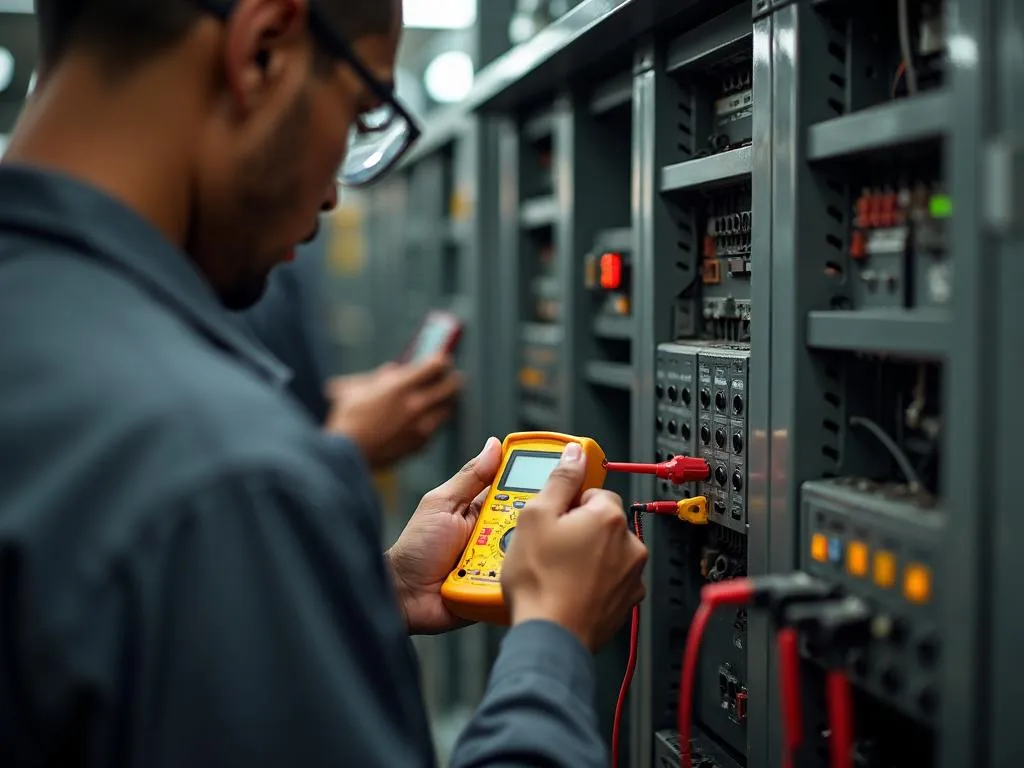
The entry-level electrician performs installation, service and repair of residential and commercial electrical parts and equipment. Reads blueprints or technical diagrams before doing work, installs and maintains wiring and lighting systems, inspects electrical components, such as transformers and circuit breakers, identifies electrical problems with a variety of testing devices, and follows state and local building regulations based on the National Electric Code.
Completion and placement. According to ATI's 2026 ACCET Completion and Placement Statistics (annual report filed with ACCET in May 2026, students scheduled to complete January–December 2025), the Electrician program had a completion rate of 81.42% (184 of 226 eligible students) and a placement rate of 70.06% (110 of 157 eligible completers). (The 2025 cohort was enrolled in the earlier Electrician program; the current 840-clock-hour version begins with starts on or after September 21, 2026.)
ATI does not promise or guarantee employment to any student or graduate. Some entry-level positions may require additional certifications, background checks, drug screenings, or state licensure not provided by the ATI program.
What to expect as a Advanced Training Institute student
Advanced Training Institute occupies an approximately 78,000-square-foot facility in Las Vegas, with roughly 36,000 square feet dedicated solely to lab space equipped with the latest industry-standard tools. The campus includes classrooms, administrative offices, a student lounge, restrooms, and a Learning Resource Center, and is handicap accessible with free student parking.
The Learning Resource Center (LRC) is designed to support the programs offered at the campus. Students and faculty have access to a wide variety of resources such as books, periodicals, audio-visual materials and digital resources, including access to 40 online databases and a digital collection of over 135,000 scholarly titles. The average class size is 24 students.
ATI's Career Services Department offers career-related employment assistance to current students and graduates throughout their entire career, at no additional cost, including resume writing assistance, interview preparation, job search strategies and employer connections. Employment is not guaranteed.
Campus Address
Why Accreditation Is Important
Advanced Training Institute is nationally accredited by the Accrediting Council for Continuing Education & Training (ACCET), a national accrediting agency recognized by the U.S. Department of Education. ATI is licensed to operate as a non-degree granting private institution by the State of Nevada Commission on Postsecondary Education.
- A reliable indicator of quality
- Approved program of study
- Qualified instructors
- Recognition by employers nationwide
Accreditations

Student Demographics
These are demographics for all students at the Las Vegas Campus (IPEDS, 2024).
Images