
Residential Electricity is a Certificate program (Hybrid) offered by American Trade School in Saint Ann, MO. The program takes 8 months (32 weeks) to complete, with a total tuition of $11,800.
Program Overview
Are you seeking electrical training to understand residential, commercial, and industrial wiring? Also, interested in becoming an Electrical Apprentice? Our electrical training program will be your ticket to a high demand technical career as an Electrician. Our electrical program prepares graduates with the theory and working knowledge in electrical installation, maintenance, and repair. Overall, American Trade School prepares graduates for an entry level position in the field.
As a leading electrician school in St. Louis, we focus on teaching the fundamentals of residential, commercial, industrial wiring, and motor applications. Students learn how to read blueprints, install and maintain electrical systems, troubleshoot problems, and follow safety codes—all essential skills for a successful career as an electrician. Our comprehensive program prepares students to become skilled, job-ready electricians through a combination of classroom instruction and real-world lab experience.
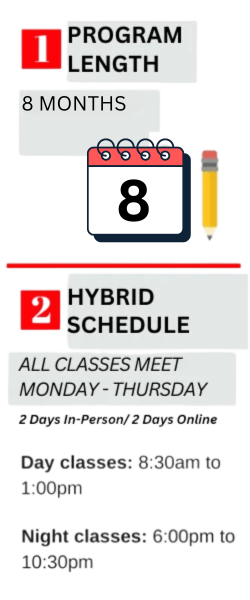
Our Electrical program offers a hybrid learning format, combining classroom and online instruction. The 8-month program consists of two courses: Fundamentals and Advanced - each is 16 weeks in length.
At American Trade School, our students are mechanical thinkers who enjoy learning new concepts and immediately applying them in the shop. Whether you're starting fresh or changing careers, our Electrical program prepares you to enter the workforce with confidence and real-world skills.
Objective. This program is designed to prepare the graduate with the theory and working knowledge in Electrical Installation, Maintenance and Repair to go into the field at an entry-level position.
What sets this Program apart
When it comes to technical schools in St. Louis, American Trade School stands out as a pioneer providing hands-on education to equip you with the skills employers value. We've established strong relationships with industry professionals in the Heating, Air Conditioning, Refrigeration, and Electrical trades.
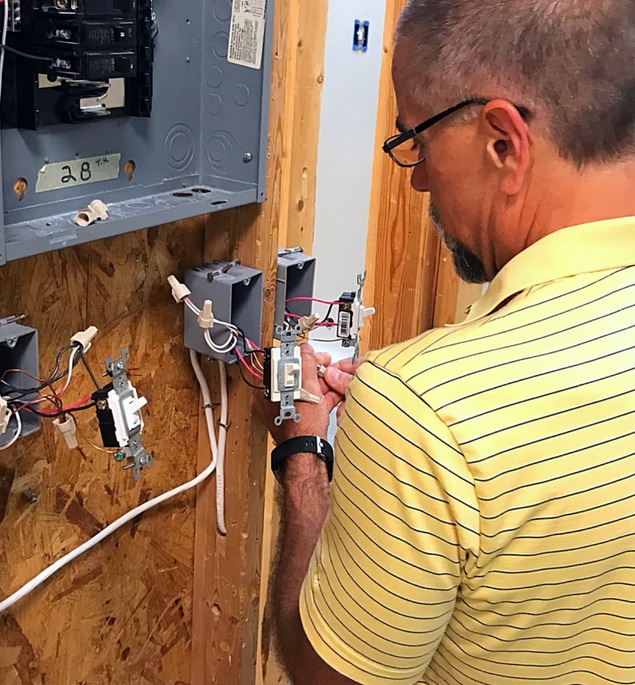
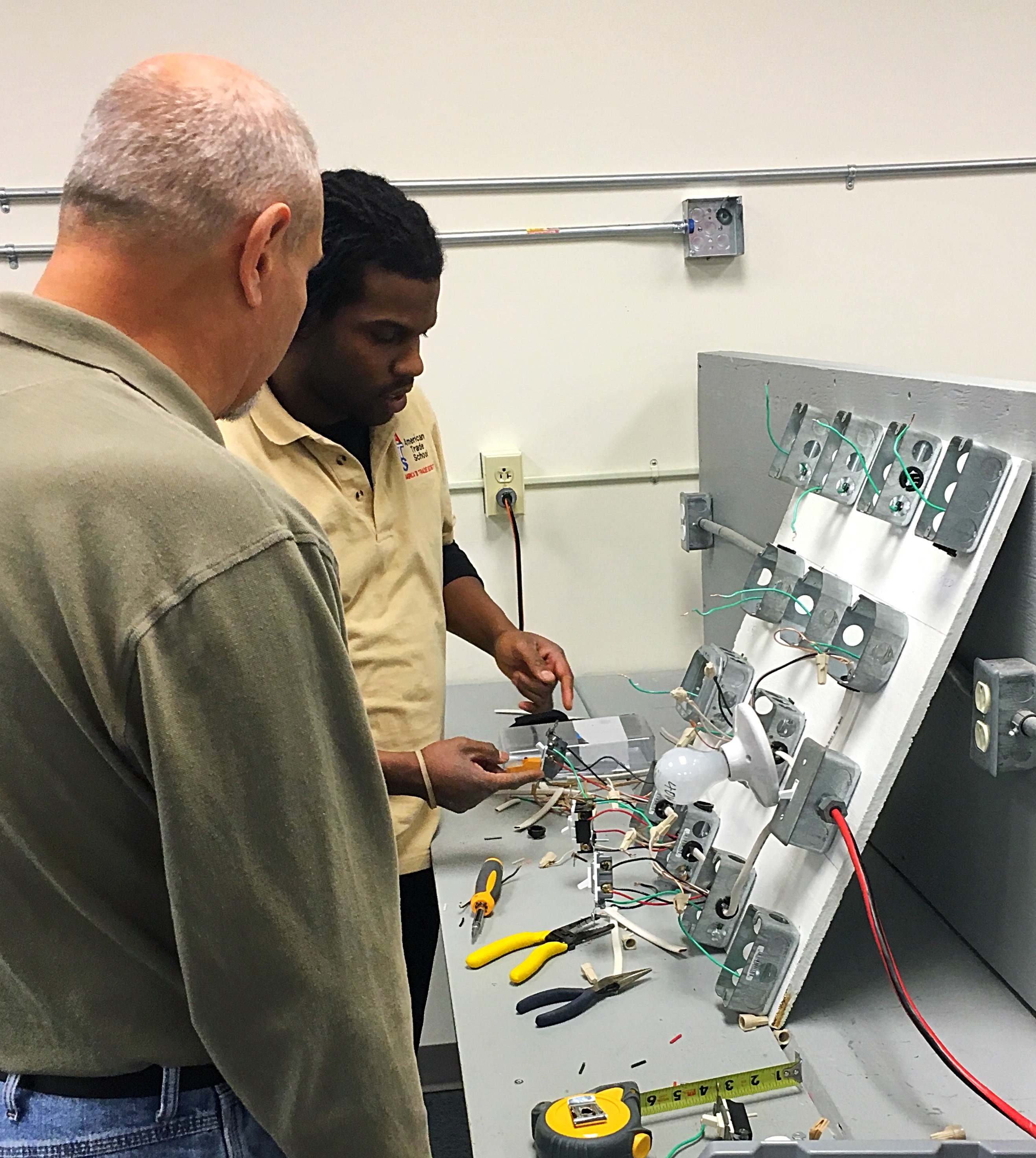
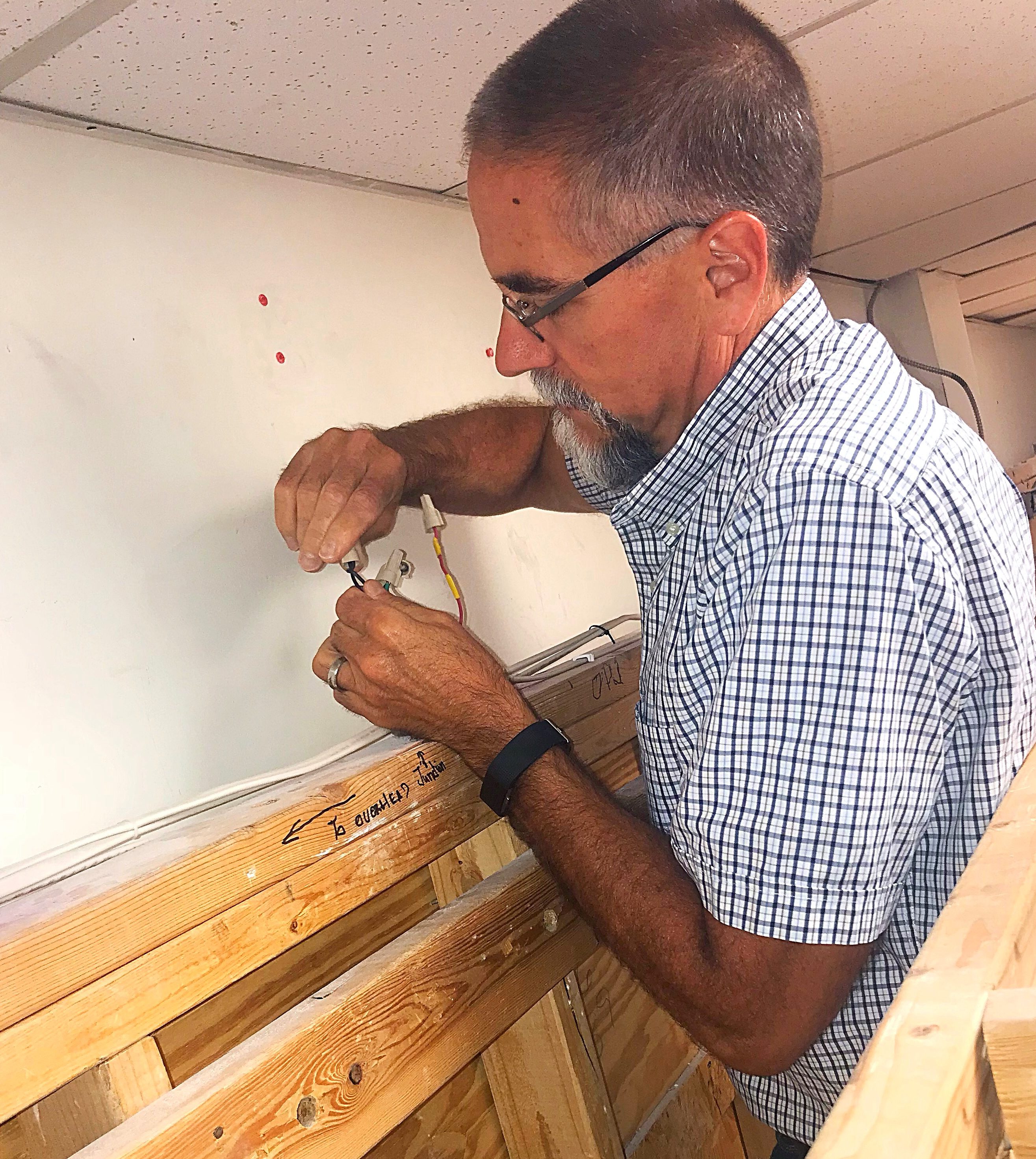
Hands-On Learning. Our programs emphasize hands-on training, allowing you to apply theoretical knowledge to practical situations. This approach enhances your confidence and job readiness.
Small Class Sizes. With fewer students in the class, instructors can provide more individualized attention to each student. This leads to tailored instruction and support.
Experienced Instructors. Our experienced instructors bring real-world experience to the classroom. This ensures you receive practical insights and guidance that goes beyond textbooks.
Career-Focused Curriculum. Our curriculum is carefully designed to align with industry standards and trends. This means you'll graduate with the knowledge and skills employers are actively seeking.
Career Services. Our commitment to your success doesn't end with graduation. Our career services department assists in finding job opportunities and preparing for interviews.
Industry recognized training partners. National Fire Protection Association (NFPA) industry partnership.
Admission Requirements and Process
Students enrolling at American Trade School for regular programs must be 17 ½ years old. In addition, prospective students must have a valid high school diploma or a high school equivalency certificate (GED/HiSET).
Academic qualifications are important. Equally important, student motivation and personal interest for success in a chosen career field is of high consideration. No student will be admitted until it is determined that he or she is capable of benefiting from the training.
American Trade School does not discriminate on the basis of race, creed, age, sex, disability, national or ethnic origin in the administration of educational policies, admissions policies, scholarship and loan programs, or other school administered programs.
General Requirements
- Minimum AgeStudents enrolling at American Trade School for regular programs must be 17 ½ years old.
- High School Diploma or EquivalencyProspective students must have a valid high school diploma or a high school equivalency certificate (GED/HiSET).
- Personal Visit and InterviewThe application procedure includes a personal visit to the school, a personal interview with an Admissions Representative and a tour of the school.
- Placement TestsApplicants complete placement tests where applicable before enrolling.
- Financial ClearanceApplicants must complete all enrollment forms and receive financial clearance before starting.
- Motivation and DriveStudent motivation and personal interest for success in a chosen career field is of high consideration alongside academic qualifications.
Application Process
- 1
- 2Complete the applicationCompletion of all application forms.
- 3Admissions interviewPersonal interview with an Admissions Representative.
- 4Tour the schoolTour of school.
- 5Placement testsCompletion of placement tests (if applicable).
- 6Enrollment formsCompletion of all enrollment forms.
- 7Financial clearanceFinancial clearance. Tuition may either be paid in full upon enrollment or complete payment must be accounted for on the Information Sheet for Student Tuition Financing (Tuition Proposal).
Program Schedule
The program offers a hybrid learning format, combining classroom and online instruction. The 8-month program consists of two courses, each 16 weeks in length.
Hybrid schedule. All classes meet Monday – Thursday: 2 days in-person / 2 days online.
Day classes: Monday – Thursday from 8:30am to 1:00pm. Evening classes: Monday – Thursday from 6:00pm to 10:30pm.
Start dates. Upcoming start dates are February 15, 2027, June 14, 2027 and October 11, 2027.
Classes are not held on New Year’s Day, Martin Luther King’s Birthday, President’s Day, Good Friday, Memorial Day, Juneteenth, Fourth of July, Labor Day, Veterans Day, Thanksgiving, Christmas Eve and Christmas Day.
- February 15th, 2027
- June 14th, 2027
- October 11th, 2027
Cost of Attendance and Financial Aid Information
Tuition and fees. From the school’s Tuition Information Sheet (Rev 09/18/2025; prices are subject to change):
- ELEC101 - Basic Electricity (Core), 16 weeks: tuition $5,900.00, registration fee $100.00, lab fee $2,500.00, books & supplies $663.34, estimated sales tax $74.55; total $9,237.89.
- ELEC102 - Residential Electricity, 16 weeks: tuition $5,900.00, registration fee $0.00, lab fee $2,500.00, books & supplies $162.95, estimated sales tax $18.31; total $8,581.26.
Program total: 32 weeks; tuition $11,800.00, registration fee $100.00, lab fees $5,000.00, books & supplies $826.29, estimated sales tax $92.86; total $17,819.15.
Optional costs (listed on the same sheet, not included in the totals above): Electrical Tools tool kit $1,628.21 plus estimated sales tax $178.91, total $1,807.12.
Paying for trade school. While federal financial aid (Title IV funding) is not available for our programs, we offer expanded financing options to help make tuition affordable for every student. American Trade School partners with Lumion, a trusted education financing provider, to offer students affordable trade school payment plans with interest rates ranging from 0% to 8%.
- Flexible payment terms to match your financial situation.
- Quick and easy application process with fast approval decisions.
- No prepayment penalties, so you can pay off your balance anytime.
- Low or no-interest options available.
- Not based on credit history, everyone is approved!
How to apply for financing. 1. Plan a visit to American Trade School to speak with an admissions representative to discuss your program and tuition. 2. Review Lumion financing options to choose the plan that best fits your needs. 3. Submit your Lumion application for a quick approval decision.
Tuition policy. Tuition may either be paid in full upon enrollment or complete payment must be accounted for on the Information Sheet for Student Tuition Financing (Tuition Proposal). If a student repeats any portion of the program, the student must pay the current tuition and fees applicable to such portion of the program.
Scholarships. The school lists the Mike Rowe Foundation, SkillPointe Foundation and Bring Back The Trades scholarships. American Trade School is also an approved training provider for Vocational Rehabilitation (VR).
Credit for previous training. Students with documented previous training or work experience may request credit and must pass the school-developed competency test with 70% or better; the non-refundable testing fee is $50.00 per test.
Required Courses
| Subject # | Name |
|---|---|
Career Outcomes
Overall, American Trade School prepares graduates for an entry level position in the field.
Electrical career pathways:
- Low Voltage Technician
- Residential Electrician
- Commercial Electrician
- Service Electrician
- Maintenance Electrician
Industry-recognized certifications: OSHA 10, administered during ELEC101.
Our job placement advisors provide a combination of advising and skills assessment and help with resume writing and interviewing techniques. As a matter of ethics, no school can guarantee placement or starting salaries.
What to expect as a American Trade School student
Placement assistance. Our job placement advisors provide a combination of advising and skills assessment. They will also help with resume writing and interviewing techniques. American Trade School strives to match graduates with employers based on qualifications and abilities. As a matter of ethics, no school can guarantee placement or starting salaries.
Housing. To accommodate students with housing needs, American Trade School will assist students with referrals to various property management companies and apartment complexes in the area.
Library resources. The library contains several computers with internet access and appropriate printed resources. Students will also have access to an online library called the Library and Information Resources Network (LIRN).
Student advising. All members of the administrative staff are available to any student needing assistance with personal, academic, vocational and/or financial problems. Parking is available for students.
Campus Address
Certification to Operate
American Trade School names no accrediting agency on its website. It is certified to operate by the Missouri Coordinating Board for Higher Education.
Student Demographics
These are demographics for all students at the American Trade School - Saint Ann Campus (IPEDS, 2024).
Curriculum
Our Electrical program offers a hybrid learning format, combining classroom and online instruction. The 8-month Residential Electricity program consists of two courses: Fundamentals and Advanced - each is 16 weeks in length.
ELEC101 – Basic Electricity (Fundamentals course: 16 weeks).
OSHA 10 is administered during this course.
AC Electricity: Students are introduced to workplace safety, electrical theory, and the structure of the National Electrical Code (NEC). They apply Ohm’s law to calculate voltage, current, resistance, and power, then test their knowledge with multimeters on various types of circuits. In the lab, students get hands-on experience wiring boards, installing single-pole, three-way, and four-way switches, setting up GFCI and split-wired receptacles, and sizing conductors for branch circuits. They also work with 120/240-volt service concepts and single-phase transformers.
DC Electricity & Low Voltage Systems: Students cover DC principles as applied in today’s workplace, with a strong emphasis on DC circuits and electrical safety. They learn residential data and communication wiring, including home security systems, Power over Ethernet, coaxial cable, video surveillance, fire alarm systems, and battery applications. In the lab, students gain hands-on experience installing and testing low-voltage systems.
ELEC102 – Residential Electricity (Advanced course: 16 weeks. Prerequisite: ELEC101).
Residential Wiring: NEC and Applications: Students build on their foundational skills and step into the real world of home wiring. They learn to wire a complete single-family home—from calculating service needs to the final inspection. Coursework covers key areas of the NEC, including load calculations, grounding and bonding, AFCI/GFCI protection, and surge suppression. In the lab, students transform a professional plan set into a live installation. They mount service equipment, size conductors and raceways, and rough-in branch circuits for lighting, receptacles, and fixed appliances. Learners also practice EMT bending, complete finish-out tasks, and verify voltage drop and load balance before energizing.
Residential Circuits and Electrical Installations: Students gain experience with renovation techniques, a vital part of residential electrical work. They learn to design, install, and troubleshoot residential electrical systems while developing skills in blueprint reading, NEC-compliant wiring, conductor derating, and integrating modern devices such as smart dimmers and retrofitted AFCI breakers. Hands-on labs include renovation projects with budgets, bids, and change orders, as well as a mock electrical inspection. By the end, students are prepared to confidently design, install, and troubleshoot real-world residential circuits.
Advanced elective courses (optional, 8 weeks each): ELEC103 – Commercial Wiring Methods and ELEC104 – Commercial Motor Applications. The advanced elective courses are optional and can be taken immediately after completing the 8-month program or at a future date.
Graduation requirements. Successful completion of each class within each term of training with a minimum 70% grade average; a final attendance average of at least 85%; and full payment of all books, supplies, tuition, and other costs incurred during the tenure with the school.
Required Courses
| Subject # | Name |
|---|---|
| ELEC101 | Basic Electricity (Fundamentals Course) |
| ELEC102 | Residential Electricity (Advanced Course) |
| Totals |
Images
Videos
Other Programs at American Trade School - Saint Ann
American Trade School in Saint Ann, MO also offers these 5 programs at 3925 Industrial Drive, Saint Ann, MO 63074.