Electrical (Hybrid) is a Diploma program (Hybrid) offered by Arizona Automotive Institute in Glendale, AZ. The program takes 10 months to complete, with a total tuition of $16,750.
Program Overview
The Electrical program is designed to prepare the student for an entry level position in the residential and commercial Electrical field. Classes combine theory with practical application of hands-on job skills. All shop courses include the use of hand and specialty tools, and the program emphasizes equipment and shop safety procedures. Students will receive exposure to skills including measuring voltage using an Ohmmeter, using the NEC codebook, Ohm’s law, conduit bending and pipe threading, installing conductors, raceway systems, pull boxes, electric motors, tools for Electricians, lighting fixtures, troubleshooting electrical circuits, transformers and protections, voice, data and video cabling systems.
The Electrical graduate may be awarded a diploma and will be prepared for entry‐level employment as a service technician capable of troubleshooting, servicing and repairing residential and commercial electrical systems. The Electrical program is aligned to the competencies and requirements of the National Center for Construction Education and Research (NCCER). Students will accordingly receive education in Core, Level I, Level II Level III and Level IV.
The Electrical program prepares students for entry level careers within the electrical field such as Electrical and Electronics Installers and Repairers. This program does not prepare students to take the electrician licensing exam. Although the information taught in this program may be helpful, it does not prepare students to become a licensed electrician.
Arizona Automotive Institute’s comprehensive Electrical program helps prepare you for an entry-level position in the residential and commercial Electrical field. We combine classroom-style education with hands-on learning to prepare you for what a career in Electrical will be like once you graduate. With enrollment starting on a rolling basis and programs that can be completed in 10 months, your dream career is in your near future!
Skills you can learn.
- Electrical Safety & NEC Training: understand how to apply safety procedures and work with the National Electrical Code (NEC) to ensure your installations are up to code and safe.
- Residential Wiring Skills: train to install and troubleshoot residential electrical systems, including lighting, switches, outlets, and circuit breakers.
- Conduit Bending and Junction Box Installation: learn mechanical conduit bending techniques and the installation of pull boxes, junction boxes, and raceways in various settings.
- Load Calculation & Circuit Design: learn to calculate electrical loads, size conductors, and design circuits for safe and efficient power distribution.
- Transformers and Power Distribution Systems: understand transformer types, connections, and grounding, and learn to install, maintain, and troubleshoot distribution panels and systems.
- Advanced Electrical Controls: learn to install, configure, and troubleshoot advanced control systems and life-safety circuits, including fire alarms and HVAC controls.
Hybrid delivery. Hybrid programs contain courses that are a combination of online and face-to-face instruction. Students are expected to interact with faculty and other students through online discussion boards as well as traditional face-to-face classroom activities, and are required to participate in all face-to-face classroom activities and online activities as outlined in the course syllabi. All distance education/online courses and programs offered by the campus have been deemed as equivalent in content and quality to the same courses offered via traditional delivery methods.
What sets this Program apart
Small Class Size. We want our students to be able to get the individual attention and assistance they deserve in their career training. We keep our class sizes small to ensure students get one-on-one training time with instructors.
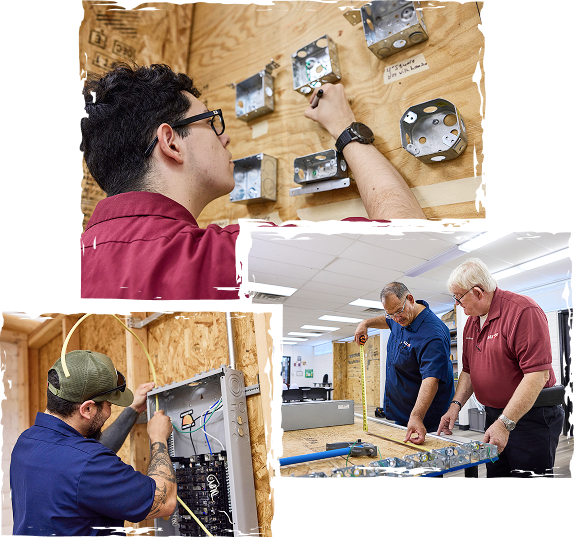
Hands-on Learning. When working in a technical trade, classroom education alone just won’t cut it. We combine traditional education with on-the-job simulated training so you have experience working in an environment similar to those you’ll work at in the future.
Affordable Education. AAI is an affordable education option for vocational trades. Each new student is able to sit down with our financial advisors and learn about financial aid, scholarships and grants that help fund their future dreams.
Support Beyond Graduation. AAI is here to get your career in the trade industry started, but our support doesn’t stop once you’ve completed your program. Our alumni and career services department help you build connections and network for new opportunities long after you’ve wrapped up your studies.
NCCER. The National Center for Construction Education and Research (NCCER), created in 1996, is a not-for-profit 501(c)(3) education foundation. Earning NCCER’s industry-recognized credentials means you, having undergone approved training, and have met the standards set by the NCCER. Your universally recognized credentials in your craft represent a national portability of your skills.
Admission Requirements and Process
Arizona Automotive Institute admits, as students, applicants having an acceptable high school diploma, a General Educational Development (GED), or a recognized equivalent. Persons desiring to apply to Arizona Automotive Institute should contact the School and speak with one of its Admissions Representatives. Prior to being accepted, an applicant must complete an application for admission, interview with an Admission Representative, and meet admission requirements as outlined.
An applicant may register at any time, but may only begin classes on the specified start date or no later than the allowable start period defined by the school’s governing agencies and as outlined on the enrollment agreement. Classes may have a limited enrollment.
Applicants in Hybrid programs are required to complete the Technical Competency, Technical Knowledge and Learning Styles sections of the SmarterMeasure Learning Readiness Indicator prior to acceptance and must score a minimum of 60% on the Technical Competency sections. Students participating in hybrid programs are expected to complete the online orientation prior to the start of classes. Students using VA benefits are prohibited from enrolling in Hybrid programs.
General Requirements
- High school diploma or equivalentArizona Automotive Institute admits applicants having an acceptable high school diploma, a General Educational Development (GED) certificate, or a recognized equivalent.
- Proof of graduationBefore starting classes you must provide a copy of your high school diploma, a transcript confirming high school graduation, a GED certificate or GED transcript reflecting passing…
- Application and interviewPrior to being accepted, an applicant must complete an application for admission and interview with an Admission Representative.
- Background checkAll students applying for admission are required to undergo a background check performed by an unaffiliated service provider, and the campus may deny admission based on the…
- Learning readiness assessmentHybrid applicants must complete the SmarterMeasure Learning Readiness Indicator and score at least 60% on the Technical Competency section, or complete the Technology for Success…
- VA benefitsStudents using VA benefits are prohibited from enrolling in Hybrid programs.
- Final acceptanceThe President or the President’s designee must give final acceptance of each student, and a student is officially enrolled once the enrollment agreement is fully executed.
Application Process
- 1Pick Your ProgramThe first step to starting your AAI education journey is to pick the program you want to pursue.
- 2Talk to an Admissions RepresentativeOur admissions representatives can help answer any additional questions you might have about the program and help you choose a program that will launch you into your career.
- 3Schedule Your Campus TourOur campus includes hands-on learning environments that allow you to learn in an accurate work-like setting.
- 4Talk to Our Financial Services OfficersWe have financial services officers on site, and you are invited to sit down and discuss your financial options with them during your campus tour. They’ll help you understand the Free Application for Federal Student Aid (FAFSA, school code 010847) and any scholarship or grant opportunities to offset the cost of your education.
- 5Start Your Education JourneyOur on-campus admissions representatives are here to help you complete your application and guide you through your paperwork; you are officially enrolled once all admission requirements are met and the enrollment agreement is fully executed.
Program Schedule
Courses start every 5 weeks. Upcoming start dates: November 16, 2026; January 4, February 8, March 15, April 19, May 24, June 28, August 2, September 6, October 11 and November 15, 2027.
AAI offers day and evening class options for most programs. Classroom facilities are open Monday – Thursday 7:00 am – 11:00 pm.
Hybrid courses are designed as a combination of online and residential (on-ground classroom) based learning. In most situations, a hybrid course consists of 55% classroom based instruction and 45% online instruction. Students are expected to actively participate in their online courses at least twice per week.
- November 16th, 2026
- January 04th, 2027
- February 08th, 2027
- March 15th, 2027
- April 19th, 2027
- May 24th, 2027
- June 28th, 2027
- August 02nd, 2027
- September 06th, 2027
- October 11th, 2027
- November 15th, 2027
Cost of Attendance and Financial Aid Information
Program charges. Total tuition is $16,750, the program fee total is $4,750 and the registration fee is $40, for total program charges of $21,540 (4 terms, 50 quarter credit hours).
Program fees represent the cost of specialized facilities, equipment, and materials required to offer a program and where applicable, tool kits, supplies and uniforms, which are non-returnable. The total program fees are divided by the projected terms to calculate a per-term charge.
Books and supplies (included in the program fee). Text $770.29; uniforms $76.96; toolkits $881.92.
Billing and payment plans. Total tuition and program fee charges are divided by projected terms to calculate a per-term charge, and AAI bills each student per term, so it does not charge additional tuition or program fees for course retakes. Arrangements may be made for students to pay on a monthly basis the portion of their charges not met by financial aid or other sources.
Federal financial aid. Financial Aid is available for those who qualify. All students seeking financial assistance meet with the Financial Aid Office, which provides guidance on completing the FAFSA at studentaid.gov. AAI’s federal school code is 010847.
- Federal Pell Grant: a need-based grant; the maximum award for full-time enrollment for the 2025-2026 award year is $7,395.
- Federal Supplemental Educational Opportunity Grant (FSEOG): need-based; awards typically range from $100 to $600.
- Direct Subsidized and Unsubsidized Stafford Loans and Direct PLUS Loans for parents; the interest rate for Stafford loans first disbursed between July 1, 2026 and June 30, 2027 is fixed at 6.52% (PLUS 9.07%).
- Federal Work Study for students demonstrating financial need.
- Private loans from outside lenders, who determine eligibility.
Institutional awards.
- High School/GED to Career Tuition Discount: $1,000 for Diploma programs, for high school graduates or GED recipients who begin classes within 12 months of receiving their diploma or GED.
- Arizona Private School Association High School Discount: a $1,000 discount for current year Arizona High School graduates.
- Get Back in the Game Discount: $1,000 for individuals who earn their GED and begin classes during the same calendar year.
- AAI Tribal Discount: 20% off tuition (not program fees) for members of a federally recognized tribe.
- Empowering Equality in Trade Professions Scholarship: up to fifteen $2,500 scholarships awarded annually to first time students; requires a scholarship application and an essay of 150 words or more.
- Students who qualify for multiple discounts/grants may only utilize one per program.
Veterans. Students using VA benefits are prohibited from enrolling in Hybrid programs.
Vocational Rehabilitation. AAI is approved for training services for the State Department of Vocational Rehabilitation.
Net Price Calculator. Estimate your cost with AAI’s Net Price Calculator: https://www.aai.edu/?mmc_netprice_campus=aai
Curriculum
The normal duration required to complete this program is 50 credits and the maximum timeframe is 75 credits. Other than stated prerequisites, the courses do not necessarily have to be taught in the order in which they are outlined.
Required Courses
| Subject # | Name | Credits |
|---|---|---|
Career Outcomes
Graduates of our program may find work* as:
- Assistants
- Electrical Technicians
- Electrical Apprentices
- Electrical Assemblers
- Electrical Installers
- Electricians
- Foremen
*Arizona Automotive Institute cannot guarantee employment or salary. The jobs mentioned are examples of certain potential jobs, not a representation that these outcomes are more probable than others.
Career outlook. The outlook for electrical and electronics installers and repairers is projected to slow a bit between 2023 and 2033. Around 10,100 openings will be available each year nationwide should projections hold.
Graduation and employment rates. Graduation and employment rates as reported to ACCSC in its 2025 Annual Report for the reporting date of July 1, 2025: Electrical (10 months), report period 1/23 – 12/23: graduation rate 86% (30 of 35); employment rate 71% (20 of 28). These disclosed employment rates reflect historical outcomes of graduate employment and should not be relied on as a promise of future employability.
Institution-wide (IPEDS): 77% graduation rate for first-time, full-time students in the 2022 full-year cohort (within 150% of normal program length); 83% retention rate for first-time students who enrolled in Fall Quarter 2024; 81% of students enrolled in 2024-2025 received Pell grant aid.
What to expect as a Arizona Automotive Institute student
Campus. The Arizona Automotive Institute campus is located at 6829 N. 46th Avenue, Glendale, Arizona 85301. The school occupies over 77,000 square feet of classrooms, labs/shops, work areas, offices, and a Learning Resource Center.
Class size. The school will maintain a proper ratio between teachers and students to allow adequate attention to each individual in both theory class and the laboratory. The student‐teacher ratio will generally not exceed 30:1 in theory classes and 20:1 in laboratory classes.
Technology. With the exception of students enrolled in CDL Training, all students receive a device that meets the requirements for their enrolled program.
Support services. All students have access to library services, academic advising, tutoring, and career services. Career Services helps with preparation of resumes and cover letters, job coaching to improve interviewing and other job seeking skills, advice and information on job availability in specific areas of training, and continuous, individualized employment assistance.
Campus Address
Why Accreditation Is Important
Arizona Automotive Institute is accredited by the Accrediting Commission of Career Schools and Colleges (ACCSC), as a branch campus of Miller-Motte College – Chattanooga. AAI is approved and regulated by the Arizona State Board for Private Postsecondary Education. The program curriculum is recognized by / aligned to the National Center for Construction Education & Research (NCCER).
- A reliable indicator of quality
- Approved program of study
- Qualified instructors
- Recognition by employers nationwide
Accreditations
Images