
Heating, Ventilation, and Air Conditioning is a Certificate program offered by Aviation Institute of Maintenance in Casselberry, FL. The program takes 12 months to complete, with a total tuition of $26,280.
Program Overview
The Heating, Ventilation, and Air Conditioning (HVAC) program provides students with the technical skills necessary for entry-level employment in the air-conditioning and refrigeration industry. This program explains typical HVAC systems followed by practical hands-on competencies for the three areas of HVAC: mechanical, electrical, and airflow systems, including extensive troubleshooting of each area. Areas of study include air-conditioning fundamentals, electrical theory, refrigerants, heat pumps, heating systems, icemakers, ice cream machines, refrigeration equipment, specialty tools, commercial water-cooled air-conditioning systems, brazing and soldering techniques, and psychrometrics.
What sets this Program apart
- Hands-on troubleshooting across all three major areas of HVAC — mechanical, electrical, and airflow systems — including commercial refrigeration equipment
Certifications students have the opportunity to complete:
- Occupational Safety and Health Administration (OSHA) Safety Certification
- Environmental Protection Agency (EPA) Section 608 Refrigerant Transition Certification
General Requirements
- AgeApplicants must be beyond the age of compulsory high school attendance and have an approved cosigner if under the age of 18.
- EducationApplicants must provide acceptable proof of graduation from high school, a General Education Diploma, or equivalent. An international/foreign transcript must be translated into English, evaluated by an approved third party, and determined to be equivalent to a US high school diploma.
- IdentificationApplicants must submit a government-issued photo ID, such as a copy of a state issued driver's license, state issued identification card, or passport.
- ApplicationApplicants must submit an Application for Admissions and a $25 application fee in order to be considered for admission. The application fee is waived for veterans with proof of service.
Application Process
- 1Submit ApplicationComplete the online application form with your personal information and educational background.Apply Now
- 2Submit TranscriptsProvide official high school transcripts or GED certificate. Some programs may require additional documentation.
- 3Financial AidComplete the FAFSA to determine eligibility for federal financial aid. Meet with a financial aid advisor to review your options.FAFSA Code for Orlando Metro: 041564Complete FAFSA Application
- 4EnrollmentOnce accepted, complete enrollment paperwork, register for classes, and attend orientation.
Program Schedule
A "semester" (term) is a 15-week period comprised of three consecutive 5-week blocks. One course is scheduled each 5-week block. One academic year is two semesters, or 6 consecutive 5-week blocks.
Class schedule at this campus
The catalog's campus appendix does not publish a class-schedule table for this campus. Standard shifts across AIM campuses are Day (Mon–Thu, morning–early afternoon), Evening (Mon–Thu), and Weekend where offered; not all shifts are offered at all campuses. Confirm shift times with the campus before publishing specifics.
School Information
Campus Location
Accreditation & Approvals
Accredited by the Accrediting Commission of Career Schools and Colleges (ACCSC). Licensed by the Commission for Independent Education, Florida Department of Education (License #5684).
- A reliable indicator of quality
- Approved program of study
- Qualified instructors
- Recognition by employers nationwide
Accreditations

Student Demographics
These are demographics for all students at the Orlando Metro Campus.
Curriculum
The Heating, Ventilation, and Air Conditioning program runs 48 weeks (about 12 months) as a sequence of five-week course blocks covering refrigeration controls, heating systems, commercial systems, psychrometrics, heat pumps, and advanced troubleshooting, with the opportunity to earn OSHA and EPA Section 608 certifications.
| Course | Credits | Clock Hours |
|---|---|---|
| RHVS100 — Air Conditioning and Refrigeration I | 4.0 | 120 |
| RHVS115 — Air Conditioning and Refrigeration Controls I | 4.0 | 120 |
| RHVS117 — Air Conditioning and Refrigeration Controls II | 4.0 | 120 |
| RHVS124 — Heating Systems | 4.0 | 120 |
| RHVS132 — Commercial Air Conditioning and Refrigeration | 4.0 | 120 |
| RHVS141 — Comfort and Psychrometrics | 4.0 | 120 |
| RHVS156 — Heat Pumps | 4.0 | 120 |
| RHVS186 — Advanced Troubleshooting and Service | 4.0 | 120 |
| RHVS192 — Air Conditioning and Refrigeration II | 4.0 | 120 |
| Total | 36.0 | 1,080 |
Cost of Attendance and Financial Aid Information
How tuition is calculated
Tuition is calculated based on a cost per credit and includes the use of equipment needed to complete the program. General Credit fees apply to credits attempted in the first and second academic years; Advanced Credit fees apply to credits attempted in the third and fourth academic years. Textbooks and tool kits are not included in the tuition but can be purchased through the school.
Financial assistance
The school is recognized by the U.S. Department of Education as a proprietary institution of higher education for participation in federal grant and loan programs. Eligibility requires that a student be a U.S. citizen, eligible non-citizen, or permanent resident, and maintain Satisfactory Academic Progress. Available programs include:
Federal Pell Grant
Federal Supplemental Educational Opportunity Grant (FSEOG)
Federal student loans (Direct Subsidized/Unsubsidized and PLUS)
Federal Work-Study
Veterans' education benefits and military tuition assistance
Outside scholarships — the school will match, dollar for dollar, up to 10% of tuition, books and fees, the total of all outside scholarships received
Fees charged separately from tuition (where applicable)
$25 Application Fee (waived for veterans with proof of service)
$125 Administrative Fee; $12 Library Fee; $100 Security Fee
$25 per-credit Technology Fee for courses taken via distance education
Aviation programs: $1,550 Aviation Maintenance Lab Fee (third academic year); $425/academic year Aviation Maintenance Materials Fee; $1,900 Advancing Status Fee (final academic year); $175 avionics testing fee in AY2 of the AMTE program
Not all fees apply to all programs — see the student's Enrollment Agreement.
Licensure and accreditation at this campus
AIM Casselberry is licensed by the Commission for Independent Education, Florida Department of Education (License #5684), 325 West Gaines Street, Suite 1414, Tallahassee, FL 32399; (888) 224-6684. AIM is accredited by the Accrediting Commission of Career Schools and Colleges (ACCSC), 2101 Wilson Boulevard, Suite 302, Arlington, VA 22201, (703) 247-4212.
Total program tuition $26,280 (36 credits at $730 per credit).
Career Outcomes
Graduates of the Heating, Ventilation, and Air Conditioning program are prepared for entry-level roles installing, servicing, and maintaining HVAC and refrigeration systems. Common career paths include:
- HVAC Technician
- Refrigeration Mechanic
- System Installer
- Maintenance Technician
Graduates find opportunities in residential and commercial settings across the HVAC and refrigeration industry.
What to expect as an Aviation Institute of Maintenance student
Educational and training objectives
Practice and demonstrate hands-on competencies for the three major areas of HVAC: mechanical, electrical, and airflow systems
Wire an HVAC system from the power source; identify units of measurement for electricity; demonstrate a standing pressure test
Demonstrate troubleshooting techniques for mechanical, electrical, and airflow problems on various HVAC and refrigeration systems
Demonstrate procedures for bending, soldering, and brazing copper tubing; identify HVAC tools and their field uses
Demonstrate duct system installation and ductwork fabrication; diagnose proper superheat and subcooling
Use appropriate safety measures according to OSHA and the EPA
Certifications available
OSHA Safety Certification
EPA Section 608 Refrigerant Transition Certification
Campus facility
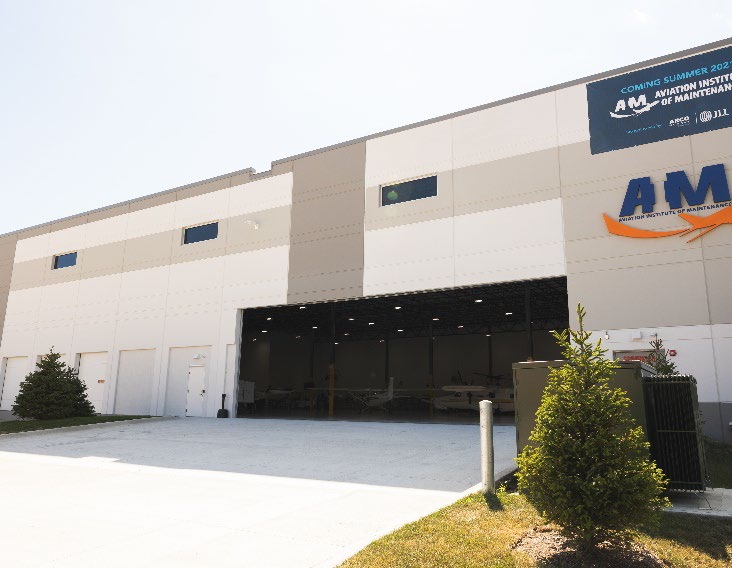
The Casselberry, FL campus offers over 42,000 square feet of space. The 18,000-square-foot hangar is designated for multiple uses, including hands-on lab instruction for students. In addition, approximately 4,500 square feet in the adjacent annex is used for expanded classroom space, including three rooms that support small-scale instructional activities and a separate large area (approximately 14 × 20 feet) to accommodate larger training needs.
Across all AIM campuses
Campuses are Wi-Fi enabled, and all necessary learning resources are available on the school's intranet. Each campus offers various spaces for student recreation, relaxation, and study. Each year, Program Advisory Committees from the industries served review the campus facility, equipment, training aids, learning resources, and other aspects of the campus to provide input and guidance on improving the learning space for students.
Testimonials
Frequently Asked Questions
School Information
Campus Location
Accreditation & Approvals
Accredited by the Accrediting Commission of Career Schools and Colleges (ACCSC). Licensed by the Commission for Independent Education, Florida Department of Education (License #5684).
- A reliable indicator of quality
- Approved program of study
- Qualified instructors
- Recognition by employers nationwide
Accreditations
Student Demographics
These are demographics for all students at the Orlando Metro Campus.