
Combination Welding is a Certificate program offered by Aviation Institute of Maintenance in Duluth, GA. The program takes 8 months to complete, with a total tuition of $18,120.
Program Overview
The Combination Welding program is designed to provide the student with the fundamentals of welding, which includes the preparation and joining of pieces of metal into machine parts and other equipment. Students have the opportunity to obtain industry competencies in shielded metal arc welding (SMAW), gas metal arc welding (GMAW), flux core arc welding (FCAW), and gas tungsten arc welding (GTAW). The program allows students to become proficient at blueprint reading, plasma and oxy-fuel cutting, measurement, and cylinder safety. Additionally, students will have the opportunity to learn skills associated with career success, such as effective communication, listening skills, time management, problem solving, and organizational skills.
What sets this Program apart
- Four welding processes — SMAW, GMAW, FCAW, and GTAW — plus plasma and oxy-fuel cutting in an 8-month program
Certifications students have the opportunity to obtain:
- Occupational Safety and Health Administration (OSHA) Safety Certification
- American Welding Society (AWS) Vertical (3G) and Overhead (4G) Certification
General Requirements
- AgeApplicants must be beyond the age of compulsory high school attendance and have an approved cosigner if under the age of 18.
- EducationApplicants must provide acceptable proof of graduation from high school, a General Education Diploma, or equivalent. An international/foreign transcript must be translated into English, evaluated by an approved third party, and determined to be equivalent to a US high school diploma.
- IdentificationApplicants must submit a government-issued photo ID, such as a copy of a state issued driver's license, state issued identification card, or passport.
- ApplicationApplicants must submit an Application for Admissions and a $25 application fee in order to be considered for admission. The application fee is waived for veterans with proof of service.
Application Process
- 1Submit ApplicationComplete the online application form with your personal information and educational background.Apply Now
- 2Submit TranscriptsProvide official high school transcripts or GED certificate. Some programs may require additional documentation.
- 3Financial AidComplete the FAFSA to determine eligibility for federal financial aid. Meet with a financial aid advisor to review your options.FAFSA Code for Atlanta Metro: 035233Complete FAFSA Application
- 4EnrollmentOnce accepted, complete enrollment paperwork, register for classes, and attend orientation.
Program Schedule
A "semester" (term) is a 15-week period comprised of three consecutive 5-week blocks. One course is scheduled each 5-week block. One academic year is two semesters, or 6 consecutive 5-week blocks.
Class schedule at this campus
Day Shift Monday - Thursday 7:30 a.m. – 2:00 p.m. - Class in session, 50-minute lunch break
Evening Shift Monday - Thursday 5:00 p.m. – 11:00 p.m. - Class in session, 30-minute lunch break
Weekend Shift Friday - Sunday 7:30 a.m. – 4:30 p.m. - Class in session, 70-minute lunch break
- September 28th, 2026
- November 02nd, 2026
- December 07th, 2026
- January 19th, 2027
- February 22nd, 2027
- March 29th, 2027
- May 10th, 2027
- June 14th, 2027
- July 19th, 2027
- August 23rd, 2027
- September 27th, 2027
- November 01st, 2027
- December 06th, 2027
School Information
Campus Location
Accreditation & Approvals
Accredited by the Accrediting Commission of Career Schools and Colleges (ACCSC). Authorized by the Georgia Nonpublic Postsecondary Education Commission (GNPEC).
- A reliable indicator of quality
- Approved program of study
- Qualified instructors
- Recognition by employers nationwide
Accreditations
Student Demographics
These are demographics for all students at the Atlanta Metro Campus.
Percentages are of total fall enrollment. 6 students whose race or ethnicity was not reported are included in that total but shown as no category, so the figures above come to 99.2% rather than 100%.
Curriculum
The Combination Welding program runs 33 weeks (about 8 months) as a sequence of five-week course blocks covering shielded metal arc, gas metal arc, flux-core, and gas tungsten arc welding across flat, horizontal, vertical, and overhead positions, with the opportunity to earn OSHA and American Welding Society (AWS) certifications.
| Course | Credits | Clock Hours |
|---|---|---|
| WES 1161 — Fundamentals of Modern Welding | 4.0 | 120 |
| WES 1181 — Shielded Metal Arc Welding Flat and Horizontal | 4.0 | 120 |
| WES 1201 — Shielded Metal Arc Welding Vertical | 4.0 | 120 |
| WES 1221 — Shielded Metal Arc Welding Overhead | 4.0 | 120 |
| WES 1241 — Gas Metal Arc Welding & Flux Core Arc Welding Processes | 4.0 | 120 |
| WES 1261 — Special Cutting and Gas Tungsten Arc Welding | 4.0 | 120 |
| Total | 24.0 | 720 |
Cost of Attendance and Financial Aid Information
How tuition is calculated
Tuition is calculated based on a cost per credit and includes the use of equipment needed to complete the program. General Credit fees apply to credits attempted in the first and second academic years; Advanced Credit fees apply to credits attempted in the third and fourth academic years. Textbooks and tool kits are not included in the tuition but can be purchased through the school.
Financial assistance
The school is recognized by the U.S. Department of Education as a proprietary institution of higher education for participation in federal grant and loan programs. Eligibility requires that a student be a U.S. citizen, eligible non-citizen, or permanent resident, and maintain Satisfactory Academic Progress. Available programs include:
Federal Pell Grant
Federal Supplemental Educational Opportunity Grant (FSEOG)
Federal student loans (Direct Subsidized/Unsubsidized and PLUS)
Federal Work-Study
Veterans' education benefits and military tuition assistance
Outside scholarships — the school will match, dollar for dollar, up to 10% of tuition, books and fees, the total of all outside scholarships received
Fees charged separately from tuition (where applicable)
$25 Application Fee (waived for veterans with proof of service)
$125 Administrative Fee; $12 Library Fee; $100 Security Fee
$25 per-credit Technology Fee for courses taken via distance education
Aviation programs: $1,550 Aviation Maintenance Lab Fee (third academic year); $425/academic year Aviation Maintenance Materials Fee; $1,900 Advancing Status Fee (final academic year); $175 avionics testing fee in AY2 of the AMTE program
Not all fees apply to all programs — see the student's Enrollment Agreement.
Licensure and accreditation at this campus
AIM Duluth is authorized by the State of Georgia Nonpublic Postsecondary Education Commission (GNPEC), 2082 East Exchange Place, Suite 220, Tucker, GA 30084-5313. AIM is accredited by the Accrediting Commission of Career Schools and Colleges (ACCSC), 2101 Wilson Boulevard, Suite 302, Arlington, VA 22201, (703) 247-4212.
Total program tuition $18,120 (24 credits at $755 per credit).
Career Outcomes
Graduates of the Combination Welding program are prepared for entry-level roles in metal fabrication and welding. Common career paths include:
- Combination Welder
- Structural Welder
- Metal Fabricator
- Pipe Welder
Graduates find opportunities across industries such as construction, manufacturing, aerospace, shipbuilding, and energy.
What to expect as an Aviation Institute of Maintenance student
Educational and training objectives
Demonstrate appropriate safety measures according to OSHA and the EPA
Employ skills in blueprint reading, measurement, and calculating dimensions for manufacturing work orders
Practice procedures for metal grinding processes and plasma and oxy-fuel cutting
Demonstrate proficiency in machine setups, changing cylinders, cutting tips, and hoses; set up and operate portable and stationary oxyacetylene and propane
Set up amperage adjustments and voltage polarity prior to welding mild steel; strike an arc and produce stringer and weaver beads
Exhibit appropriate techniques to perform SMAW, GMAW, and FCAW welds
Campus facility
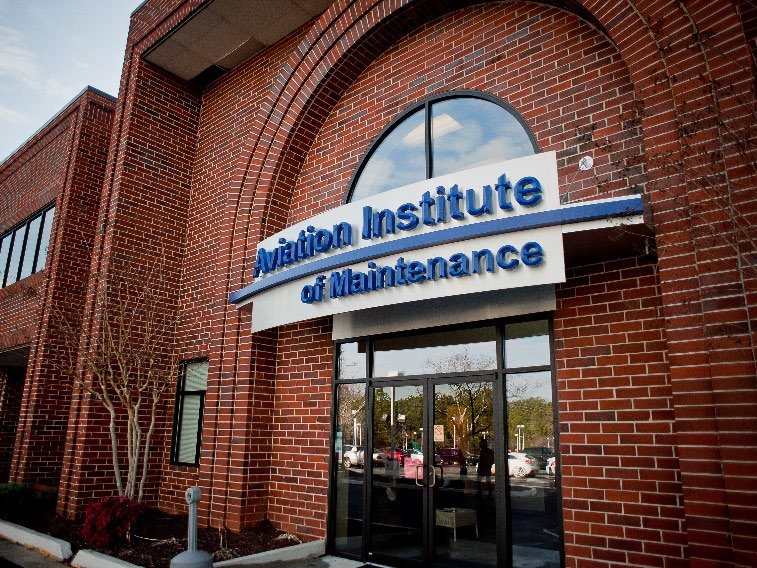
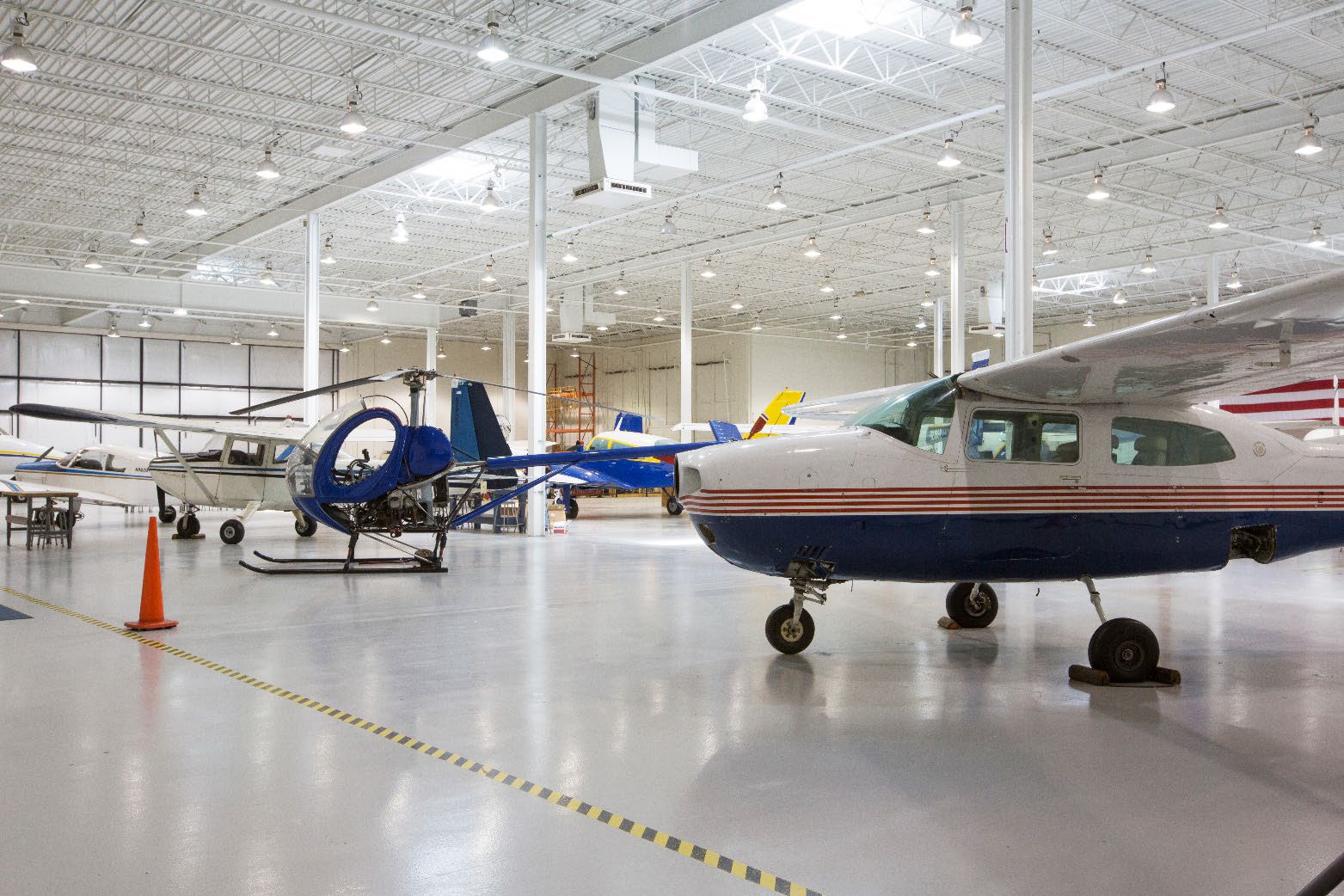
The Duluth, GA campus is housed in a facility of approximately 100,000 square feet on 16 acres. The facility boasts 30 large classrooms, a large LRC to support students’ needs, and three student break areas (inside and outside the building). There are also dedicated labs for avionics, advanced structures, welding and nondestructive testing courses. The aircraft hangar is approximately 61,000 square feet. Aircraft taxi space is available on site, as well as an indoor engine test cell for the testing of aircraft engines. There are 600 parking spaces for students, and the county bus system has a stop on the school property.
Across all AIM campuses
Campuses are Wi-Fi enabled, and all necessary learning resources are available on the school's intranet. Each campus offers various spaces for student recreation, relaxation, and study. Each year, Program Advisory Committees from the industries served review the campus facility, equipment, training aids, learning resources, and other aspects of the campus to provide input and guidance on improving the learning space for students.
Testimonials
Frequently Asked Questions
School Information
Campus Location
Accreditation & Approvals
Accredited by the Accrediting Commission of Career Schools and Colleges (ACCSC). Authorized by the Georgia Nonpublic Postsecondary Education Commission (GNPEC).
- A reliable indicator of quality
- Approved program of study
- Qualified instructors
- Recognition by employers nationwide
Accreditations
Student Demographics
These are demographics for all students at the Atlanta Metro Campus.
Percentages are of total fall enrollment. 6 students whose race or ethnicity was not reported are included in that total but shown as no category, so the figures above come to 99.2% rather than 100%.