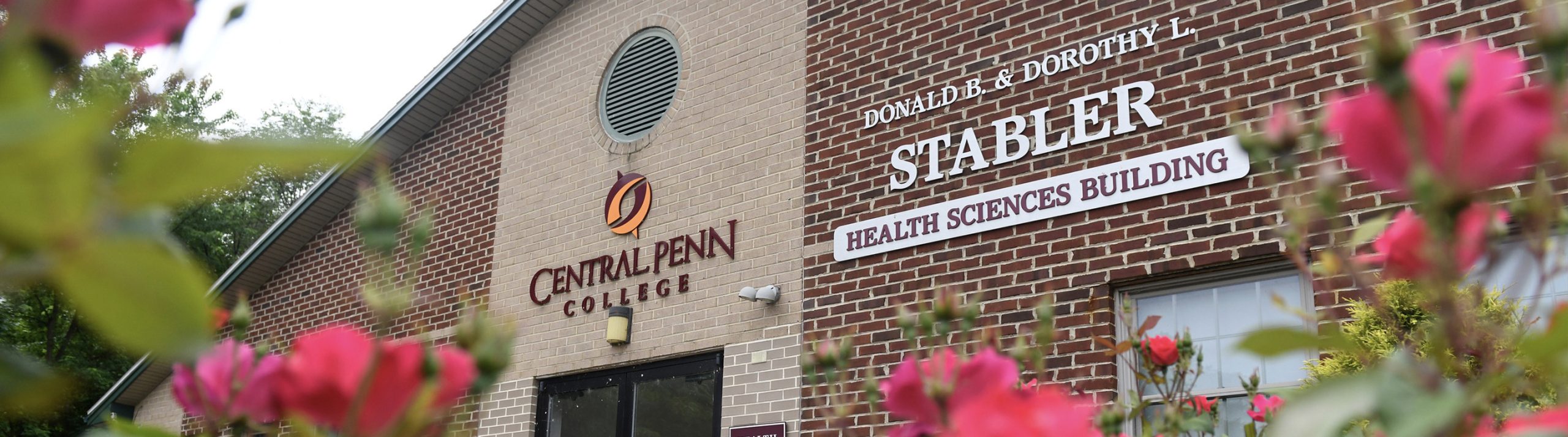
Health Science is a Bachelor Degree program offered by Central Penn College in Enola, PA. The program takes 3 years plus an internship to complete, with a total tuition of $525.
Program Overview
Mission.
The Bachelor of Science in Health Science degree prepares students for entry into graduate school in a variety of healthcare disciplines. This program is designed to provide career and academic advancement through innovative application of knowledge, scholarship, and hands-on education.
Overview.
The Bachelor of Science in Health Science (BSHS) degree program is for individuals who are preparing for entry into professional and graduate courses that are relevant to almost all health care careers including physical and life sciences, medical ethics, or research. This program is designed to provide career and academic advancement as well as to deliver a well-rounded generalist curriculum to those who are preparing for graduate school in health care disciplines. This program is offered in 2 formats: Traditional day and Hybrid formats. The hybrid format (designed for currently working professionals), provides didactic portions of coursework on-line and labs are provided one evening per week, per lab course. Enrollments for both formats are accepted in the Fall term. Transfer students are accepted in spring term provided they meet all the admission criteria.
Curriculum.
The BSHS program is designed to prepare students for graduate work that will lead to careers in allied healthcare fields. The degree’s core is composed of science courses that are common prerequisites for admission into healthcare graduate programs. Social science and health science courses will equip all students with a multidisciplinary understanding of health and healthcare in today’s world.
Program learning objectives.
- Demonstrate an understanding of the principles of physical, biological, and behavioral science as they apply to human growth and development across the lifespan.
- Apply analytical reasoning and critical thinking skills to make informed decisions regarding the dynamic healthcare environment, diversity, and medical ethics.
- Exhibit a professional attitude and demonstrate a commitment to life-long learning, scholarship and research.
- Demonstrate effective communication skills, both written and oral, in a manner reflective of healthcare professionals.
- Examine the scientific theoretical concepts foundational to health science, apply knowledge, and appraise outcomes in laboratory experiences.
- Develop scientific knowledge through scholarly inquiry using evidence-based best practices.
Admission Requirements and Process
To be considered for admission into a degree or professional certificate program, students must be a high school graduate or have received a General Equivalency Diploma (GED), Pennsylvania Home School Diploma or other recognized equivalency diploma. High School Students applying with an overall GPA of 2.0 or higher may be considered for regular admission. Students applying with a GPA below a 2.0 in high school or from another college or university, if accepted, will be admitted conditionally. Please submit an application for admission and a copy of high school and/or college transcript(s). Some applicants may be required to attend a personal interview with the Admissions Office.
An admission essay may be deemed optional for all applicants whose GPA meets or exceeds the minimum for acceptance into the desired program. For certificates and degrees in the Schools of Humanities and Business, the minimum GPA for acceptance is 2.0. For most Health Sciences certificates and degrees, unless otherwise specified, the minimum GPA is 2.2.
Admission Requirements.
The Bachelor of Science in Health Sciences must limit enrollment due to classroom space. Minimum academic standards for admission have been set. Students are evaluated for admission based on rubric scores according to the following admissions criteria:
Traditional Program (admits in Fall Term).
- High School graduates without college experience must have a high school GPA of a 2.5 or higher due to the academic rigor and specificity of the BSHS program.
- SAT or ACT scores are preferred.
- Transfer students may be accepted for spring term provided they have college experience (24 or more earned college credits) are required to have a GPA of 2.5 or higher, calculated off of all schools attended. They are required to transfer in MTH105 (College Algebra) and ALH155, ALH155L, ALH165, ALH165L (Anatomy and Physiology I and II with labs) or equivalent, with a final course grade of C+ or better.
- Submit two professional reference letters.
- Program is capped at 24 students. Students will be admitted based on the above criteria on a first-come, first-served basis.
Hybrid Program (admits in Fall Term).
- Students must have earned a minimum of 24 college credits from an accredited institution with a GPA of 2.5 or higher (calculated off of all schools attended).
- Students must transfer in ALH155, ALH155L, ALH165, ALH165L (Anatomy and Physiology I and II with lab) or equivalent with a final course grade of C+ or better.
- Transfer students may be accepted for spring term provided they also transfer in MTH105 (College Algebra) or equivalent, with a final course grade of C+ or better.
- Submit two professional reference letters.
- Program is capped at 20 students. Students will be admitted based on the above criteria on a first come, first served basis.
General Requirements
- High school diploma or equivalentApplicants must be a high school graduate or have received a GED, Pennsylvania Home School Diploma or other recognized equivalency diploma.
- Proof of eligibilityAll applicants must provide proof of eligibility through an official high school diploma, transcripts, a GED, a home-schooling certificate, a PA home school diploma, or an…
- Minimum GPAHigh school graduates without college experience must have a high school GPA of 2.5 or higher; transfer students need 24+ earned college credits and a GPA of 2.5 or higher.
- Official transcriptsStudents must request their high school guidance office to send an official transcript directly to the Admissions Office.
- ReferencesSubmit two professional reference letters.
- Test scoresSAT or ACT scores are preferred.
- Enrollment capThe traditional program is capped at 24 students, admitted on a first-come, first-served basis.
- Math placementCentral Penn College administers a placement exam to all incoming students to determine placement in mathematics.
Application Process
- 1Apply online for freeThe application is available on the College’s website at centralpenn.edu/apply; the online application is 100% free and can be completed in minutes.
- 2Send your transcriptsRequest that your high school guidance office send an official transcript directly to the Admissions Office; a GED or Pennsylvania Home School Diploma is also acceptable.
- 3Essay and interviewAdmission consideration is based upon a written essay (optional for GPAs at or above the program minimum), high school or college grade performance, and a personal interview.
- 4Receive your decisionApplication and transcripts are reviewed as soon as they are received; students are notified of acceptance or next steps within one week of the College receiving all materials.
- 5Reserve your seatWithin 30 days of receiving the registration fee notice, a $100 registration fee is paid to reserve a position in the entering class; a deposit may be required to hold your enrollment slot.
- 6Apply for financial aidComplete the FAFSA (Central Penn’s school code is 004890); the Financial Aid Office recommends filing by March 1 of each filing year.FAFSA Code for Summerdale Campus: 004890Complete FAFSA Application
Program Schedule
The traditional format is a day program. Enrollments are accepted in the Fall term; transfer students are accepted in spring term provided they meet all the admission criteria.
This program has Fall start. Upcoming start dates: October 11, 2027.
- October 11th, 2027
Cost of Attendance and Financial Aid Information
Tuition and fees. Undergraduate tuition is $525 per credit for all majors. A Student/Technology Fee of $510 per term (5 or more credits) or $315 (4 or fewer credits) is required. A one-time $150 graduation fee applies.
Program fees. Health Science program lab fee, per term $200.
Books and other expenses. Variable expenses per term (estimates): textbooks $350–$450; course material fees approximately $50–$150 per course; personal $150–$250; transportation $150–$300. Uniforms (where required) are estimated at $100–$150.
Housing and meals. Campus housing per term: individual private bedroom $2,205, standard apartment bedroom $1,505, super suite bedroom $1,595, utilities $330. Meal plans per term range from $550 (Block 75) to $1,125 (14 Meal Plan); a $250 housing security deposit is required.
Financial aid. Central Penn College processes grants, scholarships, loans, and work-study through federal, state, private, and institutional sources to help eligible students meet some of those costs, including the Federal Pell Grant, PA State Grant, Federal Supplemental Educational Opportunity Grant (SEOG), Federal Work-Study and Federal Direct Stafford Loans. To apply for all federal and state financial aid programs, students must complete the FAFSA; Central Penn’s Federal School Code for FAFSA is 004890. To receive financial aid a student must be enrolled in an eligible degree or certificate program and be enrolled on at least a half-time basis (4 credits).
Payment options. Tuition and expenses are paid each term approximately three weeks before the term starts. Central Penn has a short-term three-month payment plan through CASHNet that divides the balance of the tuition owed by three payments; there is a $35 non-refundable application fee paid with the first payment. An Employer Reimbursement Tuition Agreement Plan lets students who receive tuition reimbursement from their employer defer payment until the specified dates.
Military benefits. Military benefits accepted include the Montgomery GI Bill® (Chapters 30 and 1606), Veterans Readiness and Employment (Chapter 31), the Post-9/11 GI Bill® (Chapter 33) and Yellow Ribbon Program, Dependents’ Education Assistance (Chapter 35) and Tuition Assistance.
Net price calculator. Use Central Penn’s Net Price Calculator at https://npc.collegeboard.org/app/centralpenn for an early estimate of your total annual cost.
Curriculum
Students are required to take a total of 121 credits as directed below.
Required Courses
| Subject # | Name | Credits |
|---|---|---|
Career Outcomes
Careers you can pursue. Physical Therapy, Occupational Therapy, Physician Assisting, Healthcare Administration, Biomedical Engineering, Chiropractic, Epidemiology, Pharmacy Technology.
Graduate outcomes. 100% of Health Science graduates (1 graduates contacted) were employed in their field or continuing their education (One-Year Graduate Follow-up Report for graduates July 1, 2024 – June 30, 2025, published July 1, 2026).
College-wide outcome. 89.2% of Central Penn graduates were employed in their chosen field or continuing their education within one year of graduation (graduates July 1, 2024 – June 30, 2025; One-Year Graduate Follow-up Report published July 1, 2026).
Campus Address
Why Accreditation Is Important
Central Penn College is accredited by the Middle States Commission on Higher Education (MSCHE); status: Accreditation Reaffirmed (June 25, 2026). The Pennsylvania Secretary of Education authorizes the College to award its MPS, BS, AS and AAS degrees.
- A reliable indicator of quality
- Approved program of study
- Qualified instructors
- Recognition by employers nationwide
Accreditations
Student Demographics
These are demographics for all students at the Summerdale Campus (IPEDS, 2024).
Percentages are of total fall enrollment. 26 students whose race or ethnicity was not reported are included in that total but shown as no category, so the figures above come to 96.2% rather than 100%.
Images