
College for Technical Education

Professional Aviation

Lexington Campus
Lexington, KY
Certificate · Hybrid
Professional Aviation
This program is not accredited by the Council on Occupational Education; CTE itself is COE-accredited.
Blended: weekly 3-hour classes on the CTE campus plus three 2.5-hour flight lessons a week with Wings Flight Training.
Tuition is $1,000 per course for PPL, IFR and CPL and $2,000 for the optional CFI/CFII course, plus flight and Trac fees billed each semester.
This program takes 12, 16 or 20 months part-time, depending on the licenses sought, or as little as 6–8 months full-time.
No application or registration fee is charged.
This program does not qualify for Title IV federal aid; private lenders, scholarships and grants may help.

Professional Aviation is a Certificate program (Hybrid) offered by College for Technical Education in Lexington, KY. The program takes 12, 16 or 20 months to complete, with tuition of $1,000 per semester.

Program Overview

The Professional Aviation Certificate (PAC) is a career pathway program for aspiring professional pilots. Program duration is 12, 16 or 20 months for part-time students working 15-20 hours per week on flight training, depending on the number of licenses sought. Students can shorten their timeline to completion by working 30-40 hours per week.

PAC can be completed in as short as 6-8 months for full-time students working 40 hours per week, and the part-time program is designed to accommodate traditional college students, returning adult students seeking a career change, military Veterans, and high-school juniors and seniors who want to get an early start on the explosive aviation job market. The program is offered in partnership with Wings Flight Training.

Note: This program is not accredited by the Council on Occupational Education, and does not qualify for Title IV.

What sets this Program apart

College Trac. The "College Trac" is our only contracted flight-training solution that offers a structured part-time or full-time schedule with dedicated flight-training resources that allow students to maintain a known timeline to completion. The College Trac tuition also includes the three, 45-hour classes on CTE campus, which is valued at over $12,000. The cohort-based training model benefits College Trac students through networking opportunities and developing life-long friendships through the CTE partnership.

Admission Requirements and Process

All students must obtain a Class 1 medical certification and submit a copy prior to enrollment in this program. An insurance policy from an independent insurance company is required to provide bodily injury and property damage of at least $250,000 per occurrence and $25,000 per individual and property damage to the aircraft for at least $1,000. Each course requires a $5,000 deposit for enrollment with the remaining fee for each course due at the start of the course.

General Requirements

  • Class 1 medical certification
    All students must obtain a Class 1 medical certification and submit a copy prior to enrollment in this program.
  • Insurance
    An insurance policy providing bodily injury and property damage of at least $250,000 per occurrence and $25,000 per individual, and aircraft damage coverage of at least $1,000, is…
  • Enrollment deposit
    Each course requires a $5,000 deposit for enrollment, with the remaining fee for each course due at the start of the course.
  • Weekly time commitment
    Students should plan for an estimated 15-20 hours per week, including 9-12 hours of contact learning and 6-8 hours of home study and flight preparation.

Application Process

  1. 1
    Request information
    Complete the 'Ready to get started?' form or call (859) 272-5225 to talk with the college about the Professional Aviation Certificate.
  2. 2
    Obtain your Class 1 medical certificate
    Obtain a Class 1 medical certification and submit a copy before enrolling; the program will recommend an FAA-certified physician near you.
  3. 3
    Arrange financing and insurance
    Secure your own lender or scholarship funding and the required renter's insurance policy.
  4. 4
    Pay the course deposit
    Pay the $5,000 enrollment deposit for your course; the remaining fee is due at the start of the course.

Program Schedule

Students will spend three (3) hours in class one day per week and will be scheduled for three (3) 2.5-hour flight lessons each week. Ground school courses are scheduled according to the academic calendar: PPL in fall of year 1, IFR in spring of year 1, CPL in fall of year 2, and CFI / CFII in spring of year 2, but flight training can start anytime. Each PAC course takes one semester to complete with payments made one semester at a time. Wings Flight Training is located at 4444-A Gumbert Road (behind Blue Grass Airport).

No upcoming start dates are published.

Cost of Attendance and Financial Aid Information

Cost and Financial Aid Information is an estimate for general reference only. It is not an offer or guarantee of financial aid or of any price, and what a School charges you may differ.
Per Semester Tuition
≈ $1,000
FAFSA Code

Course costs. Private Pilot License (PPL): Tuition $1,000; Flight Fees $19,984.00; Trac Fees $386.20; Total $21,370.20. Instrument Flight Rating (IFR): Tuition $1,000; Flight Fees $23,366.50; Trac Fees $386.20; Total $24,752.70. Commercial Pilot License (CPL): Tuition $1,000; Flight Fees $21,549.00; Trac Fees $386.20; Total $22,935.20. Flight Instructor (CFI/CFII, optional): Tuition $2,000; Flight Fees $12,169.50; Trac Fees $772.40; Total $14,941.90.

Payments. Each PAC course takes one semester to complete with payments made one semester at a time. Each course requires a $5,000 deposit for enrollment with the remaining fee for each course due at the start of the course. Written and Practical Test Fees will be paid to the testing parties directly by the student; please budget an extra $1,000 per rating for these exam fees.

Financial aid. This program is not accredited by the Council on Occupational Education, and does not qualify for Title IV. Some banks, credit unions, and private lenders offer loans for aspiring professional aviators, and scholarships and grants are available. GI Bill benefits cannot currently be used for flight fees under FAR Part 61.

Career Outcomes

After graduation, most students typically work at flight schools training other students while gaining the flight experience required to meet minimum qualifications for the Airline Transport Pilot (ATP) license. After 15-20 months of flight instructing, graduates typically move on to be First Officers at regional airlines and charter flight departments.

Campus Address

Lexington Campus
1165 Centre Parkway
Suite 140
Lexington, KY 40517

Why Accreditation Is Important

Note: This program is not accredited by the Council on Occupational Education, and does not qualify for Title IV. The College for Technical Education is nationally accredited through the Council on Occupational Education and licensed through the Kentucky Commission on Proprietary Education.

  • A reliable indicator of quality
  • Approved program of study
  • Qualified instructors
  • Recognition by employers nationwide

Accreditations

Council on Occupational Education

Curriculum

Private Pilot License (PPL). The first semester of the PAC program is designed for students to earn their private license, with topics including aircraft systems, avionics, navigation, and more - all while blending in-person instruction and self-study.

Instrument Flight Rating (IFR). Second semester students work towards their IFR rating to legally fly in the clouds and under other restricted-visibility conditions.

Commercial Pilot License (CPL). Students will do a deep dive with instructors during their third semester toward becoming a commercial pilot certified for compensation transporting cargo, passengers, and numerous other industry settings.

Flight Instructor (CFI/CFII) {Optional}. Fourth and final semester students learn to pass on their knowledge and skills while building the necessary hours to meet requirements for the Airline Transport Pilot (ATP) license.
Images

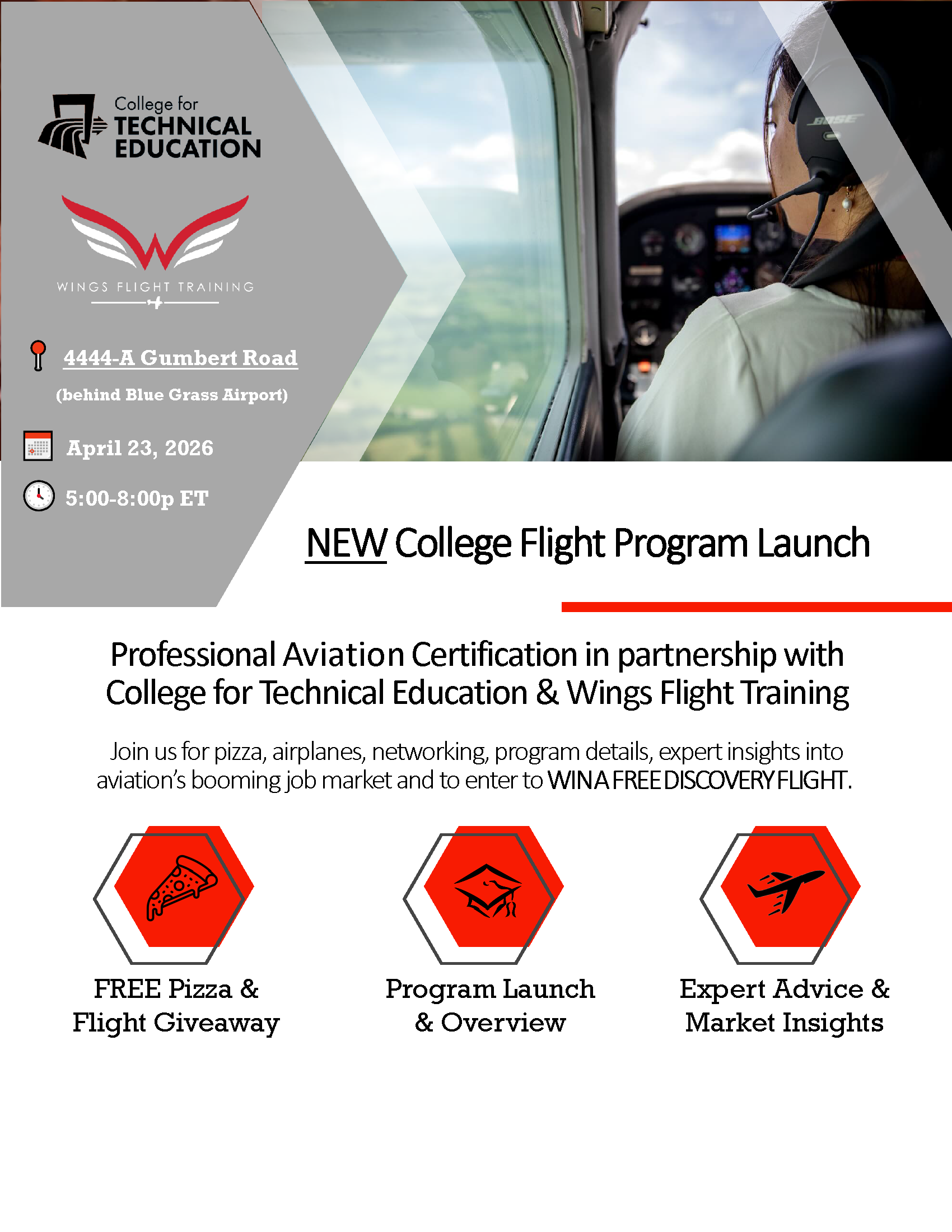
New College Flight Program Launch flyer - Professional Aviation Certification in partnership with College for Technical Education and Wings Flight Training

Frequently Asked Questions

What is the job market for professional pilots?
Right now is an ideal time to start flight training. The pilot-shortage crisis that the industry faced in 2017, 2018, and 2019 was only paused briefly by the COVID-19 pandemic. The demand for air travel slumped during the pandemic but bounced back to exceed pre-pandemic demand in 2023, and there is a full-fledge workforce shortage that is forecasted to worsen in the coming year and to last for the foreseeable future. This international pilot-shortage crisis is prompting airlines to pay higher salaries than ever before to compete for pilot talent, and many airlines are lowering entry-level hour minimums and offering $50,000 to $100,000 for incoming first officers to help them pay down their flight-training debt. PAC is a 21-month program, after which graduates become instructor pilots for another 15-20 months. Once they have gained those all-important flight hours (1,500 hours minimum), they can qualify to apply for an Airline Transport (ATP) license, making them eligible to be hired by airlines in less than four years from the program start date.
What is a typical career pathway?
After graduation, most students typically work at flight schools training other students while gaining the flight experience required to meet minimum qualifications for the Airline Transport Pilot (ATP) license, an FAA requirement for scheduled air carrier pilots and corporate aviation departments operating jet aircraft. Wings Flight Enterprises will certainly be looking to retain a good percentage of graduates for training subsequent classes of student pilots enrolled in PAC. Based on national averages, flight instructors can expect to earn $32,000-$45,000 per year, and after 15-20 months of flight instructing, graduates typically move on to be First Officers at regional airlines and charter flight departments, earning salaries of approximately $80,000 per year starting pay plus benefits and a signing bonus up to $100,000. Career pilots enjoy yearly raises and career progression that put the average salary after two years at over $122,000 per year, and Captains of international airlines earn $300,000+ per year working 10-13 days per month.
How are commercial and airline pilots different?
Airline pilots fly scheduled passenger or cargo flights and must hold an Airline Transport Pilot (ATP) license, the highest FAA qualification. However, all pilots must start their professional aviation careers by earning their private pilot licenses. Next, they earn instrument ratings to fly in the clouds and low visibility, and then they obtain a commercial pilot license before they can apply for an ATP license. There is a minimum of 1,500 hours of flight experience required to hold an ATP license, so commercial pilots most often choose to become flight instructors and work at a school teaching new pilots while building their hours before taking the ATP licensing exam.
Why choose this program over a 2 or 4 year degree?
PAC is an accelerated, targeted, vocational program for aspiring professional aviators that is more flexible, less time-consuming and faster than the rigid, full-time commitment required for an associate or bachelor’s degree in aviation. Since PAC only requires 15-20 hours of work each week, high school students can dual-enroll in PAC while finishing high school. This allows them to enter the aviation workforce 1-2 years ahead of their peers, which is valued at $150,000-$200,000 per year. PAC is also designed to attract returning adult students looking for an exciting new career. PAC allows them to work part-time to pay bills while earning their professional flight certifications. In fact, PAC is also a valuable alternative for traditional college students considering an aviation college or university. Specifically, PAC is not tied to an aviation degree, which allows our students to earn a degree in ANYTHING they choose while simultaneously earning their professional flight certifications. This has an advantage over aviation colleges whose degrees are generally related to aviation science or aviation management because those skills cannot be applied to earn money outside of aviation. PAC students, however, can earn degrees and certifications in areas outside of aviation, allowing them to work remotely while sitting around airports and hotels between flights.
Can I use my GI Bill/Veteran benefits?
Unfortunately, GI Bill benefits cannot currently be used for flight fees under Federal Aviation Regulation (FAR) Part 61, but we are working on FAR Part 141 approval for the PAC program that will allow GI Bill benefits to be used for flight fees.
What does a weekly schedule look like?
This program is built to maintain 9-12 hours of contact learning with instructors each week, and it is expected that students will spend at least another 6-8 hours of personal home study and flight preparation, for an estimated 15-20 hours per week on average. Students will spend three (3) hours in class one day per week. Additionally, students will be scheduled for three (3) 2.5-hour flight lessons each week. Ground school courses are scheduled according to the academic calendar: PPL in fall of year 1, IFR in spring of year 1, CPL in fall of year 2, and CFI / CFII in spring of year 2, but flight training is not as rigid. Flight training can start anytime, and PAC coordinators will work with your schedule to build a program that fits. Students will coordinate closely with their instructor on scheduling, and staying on track will require commitment to work around scheduling interruptions caused by weather and aircraft maintenance. Students should be prepared to make up cancelled flight lessons on any day of the week, including Sundays if required. Other outside commitments will need to be scheduled accordingly, and students must be flexible and ready to fly when the weather and aircraft availability allows.
How do I finance this?
Unfortunately, government-backed loans are not an option for flight training because the US Department of Education does not recognize flight training as an accredited educational activity despite the fact that flight training is tightly regulated by the FAA. Be that as it may, some banks, credit unions, and private lenders offer loans for aspiring professional aviators, and some airlines are offering sign-on bonuses big enough to pay back loans in full (up to $100,000). We invite you to secure your own lender and can recommend one of our preferred lenders after we have had a chance to review your financing plan. Loan eligibility depends on your credit history and in many cases requires a qualified co-signer. Scholarships and grants are also available at www.FlightScholarship.info, https://www.aopa.org/training-and-safety/learn-to-fly/aviation-scholarships, and https://www.natafoundation.org/education/scholarships/. Be sure to also check out financing options from both Stratus and Flight Training Finance.
Are there physical/medical limitations to becoming a pilot?
Yes. All students must obtain a Class 1 medical certification and submit a copy prior to enrollment in this program. A Class 1 medical certification ensures future employment as an Airline Transport Pilot (ATP). We will recommend a physician with the proper FAA certifications near you before you enroll.
Is insurance required?
We don’t recommend a specific provider, but an “insurance policy” from an independent insurance company (ex. Starr Link, AOPA, etc.) is required to provide bodily injury and property damage of at least $250,000 per occurrence and $25,000 per individual and property damage to the aircraft for at least $1,000 to protect students/renters in situations where they may be found negligent or responsible for damages. Avemco is another great provider when considering your insurance options. You can find special pricing for CTE students at this link.

Last updated

Other Programs at Lexington Campus

College for Technical Education in Lexington, KY also offers these 5 programs at 1165 Centre Parkway, Suite 140, Lexington, KY 40517.

College for Technical Education

Building Trades Technician

Certificate

On-CampusFinancial Aid
Lexington Campus
Lexington, KY
Next start
Nov 9, 2026
Duration
36 Weeks
900 clock hours / 46 credits
App fee
None
Tuition
$13,400 for the Program
College for Technical Education

Business Operations

Certificate

OnlineFinancial Aid
Lexington Campus
Online · 100% remote
Next start
Oct 26, 2026
Duration
36 Weeks
600 clock hours / 36 credits
App fee
None
Tuition
$8,500 for the Program
College for Technical Education

Hair Extension Certification

Certificate

On-CampusFinancial Aid
Lexington Campus
Lexington, KY
Next start
Rolling enrollment
Duration
1 Day
8 hours (1 day)
App fee
None
Tuition
$1,500 for the Program
College for Technical Education

Lash Artistry Certification

Certificate

On-CampusFinancial Aid
Lexington Campus
Lexington, KY
Next start
Rolling enrollment
Duration
1 Day
8 hours (1 day)
App fee
None
Tuition
$1,550 for the Program
College for Technical Education

Medical Assistant

Certificate

HybridFinancial Aid
Lexington Campus
Lexington, KY
Next start
Nov 30, 2026
Duration
39 Weeks
915 clock hours / 47 credits
App fee
None
Tuition
$12,500 for the Program
Ready to get started?
Request information about Professional Aviation at Lexington Campus.
Professional Aviation