Heating, Ventilation, Air Conditioning, and Refrigeration is an Associate In Specialized Technology Degree program (Hybrid) offered by Douglas Education Center in Monessen, PA. The program takes 16 months to complete, with a total tuition of $21,200.
Program Overview
Train for the systems that keep homes and businesses running. The HVACR program prepares students for entry-level employment in the heating, ventilation, air conditioning, and refrigeration trade. Students receive hands-on training in residential and commercial heating systems, refrigeration, air conditioning, and hydronic systems, with an emphasis on installation, maintenance, and repair.
Training also covers load calculations, psychrometrics, sheet metal fabrication, ductwork installation, motor controls, programmable logic controllers, chiller systems, and advanced troubleshooting diagnostics. Students develop additional skills in project management, estimating, blueprint reading, customer service, safety, energy efficiency, and environmental responsibility.
Skills you’ll walk out with.
- Install, maintain, and repair residential and light commercial heating systems.
- Install, maintain, and repair residential and light commercial air conditioning and refrigeration systems.
- Diagnose mechanical, electrical, and electronic HVACR components.
- Use common HVACR hand tools, power tools, and digital instruments.
- Read blueprints and apply measurements and mathematical principles to HVACR work.
- Perform preventive maintenance designed to support system performance and efficiency.
- Follow workplace safety practices, codes, regulations, and proper PPE procedures.
- Prepare for employment through resume development, interview practice, and workplace-readiness training.
What sets this Program apart
Industry-recognized credentials. Students in this program are eligible to earn industry-recognized credentials, including the Occupational Safety and Health Administration (OSHA) 10-Hour Certification, Environmental Protection Agency (EPA) Section 608 Certification, and North American Technician Excellence (NATE) Certification.
Admission Requirements and Process
A prospective student seeking admission to DEC must be a high school graduate or possess a General Education Development (GED) Diploma or recognized equivalency certificate. All programs require successful completion of the Wonderlic Scholastic Level Examination with a minimum score of 17. DEC admits, trains and refers students without regard to race, religion, age, national origin, sex or handicap. DEC is not authorized to enroll international students. The AST programs also require an admissions interview, the “Student Acknowledgement for Online Education,” the “Are You Ready for Online Education?” assessment and an Online Basic Computer Literacy Assessment (minimum score 70%).
General Requirements
- High school diploma or GEDYou must be a high school graduate or possess a General Education Development (GED) Diploma or recognized equivalency certificate; high school seniors may submit a partial…
- Application and feesComplete an application form and pay a one-time application fee ($50.00) and one-time registration fee ($100.00); both are fully refundable if the applicant is denied acceptance.
- Official transcriptRequest that an official high school transcript be sent directly to the Admissions Department; GED holders must submit official evidence of satisfactory performance.
- Wonderlic Scholastic Level ExamSuccessfully complete the Wonderlic Scholastic Level Examination with a minimum score of 17; a maximum of 3 attempts will be granted.
- Online education readinessSign the “Student Acknowledgement for Online Education,” complete the assessment “Are You Ready for Online Education?” and pass an “Online Basic Computer Literacy Assessment” with…
- Admissions interviewThe Admissions Department will contact all applicants via telephone, postal mail, and/or email to schedule an interview.
- Enrollment AgreementSign an Enrollment Agreement, the contractual agreement between the student and the school; those accepted receive a formal letter of acceptance.
Application Process
- 1Complete the online applicationApply online and pay the $50 application fee; a $100 registration fee is also required. You can pay online, over the phone, or in person.
- 2Admissions reaches outThe Admissions Department will contact you to confirm your application status and next steps.
- 3Send your high school transcriptSubmit an official high school transcript directly to the Admissions Department; applicants with a GED must provide official evidence of satisfactory performance. Transfer-of-credit requests also need official post-secondary transcripts and course descriptions.
- 4Admissions interview and Wonderlic examThe Admissions Department will schedule your interview and the Wonderlic Scholastic Level Examination; a minimum score of 17 is required.
- 5Sign your Enrollment AgreementThis is the contractual agreement between you and the school. Accepted applicants receive a formal letter of acceptance.
- 6Complete your FAFSAFile the FAFSA at studentaid.gov using DEC’s Federal School Code 013957, then complete the steps in the Financial Aid Student Portal to receive your Financial Aid Award Notification.FAFSA Code for Monessen: 013957
Program Schedule
The Heating, Ventilation, Air Conditioning, and Refrigeration Program, as well as the Residential and Commercial Electrician Program, have classes scheduled weekdays between 8:30 AM and 7:00 PM. In general, students attend 4 days per week, no more than 10 hours per day, for a total of 20-30 hours a week.
Applied general education courses are offered in a hybrid format (2.5 hours online and 2.5 hours on-ground); technical courses are residential. Instruction takes place at DEC’s Skilled Trades Facility, located on DEC’s Monessen campus at 30 Donner Place.
The program enrolls every February, June and October; the first start was October 1, 2026. Upcoming starts are February 9, 2027, June 9, 2027 and October 6, 2027.
- February 09th, 2027
- June 09th, 2027
- October 06th, 2027
Cost of Attendance and Financial Aid Information
Cost and fees (Catalog Vol. 69). Tuition is $5,300 per semester ($21,200 for 4 semesters). Program totals: application fee $50, registration fee $100, graduation fee $215, books $1,285, supplies $2,850, exams and certificates $625, lab fee $800, technology fee $600 and student support services fee $1,300, for a program total of $29,025.
Per credit. $325/credit when a student attends less than 12 or more than 17 credits per term.
Scholarships. The T.R.A.D.E.S. Scholarship is worth $5,300 (25% of tuition) for new HVACR students.
Federal student aid. DEC is approved by the U.S. Department of Education for federal student financial assistance programs including the Federal Pell Grant, FSEOG, Federal Work Study and William D. Ford Federal Direct Loans (Subsidized, Unsubsidized and Parent PLUS). Complete the FAFSA at studentaid.gov using DEC’s Federal School Code 013957.
Payment. DEC accepts financial aid, agency funding (Veterans, Vocational Rehabilitation, job retraining benefits), cash, check, credit card and online payment at www.dec.edu/pay. Payment schedules are interest-free and do not extend beyond the semester or instructional period.
Veterans. DEC is approved by the Pennsylvania Department of Education for the training of veterans; eligible students may use the GI Bill® at DEC.
Curriculum
Associate in Specialized Technology Degree Program / 60 weeks / 4 semesters: 555 didactic and 945 supervised lab hours, 66 credits.
Required Courses
| Subject # | Name | Credits |
|---|---|---|
Career Outcomes
Students will graduate ready for entry-level opportunities in HVACR, and are eligible to earn industry-recognized credentials. The program prepares graduates to pursue entry-level opportunities in HVACR installation, maintenance, repair, service, refrigeration, controls, building automation, and facility maintenance.
What to expect as a Douglas Education Center student
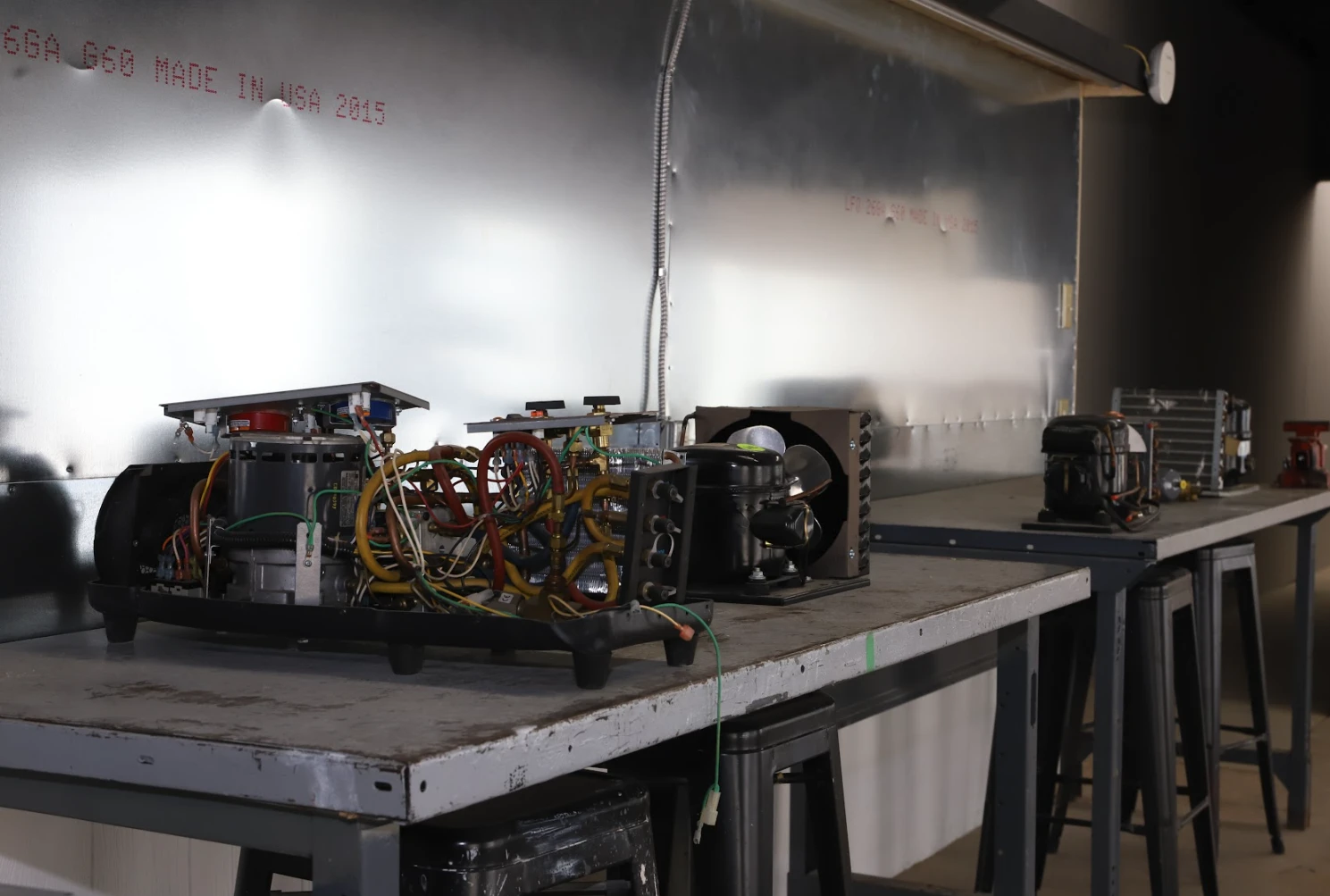
Skilled Trades Center. 30 Donner Place is a multipurpose facility which has been designed and developed to facilitate many options for education. The skilled trade programs are held here while the CDL and Heavy Equipment program will also have off-site locations for driving. Along with classrooms and computer labs, the building contains required equipment for each Skilled Trade program. This includes designated areas for Electrical and HVAC-R operations with necessary machinery, truck driving simulators, and replicas of many items used on a job site.
Career Services for life. DEC graduates have access to Career Services for life at no cost. The team works with students from the time they begin their program through graduation and after, helping with resumes, portfolios, mock interviews and job search strategies.
Campus Address
Why Accreditation Is Important
Douglas Education Center is accredited by the Accrediting Commission of Career Schools and Colleges (ACCSC), a recognized accrediting agency by the U.S. Department of Education. DEC is licensed by the Commonwealth of Pennsylvania Department of Education, State Board of Private Licensed Schools.
- A reliable indicator of quality
- Approved program of study
- Qualified instructors
- Recognition by employers nationwide
Accreditations
Images