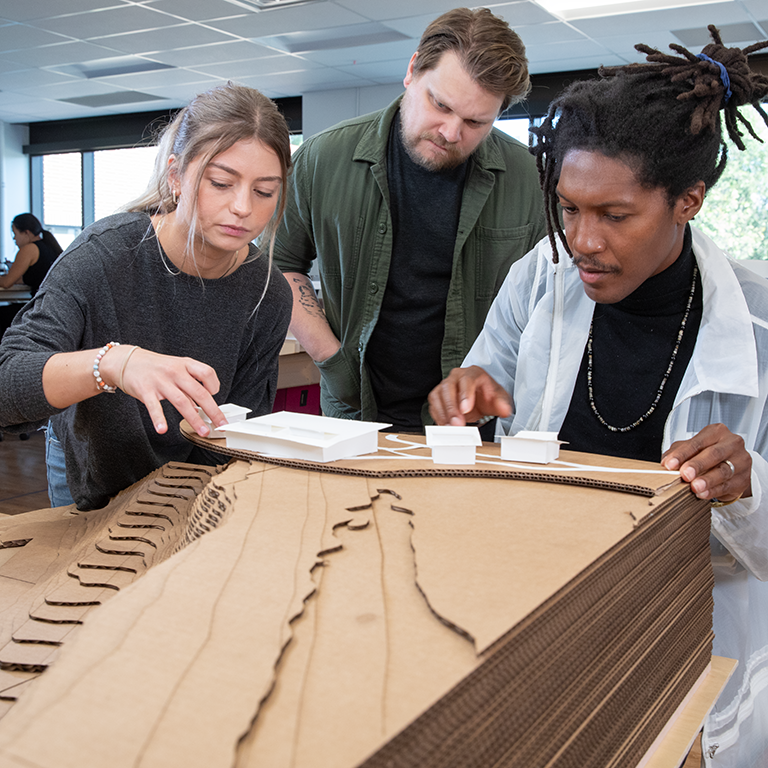

Architecture is a Bachelor Degree program offered by Dunwoody College of Technology in Minneapolis, MN. The program takes 3 years (after a 2-year AAS) to complete, with a total tuition of $97,896.
Program Overview
Dunwoody Architecture is uniquely structured as a two plus three stackable credential, awarding a technical Associate of Applied Science degree after the first two years and a comprehensive professional Bachelor of Architecture (B.Arch.) degree after the final three years. This structure allows students from other technical and community colleges to seamlessly transfer into year three of Dunwoody’s program.
The school roots its architectural education in a tradition of community engagement, social responsibility, and leadership in the profession, both locally and globally. Our distinctive position within a college of technology gives us access to collaborations across a variety of technical disciplines. Our students work intimately with fabrication labs, participate in design-build projects, and engage in global activism and climate initiatives, from Minneapolis to Puerto Rico.
Bachelor of Architecture students receive a dedicated touch-screen laptop with a suite of Autodesk and Adobe programs to be used as long as they are enrolled as students.
In addition to an ever increasing number of merit and need based scholarships, practice-based curriculum, professional-focused philosophy, and actively-practicing faculty give you the ability to work in the profession while in school. This can defray the cost of education, make you more valuable earlier in your career and allow you to complete all required experience for licensure prior to graduation.
Dunwoody’s Bachelor of Architecture is accredited by the National Architectural Accrediting Board (NAAB). In accordance with NAAB standards, the Bachelor of Architecture maintains a Learning and Teaching Culture Policy.
The Bachelor of Architecture program has been accepted into the Integrated Path to Architectural Licensure (IPAL) initiative, which offers students the opportunity to earn an architecture license upon graduation.
International Students. This program is an official STEM Designated Degree Program, as listed by the Department of Homeland Security (DHS) qualifying it to fulfill the STEM Optional Practical Training (OPT) extension requirement for the F-1 student visa.
Transfer Students. Students transferring into Dunwoody will meet all NAAB standards in courses completed in Years 3-5, allowing for transfer of non-accredited degrees while maintaining the standards. If a student completes a non-accredited degree and attempts to transfer in more than one upper-division course that fulfill the same NAAB standards, the course description and syllabus, along with examples of the student’s work (as applicable), will be evaluated by the department to verify that the relevant NAAB standard has been met. If the NAAB standard from the corresponding Dunwoody courses has not been met, the course will not be transferred, and the student must complete the relevant course(s) at Dunwoody.
The +3 completion degree is structured as follows:
YEAR 3. This first year of the +3 B.Arch. program has a heavy emphasis on design thinking by working with hands-on techniques of physical model making and 2D-representation using a suite of Autodesk and Adobe programs. This year introduces students to city and site, client and program, and the global history of architecture, including diverse traditions in the built environment.
YEAR 4. The fourth year studios emphasizes research and participatory models of community engagement using real world projects. The history and theory curriculum deepens to include a study of urbanism, activism, globalization, and the vernacular. Students are often involved in study abroad programs or design-build and fabrication projects, gaining expertise in 3D-representation and fabrication techniques in addition to broadening their knowledge of culture and society.
YEAR 5. The final year of the Bachelor of Architecture culminates in two distinctive studios: the first half of the year is dedicated to a technically rigorous, integrative studio, and the second half complements this technical rigor with a highly individualized, experimental, and exploratory studio project that enables students to develop deep and focused expertise in one area, whether that be design build, fabrication, climate justice and architecture, or some other specific topic.
What sets this Program apart
Facilities used in this program include:
Design Studios. Work in open concept studio spaces designed to foster collaboration and learning with students in the School of Design.
- Individual work spaces
- Drafting kits
- Physical modeling kits
- Wall and table spaces for displaying/reviewing designs
Fabrication Lab. The Fabrication Lab is a place to get hands on experience with materials and tools for building three dimensional objects. Bring your designs to life as you work with wood, plastic, metal, cardboard and more.
- Laser cutter- Requires DXF file
- CNC Router- Requires DXF or STL file
- 3D printer- Requires STL file
- CAD table
- Band saw
- Drill press
- Spray booth
- Hot wire cutter
- Hand drills
- Saws- jigsaw, Sawzall, track saw, hand saws
- Chisels
- Soldering iron
- Many hand tools
Admission Requirements and Process
Students applying for admission to Dunwoody College of Technology must provide a final, official high school transcript (with graduation date) or a GED score from a recognized GED testing center. Admission decisions are based on a careful, overall assessment of each student’s academic preparation and performance, as well as the additional information provided in the application. Additional requirements may be required for certain programs.
Program requirements. Students who have completed their AAS degree (or other two-year degree) in an architectural drafting or related program are eligible to transfer into the +3 Bachelor of Architecture (up to 45 technical credits).
General Requirements
- Two-year architectural degreeStudents who have completed their AAS degree (or other two-year degree) in an architectural drafting or related program are eligible to transfer into the +3 Bachelor of…
- High school diploma or GEDProvide a final, official high school transcript (with graduation date) or a GED score from a recognized GED testing center.
- College transcriptsIf you have completed college credits and intend to apply for federal financial aid, or want the credits considered for transfer, an official transcript from that institution is…
- Admission reviewAdmission decisions weigh coursework through high school graduation, any previous college-level coursework, grade point average and the application essay.
- Test scores optionalACT, SAT or PSAT scores are considered if available but are not required.
- ImmunizationMinnesota law (M.S. 135A.14) requires students born after 1956 to be immunized against diphtheria, tetanus, measles, mumps and rubella; accepted students fill out an immunization…
- OrientationOrientation is an enrollment requirement for all new students; admitted students are mailed information on Orientation sessions.
Application Process
- 1Fill out an application for admissionRegister for Dunwoody’s Admissions portal and start your application; you can save your progress and come back to it.
- 2Provide official transcriptsRequest official transcripts from all educational institutions attended (including high school), sent directly to the Dunwoody Admissions Office, or have your GED scores sent.
- 3Personal interviewA personal interview with an Admissions Counselor is recommended to ensure Dunwoody is the right fit for your educational and career goals.
- 4Admissions decisionYour completed file goes to the admissions committee, which meets once a week; students are notified of decisions within four business days.
- 5Apply for financial aidComplete the FAFSA (Dunwoody school code 004641); a completed FAFSA is also required to be considered for Dunwoody scholarships.FAFSA Code for Minneapolis Campus: 004641Complete FAFSA Application
- 6Attend orientationAdmitted students are mailed information on Orientation, an enrollment requirement for all new students, where they receive their class schedule and student ID.
Program Schedule
Length of program. 3 years (6 semesters).
Classes offered. Day; Distance Learning.
Available starts. Fall Semester.
Upcoming start dates. August 30, 2027 (per the 2026-2027 academic calendar).
- August 30th, 2027
Cost of Attendance and Financial Aid Information
Program cost (2026-27). Total program tuition is $97,896 (Year 3: $32,586; Year 4: $32,586; Year 5: $32,724). Required fees (device) total $2,334 and books, supplies, materials and course/program fees total $808, for an estimated total program cost of $101,038.
Cost of attendance. For the 2025-26 academic year Dunwoody lists average annual costs (which vary by program) of $27,704 tuition, $744 books and supplies and $710 fees, plus living expenses of $3,898 food, $11,766 on-campus or $12,106 off-campus housing, $2,000 transportation and $2,200 miscellaneous.
Financial aid. Most Dunwoody students receive some form of financial aid, including federal and state grants, federal loans and work study. Start by completing the Free Application for Federal Student Aid (FAFSA); Dunwoody’s federal school code is 004641. A completed FAFSA is also required to be considered for Dunwoody scholarships, and each year Dunwoody gives out nearly $4 million in scholarship funding.
Minnesota programs. Dunwoody participates in the Minnesota State Grant, Dream Act, Postsecondary Child Care Grant, GI Bill Scholarship, Indian Scholarship, Fostering Independence Grant, State Work-Study and SELF Loan programs.
Veterans. The Department of Veterans Affairs recognizes Dunwoody as a Benefits Eligible College, and Dunwoody is a Yellow Ribbon School. Dunwoody waives the application fee and enrollment fees for veterans and military students.
Payment plans. Dunwoody offers a payment plan option for students to divide the balance owed each semester into smaller payments; students must enroll in the payment plan each semester.
Curriculum
The Architecture (BARCH), Bachelor of Architecture requires 150 credits. By the end of this program, students will be able to:
- Collaborate on design solutions.
- Demonstrate professionalism, ethics, and leadership.
- Constructively review and critique and welcome feedback.
- Communicate visually and verbally with a variety of stakeholders.
- Apply knowledge of human experience and global context to design solutions.
- Apply the design process.
- Apply the principles and elements of design.
- Documentation and integration of design solutions.
- Utilize standards that protect the health, safety, and well-being of stakeholders.
- Demonstrate knowledge and responsibility for sustainable design.
- Demonstrate technical knowledge.
Class topics include:
- City & Site, Site & Precedent, Program & Society
- Global History of Architecture, Metropolis & Activism, Research
- Ordering Systems, Fabrication, Material Studies
- Professional Practice, Business Management, Entrepreneurship
Required Courses
| Subject # | Name | Credits |
|---|---|---|
Career Outcomes
Common job titles. Possible job titles upon graduation include:
- Architectural Designer
- Architect
- Project Architect
- Project Manager
- Senior Designer
- Job Captain
2024-25 graduate outcomes. Of 34 Architecture graduates in 2024-25, the in-field employment rate was 87% and the career outcomes rate was 97% (Dunwoody Career Services Annual Report 2024-2025; employment recorded up to six months after graduation).
Average salary. $63K (School of Design, Bachelor of Architecture; 2023-24 Dunwoody Career Services Annual Report, as shown on the program page).
What to expect as a Dunwoody College of Technology student
Student organizations. Opportunities to get involved outside of the classroom include:
- American Institute of Architecture Students (AIAS)
- Women In Architecture (WIA)
- National Organization of Minority Architecture Students (NOMA)
- Construction Specifications Institute (CSI)
Campus Address
Why Accreditation Is Important
Dunwoody College of Technology is accredited by the Higher Learning Commission (HLC) and registered with the Minnesota Office of Higher Education. The Bachelor of Architecture is accredited by the National Architectural Accrediting Board (NAAB): accredited January 1, 2023, awarded 8 years through 2031.
- A reliable indicator of quality
- Approved program of study
- Qualified instructors
- Recognition by employers nationwide
Accreditations

Student Demographics
These are demographics for all students at the Minneapolis Campus (IPEDS, 2024).
Percentages are of total fall enrollment. 9 students whose race or ethnicity was not reported are included in that total but shown as no category, so the figures above come to 99.4% rather than 100%.
Testimonials

Images