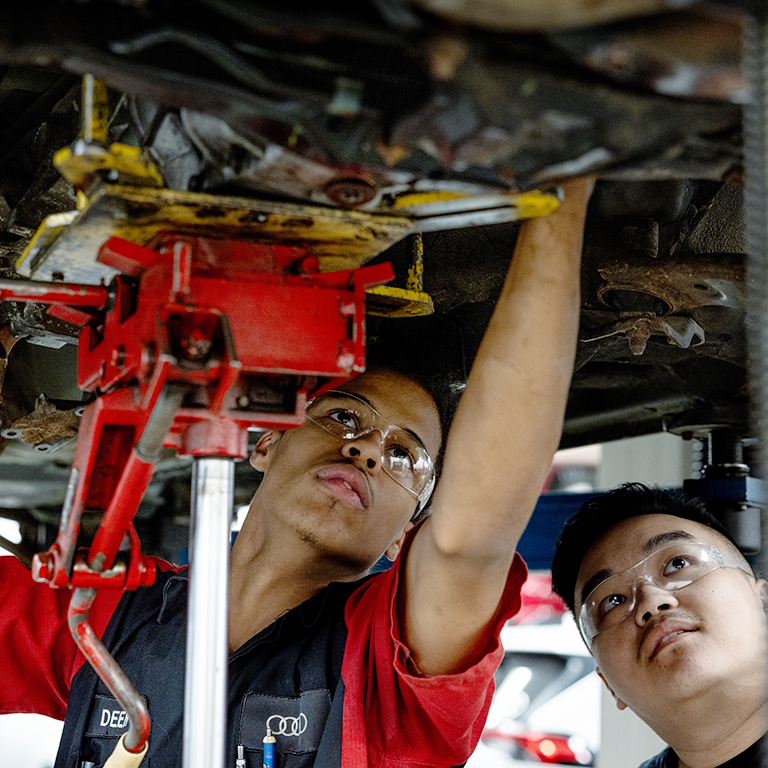

Automotive Service Technology is an Associate Degree program offered by Dunwoody College of Technology in Minneapolis, MN. The program takes 2 years to complete, with a total tuition of $56,814.
Program Overview
Dunwoody Automotive Service Technology prepares you to work at leading dealerships and independent repair shops. Train on industry-standard equipment, learn how to diagnosis and repair vehicles, and grow your professional network through internship opportunities.
Daily projects and lab time will include work on a variety of vehicles and static displays—including both late model imports and domestics. Many of these cars were donated new directly from the manufacturers themselves, which illustrates Dunwoody’s strong partnership with industry.
Use of all of Dunwoody lab tools and materials is available to you at no extra cost. And instruction comes from ASE-certified instructors, which means you will be learning from professionals who have worked in—and have been certified by—the automotive industry.
Upon graduation, you will be prepared for ASE certification tests in eight skill categories, ensuring you can do your job—and do it well—on day one.
Dunwoody’s Automotive Service training was one of the first programs offered when Dunwoody College was established in 1914. This demonstrates the program’s long heritage and experience in Automotive Education.
The Automotive Service Excellence (ASE) Education Foundation has accredited Dunwoody’s Automotive Service Technology program in Master Automobile Service Technology—the highest level of achievement recognized by the ASE Education Foundation.
To learn more, contact Robert Larkin at rlarkin@dunwoody.edu or 612.381.3316.
This degree directly transfers into Dunwoody’s Bachelor of Science in Business Management & Leadership.
Manufacturer Specific Add-On Credentials. Students who enroll in the Automotive Service Technology program also have the option of adding on a manufacturer-specific credential. Students complete online training modules on their own time. Access to the training modules is available 24/7 at no additional cost to the student. Options include:
- Audi Education Partnership
- MB Campus (Mercedes-Benz)
- MoparCAP Local
- Subaru Knowledge, Information, & Learning
What sets this Program apart
Facilities used in this program include:
Automotive Service Lab. A full-service automotive lab, including service desk, and more than 30 service bays
- All DATA and Identifix automotive service information resources
- Automotive scan tools and other diagnostic tools
- Alignment system; practice units for engines, transmissions, transfer cases, etc.
- An abundance of tools used in automotive service and repair
- Honda PACT, MoparCAP (MCAP), and Toyota TTEN programs utilize original equipment manufacturer (OEM) service information, vehicles, tools, and equipment
Admission Requirements and Process
Students applying for admission to Dunwoody College of Technology must provide a final, official high school transcript (with graduation date) or a GED score from a recognized GED testing center. Admission decisions are based on a careful, overall assessment of each student’s academic preparation and performance, as well as the additional information provided in the application. Additional requirements may be required for certain programs.
General Requirements
- High school diploma or GEDProvide a final, official high school transcript (with graduation date) or a GED score from a recognized GED testing center.
- College transcriptsIf you have completed college credits and intend to apply for federal financial aid, or want the credits considered for transfer, an official transcript from that institution is…
- Admission reviewAdmission decisions weigh coursework through high school graduation, any previous college-level coursework, grade point average and the application essay.
- Test scores optionalACT, SAT or PSAT scores are considered if available but are not required.
- ImmunizationMinnesota law (M.S. 135A.14) requires students born after 1956 to be immunized against diphtheria, tetanus, measles, mumps and rubella; accepted students fill out an immunization…
- OrientationOrientation is an enrollment requirement for all new students; admitted students are mailed information on Orientation sessions.
Application Process
- 1Fill out an application for admissionRegister for Dunwoody’s Admissions portal and start your application; you can save your progress and come back to it.
- 2Provide official transcriptsRequest official transcripts from all educational institutions attended (including high school), sent directly to the Dunwoody Admissions Office, or have your GED scores sent.
- 3Personal interviewA personal interview with an Admissions Counselor is recommended to ensure Dunwoody is the right fit for your educational and career goals.
- 4Admissions decisionYour completed file goes to the admissions committee, which meets once a week; students are notified of decisions within four business days.
- 5Apply for financial aidComplete the FAFSA (Dunwoody school code 004641); a completed FAFSA is also required to be considered for Dunwoody scholarships.FAFSA Code for Minneapolis Campus: 004641Complete FAFSA Application
- 6Attend orientationAdmitted students are mailed information on Orientation, an enrollment requirement for all new students, where they receive their class schedule and student ID.
Program Schedule
Length of program. 2 years (4 semesters).
Classes offered. Day.
Available starts. Fall Semester.
Upcoming start dates. August 30, 2027 (per the 2026-2027 academic calendar).
- August 30th, 2027
Cost of Attendance and Financial Aid Information
Program cost (2026-27). Total program tuition is $56,814 (Year 1: $29,772; Year 2: $27,042). Required fees (device) total $996, for an estimated total program cost of $57,810.
Cost of attendance. For the 2025-26 academic year Dunwoody lists average annual costs (which vary by program) of $27,704 tuition, $744 books and supplies and $710 fees, plus living expenses of $3,898 food, $11,766 on-campus or $12,106 off-campus housing, $2,000 transportation and $2,200 miscellaneous.
Financial aid. Most Dunwoody students receive some form of financial aid, including federal and state grants, federal loans and work study. Start by completing the Free Application for Federal Student Aid (FAFSA); Dunwoody’s federal school code is 004641. A completed FAFSA is also required to be considered for Dunwoody scholarships, and each year Dunwoody gives out nearly $4 million in scholarship funding.
Minnesota programs. Dunwoody participates in the Minnesota State Grant, Dream Act, Postsecondary Child Care Grant, GI Bill Scholarship, Indian Scholarship, Fostering Independence Grant, State Work-Study and SELF Loan programs.
Veterans. The Department of Veterans Affairs recognizes Dunwoody as a Benefits Eligible College, and Dunwoody is a Yellow Ribbon School. Dunwoody waives the application fee and enrollment fees for veterans and military students.
Payment plans. Dunwoody offers a payment plan option for students to divide the balance owed each semester into smaller payments; students must enroll in the payment plan each semester.
Curriculum
The Automotive Service Technology (AUTO), AAS requires 64 credits. By the end of this program, students will be able to:
- Identify and describe automobile components.
- Explain automotive systems' operations.
- Disassemble and assemble components.
- Diagnose vehicle conditions.
- Evaluate component condition and recommend action.
- Repair conditions and verify operation.
- Demonstrate effective customer satisfaction techniques.
- Demonstrate effective use of service information.
Class topics include:
- Brakes, Steering & Suspensions
- Electrical & Electronic Principles
- Engine Repair
- Automatic Transmissions
- Accessories, Heating & Air Conditioning
- Engine Performance
- Drivetrain
Required Courses
| Subject # | Name | Credits |
|---|---|---|
Career Outcomes
Common job titles. Possible job titles upon graduation include:
- Automotive Service Technician
- General Service Technician
- Light Duty Technician
- Master Technician
Recent employers of graduates. Companies that hire our graduates include:
- Bobby & Steve’s Auto World
- Carousel Motor Group
- Honest-1
- Luther Automotive Group
- Superior Service Center
- Walser Automotive Group
2024-25 graduate outcomes. Of 25 Automotive Service Technology graduates in 2024-25, the in-field employment rate was 87% and the career outcomes rate was 100% (Dunwoody Career Services Annual Report 2024-2025; employment recorded up to six months after graduation).
Average salary. $41K (Automotive, A.A.S.; 2023-24 Dunwoody Career Services Annual Report, as shown on the program page).
What to expect as a Dunwoody College of Technology student
Student organizations. Opportunities to get involved outside of the classroom include:
- Baja Club
- Shell Eco Marathon
- Phi Theta Kappa Honor Society (PTK)
- SkillsUSA
- Student Government Association (SGA)
Campus Address
Why Accreditation Is Important
Dunwoody College of Technology is accredited by the Higher Learning Commission (HLC) and registered with the Minnesota Office of Higher Education. Automotive Service Technology is accredited by the ASE Education Foundation through December 1, 2029 (initial accreditation May 1994).
- A reliable indicator of quality
- Approved program of study
- Qualified instructors
- Recognition by employers nationwide
Accreditations

Student Demographics
These are demographics for all students at the Minneapolis Campus (IPEDS, 2024).
Percentages are of total fall enrollment. 9 students whose race or ethnicity was not reported are included in that total but shown as no category, so the figures above come to 99.4% rather than 100%.
Images