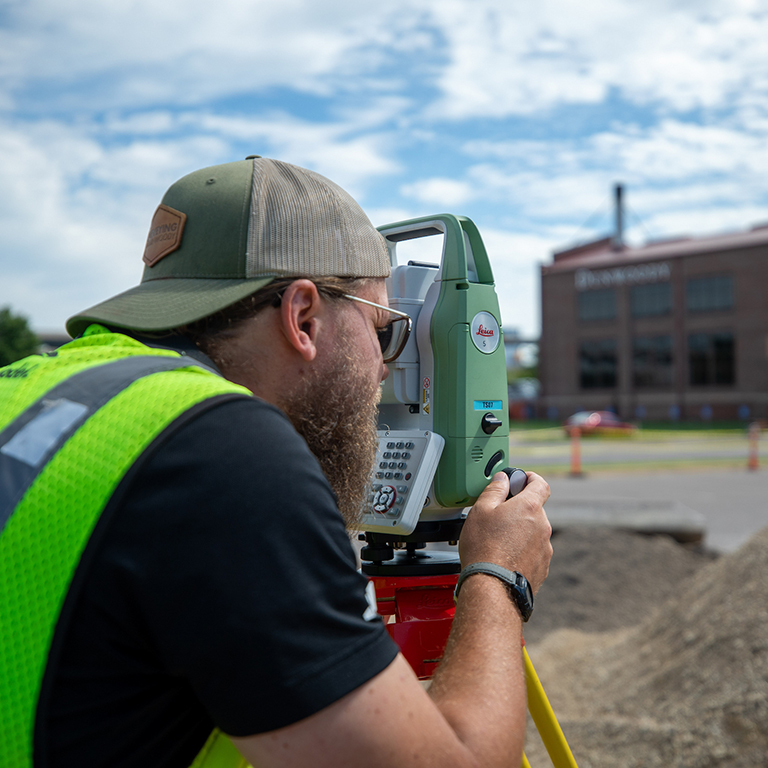

Civil Engineering is a Bachelor Degree program offered by Dunwoody College of Technology in Minneapolis, MN. The program takes 4 years to complete.
Program Overview
Dunwoody’s Bachelor of Science in Civil Engineering combines engineering theory with extensive hands-on lab, field, and project-based learning experiences to prepare graduates to design, build, and maintain the infrastructure that shapes our communities. Civil Engineering blends both creativity and engineering to create places and spaces that work both functionally and aesthetically.
As a student you will take courses in all five major civil engineering disciplines: structural, geotechnical, transportation, water resources, and environmental engineering. Topics range from soil mechanics and water engineering to topographic surveying and project management with a focus on design that works well with the physical site and how the structure will be used.
You also prepare to take the Fundamentals of Engineering exam, a key step in becoming a licensed civil engineer.
Small class sizes give you the chance to work closely with experienced instructors and network with your cohort as you move through your civil engineering courses.
Arts and sciences courses in the Hawk Core Curriculum help you understand the core mathematical and scientific principles that all engineering projects grow out of as well as provide you with the communication and critical thinking skills required to succeed in the profession.
During your final year, you will complete a multidisciplinary senior design project, which will help round out your professional portfolio.
What sets this Program apart
Facilities used in this program include:
Surveying Lab. Uses the Dunwoody campus and its environs as a lab for learning the tools and techniques used in surveying both outdoor and indoor spaces. SURVEYING EQUIPMENT:
- Sokkia Automatic & Digital Levels
- Trimble & Leica Total Stations
- Trimble & Topcon GNSS (GPS) Receivers & Data Collectors
- Phantom 3 & Phantom 4 Drones (used for photogrammetry & RTK surveying)
- Faro Laser Scanner
- Laptop Computers loaded with Industry Software
Engineering, Materials, Mechanics & Metrology Lab. Open to all manufacturing and engineering students (and those with training on the equipment), this lab brings together equipment for additive manufacturing, material testing, measurement, and CNC simulation.
- Two Stratasys Fortus 250 3D Printers
- One Stratasys F370 3D Printer
- One Fortus 400 3D Printer
- Two MakerBot 3D Printers
- Two Zeiss Duramax Coordinate Measurement Machines
- Two MTS Criterion Tensile/Shear/Compression Testers
- 7 Haas CNC Controller Simulators
- One Zeiss Stemi 305 Microscope
Admission Requirements and Process
Students applying for admission to Dunwoody College of Technology must provide a final, official high school transcript (with graduation date) or a GED score from a recognized GED testing center. At Dunwoody, students are accepted directly into the Civil Engineering program from day one.
General Requirements
- High school diploma or GEDProvide a final, official high school transcript (with graduation date) or a GED score from a recognized GED testing center.
- College transcriptsIf you have completed college credits and intend to apply for federal financial aid, or want the credits considered for transfer, an official transcript from that institution is…
- Admission reviewAdmission decisions weigh coursework through high school graduation, any previous college-level coursework, grade point average and the application essay.
- Test scores optionalACT, SAT or PSAT scores are considered if available but are not required.
- ImmunizationMinnesota law (M.S. 135A.14) requires students born after 1956 to be immunized against diphtheria, tetanus, measles, mumps and rubella; accepted students fill out an immunization…
- OrientationOrientation is an enrollment requirement for all new students; admitted students are mailed information on Orientation sessions.
Application Process
- 1Fill out an application for admissionRegister for Dunwoody’s Admissions portal and start your application; you can save your progress and come back to it.
- 2Provide official transcriptsRequest official transcripts from all educational institutions attended (including high school), sent directly to the Dunwoody Admissions Office, or have your GED scores sent.
- 3Personal interviewA personal interview with an Admissions Counselor is recommended to ensure Dunwoody is the right fit for your educational and career goals.
- 4Admissions decisionYour completed file goes to the admissions committee, which meets once a week; students are notified of decisions within four business days.
- 5Apply for financial aidComplete the FAFSA (Dunwoody school code 004641); a completed FAFSA is also required to be considered for Dunwoody scholarships.FAFSA Code for Minneapolis Campus: 004641Complete FAFSA Application
- 6Attend orientationAdmitted students are mailed information on Orientation, an enrollment requirement for all new students, where they receive their class schedule and student ID.
Program Schedule
Length of program. 4 years (8 semesters).
Classes offered. Day on Campus.
Available starts. Fall Semester only.
First graduates May 2031.
Cost of Attendance and Financial Aid Information
Civil Engineering (CVNG) does not yet appear on Dunwoody’s 2026-27 Program Pricing sheet or in the 2026-2027 Catalog/Student Handbook, so no tuition is published for it yet (the program’s first graduates are expected May 2031).
Average net price (college-wide). For context, Dunwoody’s average yearly net price after grants and scholarships for all aided students was $24,789 in 2022-23 (IPEDS). This is the college’s average for all aided students, not this program’s price.
Cost of attendance. For the 2025-26 academic year Dunwoody lists average annual costs (which vary by program) of $27,704 tuition, $744 books and supplies and $710 fees.
Financial aid. Start by completing the FAFSA; Dunwoody’s federal school code is 004641. Contact the Financial Aid Office at financialaid@dunwoody.edu or 612.381.3405 about this program.
Curriculum
The Civil Engineering (CVNG), Bachelor of Science requires 122 credits. Program outcomes:
- An ability to identify, formulate, and solve complex engineering problems by applying principles of engineering, science, and mathematics.
- An ability to apply engineering design to produce solutions that meet specified needs with consideration of public health, safety, and welfare as well as global, cultural, social, environmental, and economic factors.
- An ability to communicate effectively with a range of audiences.
- An ability to recognize ethical and professional responsibilities in engineering situations and make informed judgments, which must consider the impact of engineering solutions in global, economic, environmental, and societal contexts.
- An ability to function effectively on a team whose members together provide leadership, create a collaborative environment, establish goals, plan tasks, and meet objectives.
- An ability to develop and conduct appropriate experimentation, analyze and interpret data, and use engineering judgment to draw conclusions.
- An ability to acquire and apply new knowledge as needed, using appropriate learning strategies.
Required Courses
| Subject # | Name | Credits |
|---|---|---|
Career Outcomes
Common job titles. Possible job titles upon graduation include:
- Civil Engineer
- Pavement Engineer
- Structural Engineer
- Transportation Engineer / Traffic Engineer
- Water Engineer
- Environmental Engineer
- Project Manager / Project Engineer
- City Engineer / Municipal Engineer
- Bridge Engineer
Average salary. $69k for recent School of Engineering graduates (2024-25 Dunwoody Career Services Report, as shown on the program page).
What to expect as a Dunwoody College of Technology student
Student organizations. Opportunities to get involved outside of the classroom include:
- Baja Club (experimental vehicles)
- The Dunwoody Order of Student Engineers
- Robotic Snow Plow Team
- Shell Eco Marathon
- Society of Women Engineers (SWE)
Campus Address
Why Accreditation Is Important
Dunwoody College of Technology is accredited by the Higher Learning Commission (HLC) and registered with the Minnesota Office of Higher Education.
- A reliable indicator of quality
- Approved program of study
- Qualified instructors
- Recognition by employers nationwide
Accreditations

Student Demographics
These are demographics for all students at the Minneapolis Campus (IPEDS, 2024).
Percentages are of total fall enrollment. 9 students whose race or ethnicity was not reported are included in that total but shown as no category, so the figures above come to 99.4% rather than 100%.
Images