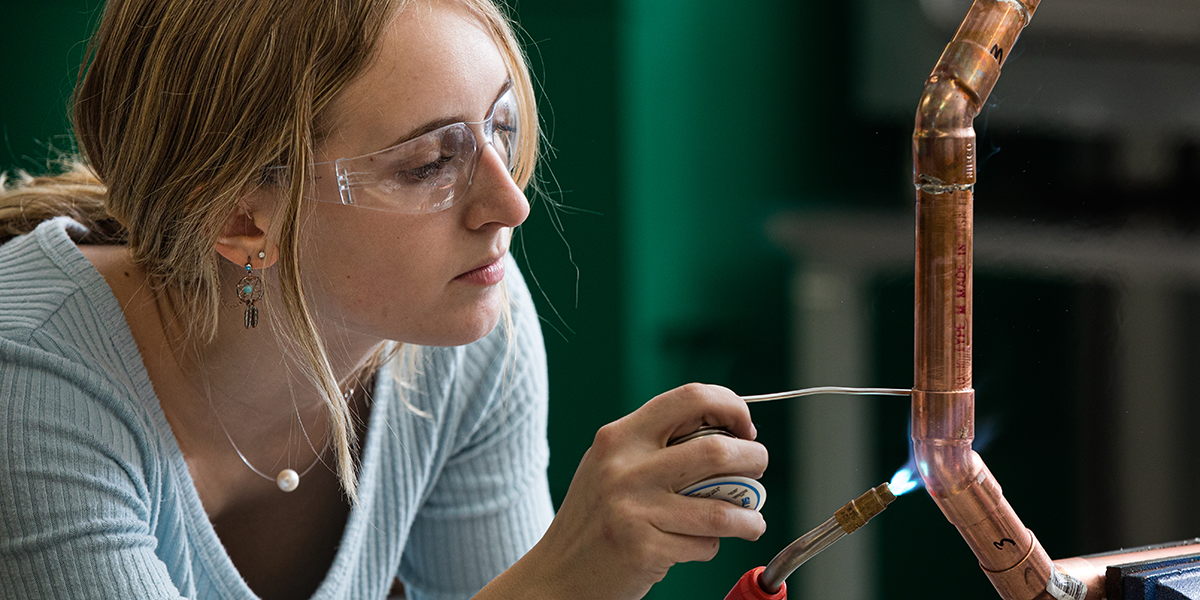

HVAC & Refrigeration Technology is an Associate Degree program offered by Dunwoody College of Technology in Minneapolis, MN. The program takes 2 years to complete, with a total tuition of $55,353.
Program Overview
The HVAC & Refrigeration Technology program teaches you to design, estimate, install, and maintain modern Heating, Ventilation, Air Conditioning and Refrigeration (HVACR) systems. Dunwoody’s program provides graduates the flexibility to go down various career paths in the industry and take on a wide variety of roles throughout their career.
With a thorough understanding of all aspects of HVACR systems upon graduation, you’ll be ready to join a pipefitters union or work for a residential and/or commercial HVACR service company, a construction or engineering services firm, or take on roles with organizations who need in-house HVACR and building controls and management expertise.
Through hands-on learning—taught by instructors with extensive industry experience—you will be prepared to maintain today’s complex HVACR systems, which consist of multiple mechanical, electrical, energy management, and electronic components. Conduct lab experimentations with industry-standard equipment and utilize computer and lab simulations to understand topics like heating systems, cooling systems, commercial and industrial refrigeration service, HVAC control concepts and building systems operations. Learn project management and estimating principles and software as well as how to fabricate and install duct fittings.
You’ll also receive one-on-one face time with local employers, who provide insights on career opportunities, what to expect in industry, and what types of employees they are looking for.
An OSHA 10 Construction Card is offered to students who successfully complete the required 10 hours of training.
You will also be prepared to take the Minnesota’s Special Engineers Boiler Operator License, which allows you to legally operate boilers; EPA Section 608 Certification by Esco Institute, which allows you to legally handle refrigerants, universally; and Hydrocarbon Refrigerants Certification, ensuring you have a solid understanding of the refrigeration cycle and proper handling of CFC, HCFC, and HFC refrigerants.
The program will prepare you to earn several HVAC Excellence certifications.
HVAC Excellence, the largest provider of certification in the HVACR industry, has accredited all of Dunwoody’s HVAC programs. This certification ensures that Dunwoody’s programs meet or exceed industry standards for quality technical education.
This degree directly transfers into Dunwoody’s Bachelor of Science in Construction Management or Bachelor of Science in Business Management & Leadership.
What sets this Program apart
Facilities used in this program include:
Commercial Heating, Air Conditioning, and Refrigeration Lab. Learn about the systems used to heat and air condition commercial spaces as well as equipment used in refrigeration of commercial goods such as perishable foods and medical supplies.
- 7 roof top units, 6 variable air volume boxes, 5 power roof ventilators, 1 chiller, and 3 make-up air units for air conditioning and ventilation
- 2 industrial burners, 2 commercial gas burners, 1 steam boiler and 2 heat pumps for heating
- 6 ice machines, 2 walk-in coolers, 2 walk in freezers, and a variety of reach-in coolers/freezers
- 10 VFD (Variable Frequency Drive) lab stations
Residential Heating & Air Conditioning Lab. Learn about the various types of furnaces and air conditioners used to heat and cool residential buildings.
- 6 high efficiency condensed force air furnaces and 14 mid-efficiency force air furnaces, all using diverse ignition systems
- 6 low efficiency furnaces using standing pilot and electronic ignition systems
- 6 oil-burning, high pressure gun furnaces that use primary control/cad cell ignition
- 3 electric forced air furnaces; 2 have PC board control; 1 uses sequencers
- 6 mid-to-high efficiency central air conditioners and 10 low-to-mid efficiency central air conditioners
- 5 air-to-air heat pumps using all fuel kits to interface with fossil fuel furnaces
- 1 air handler hooked up with supply ductwork
Electrical/Thermal Science Lab. Learn the basics of electrical and thermal science.
- Breadboards for electrical experiments and controls
- Equipment for BTU transfer, gain, and loss experiments
- A diverse array of air balancing testers and tools
HVAC Installation Lab.
- Sheet Metalworking Floor and Hand Tools
Admission Requirements and Process
Students applying for admission to Dunwoody College of Technology must provide a final, official high school transcript (with graduation date) or a GED score from a recognized GED testing center. Admission decisions are based on a careful, overall assessment of each student’s academic preparation and performance, as well as the additional information provided in the application. Additional requirements may be required for certain programs.
General Requirements
- High school diploma or GEDProvide a final, official high school transcript (with graduation date) or a GED score from a recognized GED testing center.
- College transcriptsIf you have completed college credits and intend to apply for federal financial aid, or want the credits considered for transfer, an official transcript from that institution is…
- Admission reviewAdmission decisions weigh coursework through high school graduation, any previous college-level coursework, grade point average and the application essay.
- Test scores optionalACT, SAT or PSAT scores are considered if available but are not required.
- ImmunizationMinnesota law (M.S. 135A.14) requires students born after 1956 to be immunized against diphtheria, tetanus, measles, mumps and rubella; accepted students fill out an immunization…
- OrientationOrientation is an enrollment requirement for all new students; admitted students are mailed information on Orientation sessions.
Application Process
- 1Fill out an application for admissionRegister for Dunwoody’s Admissions portal and start your application; you can save your progress and come back to it.
- 2Provide official transcriptsRequest official transcripts from all educational institutions attended (including high school), sent directly to the Dunwoody Admissions Office, or have your GED scores sent.
- 3Personal interviewA personal interview with an Admissions Counselor is recommended to ensure Dunwoody is the right fit for your educational and career goals.
- 4Admissions decisionYour completed file goes to the admissions committee, which meets once a week; students are notified of decisions within four business days.
- 5Apply for financial aidComplete the FAFSA (Dunwoody school code 004641); a completed FAFSA is also required to be considered for Dunwoody scholarships.FAFSA Code for Minneapolis Campus: 004641Complete FAFSA Application
- 6Attend orientationAdmitted students are mailed information on Orientation, an enrollment requirement for all new students, where they receive their class schedule and student ID.
Program Schedule
Length of program. 2 years (4 semesters).
Classes offered. Day.
Available starts. Fall; Spring.
Upcoming start dates. January 25, 2027, August 30, 2027, January 24, 2028 (per the 2026-2027 academic calendar).
- January 25th, 2027
- August 30th, 2027
- January 24th, 2028
Cost of Attendance and Financial Aid Information
Program cost (2026-27). Total program tuition is $55,353 (Year 1: $28,551; Year 2: $26,802). Required fees (device) total $996 and books, supplies, materials and course/program fees total $249, for an estimated total program cost of $56,598.
Cost of attendance. For the 2025-26 academic year Dunwoody lists average annual costs (which vary by program) of $27,704 tuition, $744 books and supplies and $710 fees, plus living expenses of $3,898 food, $11,766 on-campus or $12,106 off-campus housing, $2,000 transportation and $2,200 miscellaneous.
Financial aid. Most Dunwoody students receive some form of financial aid, including federal and state grants, federal loans and work study. Start by completing the Free Application for Federal Student Aid (FAFSA); Dunwoody’s federal school code is 004641. A completed FAFSA is also required to be considered for Dunwoody scholarships, and each year Dunwoody gives out nearly $4 million in scholarship funding.
Minnesota programs. Dunwoody participates in the Minnesota State Grant, Dream Act, Postsecondary Child Care Grant, GI Bill Scholarship, Indian Scholarship, Fostering Independence Grant, State Work-Study and SELF Loan programs.
Veterans. The Department of Veterans Affairs recognizes Dunwoody as a Benefits Eligible College, and Dunwoody is a Yellow Ribbon School. Dunwoody waives the application fee and enrollment fees for veterans and military students.
Payment plans. Dunwoody offers a payment plan option for students to divide the balance owed each semester into smaller payments; students must enroll in the payment plan each semester.
Curriculum
The HVAC & Refrigeration Technology (HVAC), AAS requires 63 credits. By the end of this program, students will be able to:
- Operate commercial and residential HVACR equipment.
- Describe fundamental control schemes used in HVACR systems.
- Diagnose problems in HVACR mechanical systems.
- Diagnose problems in HVACR electrical systems.
- Measure air flow in HVACR mechanical systems.
- Perform standard preventative maintenance procedures in HVACR mechanical systems.
- Perform standard installation practices for HVACR mechanical equipment.
- Fabricate common duct fittings used in HVACR installations.
- Select Equipment Using HVACR Industry Design Concepts
- Practice standard HVACR safety procedures.
- Provide effective customer service skills.
Class topics include:
- Heating Systems
- Cooling Systems
- Commercial HVACR
- HVAC Installation & Design
- HVAC Installation Performance
Required Courses
| Subject # | Name | Credits |
|---|---|---|
Career Outcomes
Common job titles. Possible job titles upon graduation include:
- HVAC Installation Technician
- HVAC Service Technician
- Sheet Metal Fabricator
- Estimator/Sales
- Residential Systems Designer
- HVAC&R Service Technician
- Building Engineer
- Pipefitter
- Refrigeration Mechanic
- R&D Technician
- Building Controls Technician
Recent employers of graduates. Companies that hire our graduates include:
- General Mills
- Minneapolis Pipefitters Local Union 539
- CenterPoint Energy
- Standard Heating & Air Conditioning
- St. Paul Pipefitters Local Union 455
- Centraire Heating & Air Conditioning, Inc.
- B&D Plumbing, Heating & Air Conditioning
- Honeywell International, Inc.
- Local Union 10
- Midland Heating & Air
Average salary. $64K (Construction Sciences & Building Technology, A.A.S.; 2023-24 Dunwoody Career Services Annual Report, as shown on the program page).
What to expect as a Dunwoody College of Technology student
Student organizations. Opportunities to get involved outside of the classroom include:
- Phi Theta Kappa Honor Society (PTK)
- SkillsUSA
Campus Address
Why Accreditation Is Important
Dunwoody College of Technology is accredited by the Higher Learning Commission (HLC) and registered with the Minnesota Office of Higher Education. HVAC & Refrigeration Technology is accredited by HVAC Excellence, awarded 6 years through November 20, 2031.
- A reliable indicator of quality
- Approved program of study
- Qualified instructors
- Recognition by employers nationwide
Accreditations

Student Demographics
These are demographics for all students at the Minneapolis Campus (IPEDS, 2024).
Percentages are of total fall enrollment. 9 students whose race or ethnicity was not reported are included in that total but shown as no category, so the figures above come to 99.4% rather than 100%.
Images