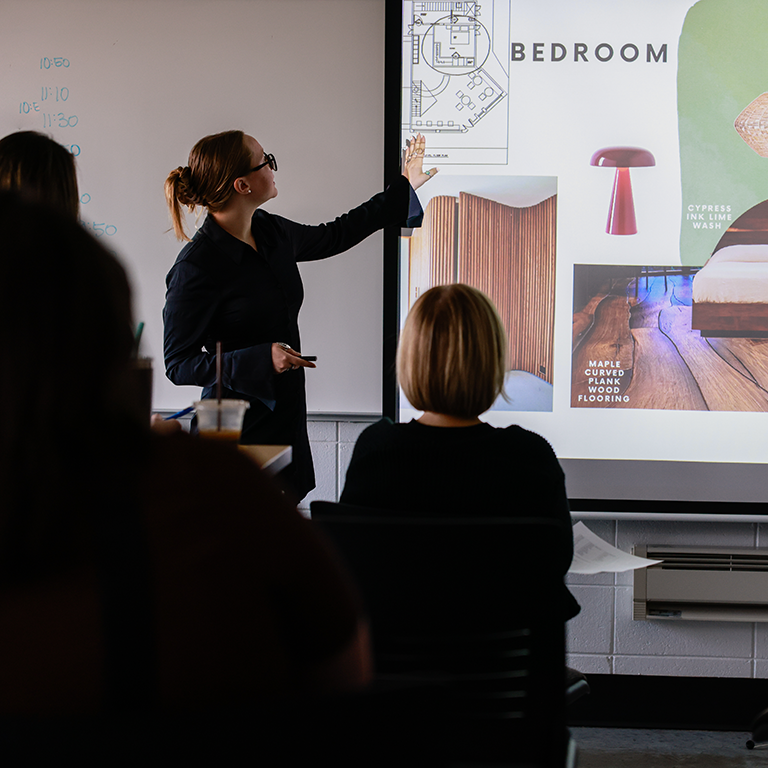

Interior Architecture is a Bachelor Degree program offered by Dunwoody College of Technology in Minneapolis, MN. The program takes 4 years to complete, with a total tuition of $122,700.
Program Overview
Interior Architecture at Dunwoody educates students to realize the design possibilities of collaboration, innovative technology, and user experience to become leaders in the profession.
The degree specifically prepares graduates to become design professionals who can design for a variety of spaces with a special focus on healthcare, hospitality, education, and commercial projects.
This major is perfect for those who are interested in design trends and the technical aspects of textures, colors, lighting, etc., but also have a passion for improving how people live and work.
While Interior Architecture is about the furnishings and fittings of spaces, it also encompasses other elements of structures and spaces, including architectural details and sustainability.
In your courses, you will learn to use design theories, interior materials, building codes, cost analysis, and both hand and computer-aided drafting to develop and prepare functional and innovative designs. You will gain expertise in software commonly used in the industry, such as AutoCAD, Revit, Adobe Creative Cloud, Bluebeam, and Rhino.
You will also participate in cross-disciplinary collaboration with peers in architecture, graphic design, and other construction sciences majors.
You will also build your portfolio throughout your coursework and complete a capstone project that demonstrates your skills in the field of Interior Architecture.
CIDA Accreditation. The CIDA-accredited program prepares students for entry-level interior design practice, for advanced study, and to apply for membership in professional interior design
organizations. The granted by meets the educational requirement for eligibility to sit for the National Council for Interior Design Qualification Examination (NCIDQ Exam). For more information about NCIDQ Exam eligibility visit: https://www.cidq.org/eligibility-requirements.
Student Achievement Data – 2025
What sets this Program apart
Facilities used in this program include:
Design Studios. Work in open concept studio spaces designed to foster collaboration and learning with students in the School of Design.
- Individual work spaces
- Drafting kits
- Physical modeling kits
- Wall and table spaces for displaying/reviewing designs
Fabrication Lab. The Fabrication Lab is a place to get hands on experience with materials and tools for building three dimensional objects. Bring your designs to life as you work with wood, plastic, metal, cardboard and more.
- Laser cutter- Requires DXF file
- CNC Router- Requires DXF or STL file
- 3D printer- Requires STL file
- CAD table
- Band saw
- Drill press
- Spray booth
- Hot wire cutter
- Hand drills
- Saws- jigsaw, Sawzall, track saw, hand saws
- Chisels
- Soldering iron
- Many hand tools
Admission Requirements and Process
Students applying for admission to Dunwoody College of Technology must provide a final, official high school transcript (with graduation date) or a GED score from a recognized GED testing center. Admission decisions are based on a careful, overall assessment of each student’s academic preparation and performance, as well as the additional information provided in the application. Additional requirements may be required for certain programs.
General Requirements
- High school diploma or GEDProvide a final, official high school transcript (with graduation date) or a GED score from a recognized GED testing center.
- College transcriptsIf you have completed college credits and intend to apply for federal financial aid, or want the credits considered for transfer, an official transcript from that institution is…
- Admission reviewAdmission decisions weigh coursework through high school graduation, any previous college-level coursework, grade point average and the application essay.
- Test scores optionalACT, SAT or PSAT scores are considered if available but are not required.
- ImmunizationMinnesota law (M.S. 135A.14) requires students born after 1956 to be immunized against diphtheria, tetanus, measles, mumps and rubella; accepted students fill out an immunization…
- OrientationOrientation is an enrollment requirement for all new students; admitted students are mailed information on Orientation sessions.
Application Process
- 1Fill out an application for admissionRegister for Dunwoody’s Admissions portal and start your application; you can save your progress and come back to it.
- 2Provide official transcriptsRequest official transcripts from all educational institutions attended (including high school), sent directly to the Dunwoody Admissions Office, or have your GED scores sent.
- 3Personal interviewA personal interview with an Admissions Counselor is recommended to ensure Dunwoody is the right fit for your educational and career goals.
- 4Admissions decisionYour completed file goes to the admissions committee, which meets once a week; students are notified of decisions within four business days.
- 5Apply for financial aidComplete the FAFSA (Dunwoody school code 004641); a completed FAFSA is also required to be considered for Dunwoody scholarships.FAFSA Code for Minneapolis Campus: 004641Complete FAFSA Application
- 6Attend orientationAdmitted students are mailed information on Orientation, an enrollment requirement for all new students, where they receive their class schedule and student ID.
Program Schedule
Length of program. 4 years (8 semesters).
Classes offered. Day.
Available starts. Fall Semester.
Upcoming start dates. August 30, 2027 (per the 2026-2027 academic calendar).
- August 30th, 2027
Cost of Attendance and Financial Aid Information
Program cost (2026-27). Total program tuition is $122,700 (Year 1: $29,396; Year 2: $28,270; Year 3: $32,586; Year 4: $32,448). Required fees (device) total $3,112 and books, supplies, materials and course/program fees total $155, for an estimated total program cost of $125,967.
Cost of attendance. For the 2025-26 academic year Dunwoody lists average annual costs (which vary by program) of $27,704 tuition, $744 books and supplies and $710 fees, plus living expenses of $3,898 food, $11,766 on-campus or $12,106 off-campus housing, $2,000 transportation and $2,200 miscellaneous.
Financial aid. Most Dunwoody students receive some form of financial aid, including federal and state grants, federal loans and work study. Start by completing the Free Application for Federal Student Aid (FAFSA); Dunwoody’s federal school code is 004641. A completed FAFSA is also required to be considered for Dunwoody scholarships, and each year Dunwoody gives out nearly $4 million in scholarship funding.
Minnesota programs. Dunwoody participates in the Minnesota State Grant, Dream Act, Postsecondary Child Care Grant, GI Bill Scholarship, Indian Scholarship, Fostering Independence Grant, State Work-Study and SELF Loan programs.
Veterans. The Department of Veterans Affairs recognizes Dunwoody as a Benefits Eligible College, and Dunwoody is a Yellow Ribbon School. Dunwoody waives the application fee and enrollment fees for veterans and military students.
Payment plans. Dunwoody offers a payment plan option for students to divide the balance owed each semester into smaller payments; students must enroll in the payment plan each semester.
Curriculum
The Interior Architecture (IARC), Bachelor of Science requires 120 credits. By the end of this program, students will be able to:
- Collaborate on design solutions.
- Demonstrate professionalism, ethics, and leadership.
- Constructively review and critique and welcome feedback.
- Communicate visually and verbally with a variety of stakeholders.
- Apply knowledge of human experience and global context to design solutions.
- Apply the design process.
- Apply the principles and elements of design.
- Documentation and integration of design solutions.
- Utilize standards that protect the health, safety, and well-being of stakeholders.
- Demonstrate knowledge and responsibility for sustainable design.
- Demonstrate technical knowledge.
Class topics include:
- Design Principles
- Design Materials
- BIM (Building Information Modeling)
- Lighting Design
- Healthcare, Hospitality, and Education studios
- Sustainable Design
- Furniture Design
- Detailing and Advanced Detailing
Required Courses
| Subject # | Name | Credits |
|---|---|---|
Career Outcomes
Common job titles. Possible job titles upon graduation include:
- Interior Designer
- Project Designer
- Space Planner
- Senior Interior Designer/Architect
- Studio Manager
- Production Designer
- Design Architect
- Environment Artist
Recent employers of graduates. Companies that hire our graduates include:
- RSP Architects
- NELSON
- bdh+young
- AECOM
- Best Buy
2024-25 graduate outcomes. Of 8 Interior Design (IDSN) graduates in 2024-25, the in-field employment rate was 100% and the career outcomes rate was 100% (Dunwoody Career Services Annual Report 2024-2025; employment recorded up to six months after graduation).
Average salary. $50K (School of Design, B.S.; 2023-24 Dunwoody Career Services Annual Report, as shown on the program page).
What to expect as a Dunwoody College of Technology student
Student organizations. Opportunities to get involved outside of the classroom include:
- Students of Interior Architecture (SIA)
- Women in Design
- National Organization of Minority Architects (NOMA)
- Phi Theta Kappa Honor Society (PTK)
- Student Government Association (SGA)
Campus Address
Why Accreditation Is Important
Dunwoody College of Technology is accredited by the Higher Learning Commission (HLC) and registered with the Minnesota Office of Higher Education. Interior Design, B.S. is listed as accredited by the Council for Interior Design Accreditation (CIDA): accredited April 2020, awarded 6 years through April 2026.
- A reliable indicator of quality
- Approved program of study
- Qualified instructors
- Recognition by employers nationwide
Accreditations

Student Demographics
These are demographics for all students at the Minneapolis Campus (IPEDS, 2024).
Percentages are of total fall enrollment. 9 students whose race or ethnicity was not reported are included in that total but shown as no category, so the figures above come to 99.4% rather than 100%.
Images