
Mechanical Engineering is a Bachelor Degree program offered by Dunwoody College of Technology in Minneapolis, MN. The program takes 4 years to complete, with a total tuition of $133,199.
Program Overview
Practice the practical from day one with a mechanical engineering degree from Dunwoody. This is an engineering education for those who want more than a traditional mechanical engineering major.
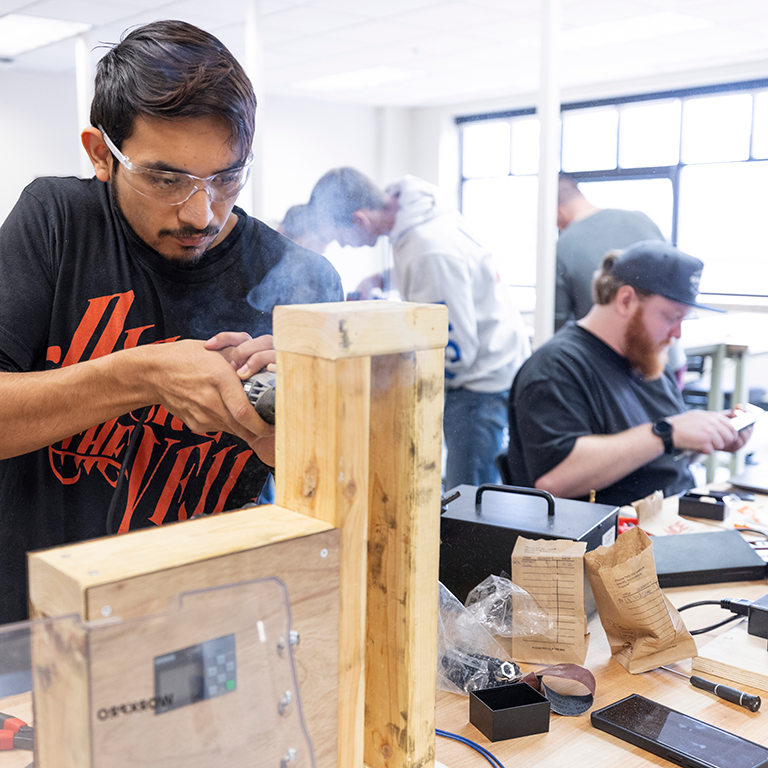
Coursework combines lab and theory so that the engineering principles you learn are reinforced and experienced through hands-on projects. Faculty have industry experience and are here to help you learn and succeed.
Dunwoody’s Bachelor of Science in Mechanical Engineering can lead to employment in a variety of industries, including manufacturing, transportation, and quality control/testing. It’s a versatile degree for those who enjoy hands-on creation and problem-solving.
Work in labs and shops stocked with state-of-the-industry equipment and tools, including:
- Stratsys 3D printers
- A Zeiss coordinate measuring machine
- MTS Criterion Universal Testing System
- And access to equipment and collaboration with students from welding, CNC machining, robotics, and more
Small class sizes give you the chance to work closely with experienced instructors and network with your cohort as you move through the program.
Arts & Sciences courses help you understand the core mathematical and scientific principles that all engineering projects grow out of and provide you with the communication and critical thinking skills required to succeed in the profession.
Engineering coops and/or a senior project allow you to showcase your engineering skills in the real world. Upon graduation, you’ll be prepared to pass the Fundamentals of Engineering Exam—the first step in becoming a licensed professional engineer (PE).
What sets this Program apart
Facilities used in this program include:
Controls Engineering Lab. Assemble and program the industrial controls used in discrete manufacturing and advanced process control applications.
- 24 Allen Bradley L18ERM CompactLogix PLCs
- 24 Allen Bradley PanelView HMIs
- 24 Kinetix Motion Controllers
- 24 Powerflex VFDs
- 24 Cognex Machine Vision Systems
- Emerson Process Controls & Instrumentation
Engineering, Materials, Mechanics & Metrology Lab. Open to all manufacturing and engineering students (and those with training on the equipment), this lab brings together equipment for additive manufacturing, material testing, measurement, and CNC simulation.
- Two Stratasys Fortus 250 3D Printers
- One Stratasys F370 3D Printer
- One Fortus 400 3D Printer
- Two MakerBot 3D Printers
- Two Zeiss Duramax Coordinate Measurement Machines
- Two MTS Criterion Tensile/Shear/Compression Testers
- 7 Haas CNC Controller Simulators
- One Zeiss Stemi 305 Microscope
Basic Electricity Lab. Complete projects that help you learn the fundamentals of electricity, including how to analyze, design, build, and test series, parallel and combination AC and DC circuits.
- 12 individual workstations that include: Lighted Magnifier; Digital Microscope; Soldering Iron; Fume Extractor; Work Holding Equipment; Hot Air Rework Equipment; Prototyping and Wiring Tools; Linear Power Supply Transformer Trainer; Digital Oscilloscope; Digital Multimeter; Analog Multimeter; DC Power Supply; AC Function Generator
- 2 LPKF S64 PCB Milling Machines
- Neoden Solder Paste Stencil Station
- Neoden PCB Pick and Place Machine
- Neoden PCB Reflow Oven
- Digital Thermal Imaging Camera
- 5 LabVIEW DAQ Trainers
- 12 Microcontroller Development Training Kits
- Instructor overhead projector station for demonstrations
Gene Haas Manufacturing Innovation Lab. Learn to program CNC milling and turning operations and develop the tooling used in modern manufacturing processes like injection molding and metal stamping.
- 10 Haas CNC Mini Mills
- 2 Haas VF2 Mills
- Haas ST-10 Lathe
- Sodick Wire EDM
- Charmilles Sinker EDM
- Cincinatti Injection Mold Press
Foundry. Learn to cast metal with an industrial kiln.
- 1 VK Industrial Kiln
- Various crucibles and pouring equipment
- Sand casting molds and tools
Admission Requirements and Process
Students applying for admission to Dunwoody College of Technology must provide a final, official high school transcript (with graduation date) or a GED score from a recognized GED testing center. Admission decisions are based on a careful, overall assessment of each student’s academic preparation and performance, as well as the additional information provided in the application. Additional requirements may be required for certain programs.
General Requirements
- High school diploma or GEDProvide a final, official high school transcript (with graduation date) or a GED score from a recognized GED testing center.
- College transcriptsIf you have completed college credits and intend to apply for federal financial aid, or want the credits considered for transfer, an official transcript from that institution is…
- Admission reviewAdmission decisions weigh coursework through high school graduation, any previous college-level coursework, grade point average and the application essay.
- Test scores optionalACT, SAT or PSAT scores are considered if available but are not required.
- ImmunizationMinnesota law (M.S. 135A.14) requires students born after 1956 to be immunized against diphtheria, tetanus, measles, mumps and rubella; accepted students fill out an immunization…
- OrientationOrientation is an enrollment requirement for all new students; admitted students are mailed information on Orientation sessions.
Application Process
- 1Fill out an application for admissionRegister for Dunwoody’s Admissions portal and start your application; you can save your progress and come back to it.
- 2Provide official transcriptsRequest official transcripts from all educational institutions attended (including high school), sent directly to the Dunwoody Admissions Office, or have your GED scores sent.
- 3Personal interviewA personal interview with an Admissions Counselor is recommended to ensure Dunwoody is the right fit for your educational and career goals.
- 4Admissions decisionYour completed file goes to the admissions committee, which meets once a week; students are notified of decisions within four business days.
- 5Apply for financial aidComplete the FAFSA (Dunwoody school code 004641); a completed FAFSA is also required to be considered for Dunwoody scholarships.FAFSA Code for Minneapolis Campus: 004641Complete FAFSA Application
- 6Attend orientationAdmitted students are mailed information on Orientation, an enrollment requirement for all new students, where they receive their class schedule and student ID.
Program Schedule
Length of program. 4 years (8 semesters).
Classes offered. Day.
Available starts. Fall Semester.
Upcoming start dates. August 30, 2027 (per the 2026-2027 academic calendar).
- August 30th, 2027
Cost of Attendance and Financial Aid Information
Program cost (2026-27). Total program tuition is $133,199 (Year 1: $29,491; Year 2: $29,667; Year 3: $34,705; Year 4: $39,336). Required fees (device) total $3,112 and books, supplies, materials and course/program fees total $4,570, for an estimated total program cost of $140,881.
Cost of attendance. For the 2025-26 academic year Dunwoody lists average annual costs (which vary by program) of $27,704 tuition, $744 books and supplies and $710 fees, plus living expenses of $3,898 food, $11,766 on-campus or $12,106 off-campus housing, $2,000 transportation and $2,200 miscellaneous.
Financial aid. Most Dunwoody students receive some form of financial aid, including federal and state grants, federal loans and work study. Start by completing the Free Application for Federal Student Aid (FAFSA); Dunwoody’s federal school code is 004641. A completed FAFSA is also required to be considered for Dunwoody scholarships, and each year Dunwoody gives out nearly $4 million in scholarship funding.
Minnesota programs. Dunwoody participates in the Minnesota State Grant, Dream Act, Postsecondary Child Care Grant, GI Bill Scholarship, Indian Scholarship, Fostering Independence Grant, State Work-Study and SELF Loan programs.
Veterans. The Department of Veterans Affairs recognizes Dunwoody as a Benefits Eligible College, and Dunwoody is a Yellow Ribbon School. Dunwoody waives the application fee and enrollment fees for veterans and military students.
Payment plans. Dunwoody offers a payment plan option for students to divide the balance owed each semester into smaller payments; students must enroll in the payment plan each semester.
Curriculum
The Mechanical Engineering (MENG), Bachelor of Science requires 124 credits. By the end of this program, students will be able to:
- EAC 1: An ability to identify, formulate, and solve complex engineering problems by applying principles of engineering, science, and mathematics.
- EAC 2: An ability to apply engineering design to produce solutions that meet specified needs with consideration of public health, safety, and welfare, as well as global, cultural, social, environmental, and economic factors.
- EAC 3: An ability to communicate effectively with a range of audiences.
- EAC 4: An ability to recognize ethical and professional responsibilities in engineering situations and make informed judgments, which must consider the impact of engineering solutions in global, economic, environmental, and societal contexts.
- EAC 5: An ability to function effectively on a team whose members together provide leadership, create a collaborative and inclusive environment, establish goals, plan tasks, and meet objectives.
- EAC 6: An ability to develop and conduct appropriate experimentation, analyze and interpret data, and use engineering judgment to draw conclusions.
- EAC 7: An ability to acquire and apply new knowledge as needed, using appropriate learning strategies.
Class topics include:
- Engineering design
- Manufacturing materials
- Project management
- Basic industrial processes
- Advanced mathematics
- Statistics
- Manufacturing processes
- Statics/dynamics/finite analysis
Required Courses
| Subject # | Name | Credits |
|---|---|---|
Career Outcomes
Common job titles. Possible job titles upon graduation include:
- Mechanical Engineer
- Manufacturing Engineer
- Project Engineer
- HVAC Design Engineer
2024-25 graduate outcomes. Of 7 Mechanical Engineering graduates in 2024-25, the in-field employment rate was 100% and the career outcomes rate was 100% (Dunwoody Career Services Annual Report 2024-2025; employment recorded up to six months after graduation).
Average salary. $80K (Mechanical Engineering, B.S; 2023-24 Dunwoody Career Services Annual Report, as shown on the program page).
What to expect as a Dunwoody College of Technology student
Student organizations. Opportunities to get involved outside of the classroom include:
- Baja Club (experimental vehicles)
- The Dunwoody Order of Student Engineers
- Robotic Snow Plow Team
- Shell Eco Marathon
- Society of Women Engineers (SWE)
Campus Address
Why Accreditation Is Important
Dunwoody College of Technology is accredited by the Higher Learning Commission (HLC) and registered with the Minnesota Office of Higher Education. Accredited by the Engineering Accreditation Commission of ABET under the General Criteria and the Mechanical Engineering Program Criteria.
- A reliable indicator of quality
- Approved program of study
- Qualified instructors
- Recognition by employers nationwide
Accreditations

Student Demographics
These are demographics for all students at the Minneapolis Campus (IPEDS, 2024).
Percentages are of total fall enrollment. 9 students whose race or ethnicity was not reported are included in that total but shown as no category, so the figures above come to 99.4% rather than 100%.
Images