Welding Technology is a Certificate program offered by Dunwoody College of Technology in Minneapolis, MN. The program takes 1 year to complete, with a total tuition of $29,098.
Program Overview
Ready to start a career in welding? Dunwoody’s welding certificate program provides the foundational skills and hands-on training you need to succeed in the field.
Learn industry-standard welding processes including Shielded Metal Arc Welding (SMAW), Gas Metal Arc Welding (GMAW), Flux-Cored Arc Welding (FCAW), and Gas Tungsten Arc Welding (GTAW). You’ll also learn two essential cutting methods: oxyacetylene cutting (OFC-A) and plasma arc cutting (PAC).
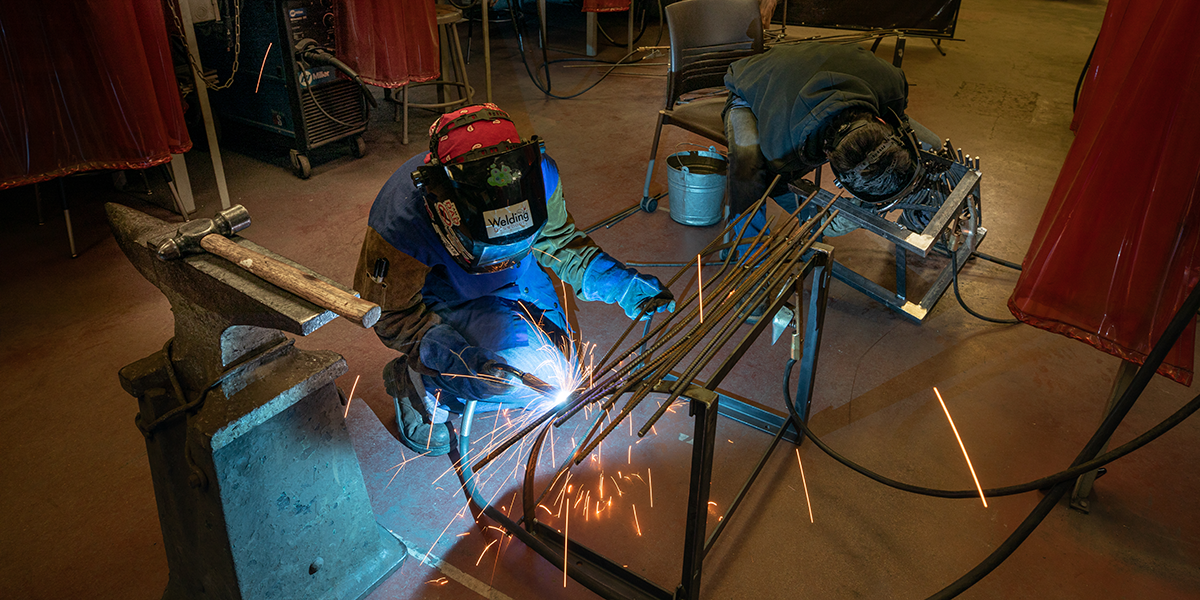
Train in Dunwoody’s state-of-the-art welding lab, where you’ll practice producing clean, strong welds using steel, stainless steel, and aluminum alloys.
In your final semester, you’ll take part in a simulated welding shop environment with production schedules designed to prepare you for the pace and expectations of real-world fabrication work.
The Welding Technology program’s curriculum is closely aligned with American Welding Society (AWS) standards, ensuring you graduate with the skills employers are looking for. You’ll also have the opportunity to earn up to four AWS D1.1 welding certifications.
All instructors are AWS-certified welders, and students are encouraged to join Dunwoody’s local AWS student chapter for additional networking and professional development opportunities.
Credits earned in the Welding Technology certificate directly transfer into Dunwoody’s Welding & Metal Fabrication associate’s degree program.
” Learning by doing, trial and error, and actually getting your hands dirty will teach you things about yourself and your profession that a classic education will not. I can say wholeheartedly that I gained more confidence in myself as a professional in one year at Dunwoody than I did getting my bachelor’s at another four-year college. “
Jane Thompson
’18 Welding Technology
What sets this Program apart
Facilities used in this program include:
Weld Shop. Practice various weld processes, including oxyacetylene welding and cutting, stick welding, wire feed welding, and tungsten inert gas welding.
- 36 welding booths
- 18 Lincoln C300 MIG/Stick Welders
- 18 Miller Dynasty 280DX TIG/STICK Welders
- Plasma Cutter
- Bettenbender Metal Shear
- Pirahna Ironworker
- Jet Horizontal Saw
- Do-All Horizontal Saw
Grinding Lab. Practice precision grinding (abrasive machining).
- 7 precision surface grinders
- 4 pedestal grinders
- 2 Drill presses
- 1 Do-All Horizontal Saw
- 1 Do-All Chop Saw
Admission Requirements and Process
Students applying for admission to Dunwoody College of Technology must provide a final, official high school transcript (with graduation date) or a GED score from a recognized GED testing center. Admission decisions are based on a careful, overall assessment of each student’s academic preparation and performance, as well as the additional information provided in the application. Additional requirements may be required for certain programs.
General Requirements
- High school diploma or GEDProvide a final, official high school transcript (with graduation date) or a GED score from a recognized GED testing center.
- College transcriptsIf you have completed college credits and intend to apply for federal financial aid, or want the credits considered for transfer, an official transcript from that institution is…
- Admission reviewAdmission decisions weigh coursework through high school graduation, any previous college-level coursework, grade point average and the application essay.
- Test scores optionalACT, SAT or PSAT scores are considered if available but are not required.
- ImmunizationMinnesota law (M.S. 135A.14) requires students born after 1956 to be immunized against diphtheria, tetanus, measles, mumps and rubella; accepted students fill out an immunization…
- OrientationOrientation is an enrollment requirement for all new students; admitted students are mailed information on Orientation sessions.
Application Process
- 1Fill out an application for admissionRegister for Dunwoody’s Admissions portal and start your application; you can save your progress and come back to it.
- 2Provide official transcriptsRequest official transcripts from all educational institutions attended (including high school), sent directly to the Dunwoody Admissions Office, or have your GED scores sent.
- 3Personal interviewA personal interview with an Admissions Counselor is recommended to ensure Dunwoody is the right fit for your educational and career goals.
- 4Admissions decisionYour completed file goes to the admissions committee, which meets once a week; students are notified of decisions within four business days.
- 5Apply for financial aidComplete the FAFSA (Dunwoody school code 004641); a completed FAFSA is also required to be considered for Dunwoody scholarships.FAFSA Code for Minneapolis Campus: 004641Complete FAFSA Application
- 6Attend orientationAdmitted students are mailed information on Orientation, an enrollment requirement for all new students, where they receive their class schedule and student ID.
Program Schedule
Length of program. 1 year (2 semesters).
Classes offered. Day.
Available starts. Fall Semester.
Upcoming start dates. August 30, 2027 (per the 2026-2027 academic calendar).
- August 30th, 2027
Cost of Attendance and Financial Aid Information
Program cost (2026-27). Total program tuition is $29,098 (Year 1: $29,098). Required fees (device) total $778 and books, supplies, materials and course/program fees total $305, for an estimated total program cost of $30,181.
Cost of attendance. For the 2025-26 academic year Dunwoody lists average annual costs (which vary by program) of $27,704 tuition, $744 books and supplies and $710 fees, plus living expenses of $3,898 food, $11,766 on-campus or $12,106 off-campus housing, $2,000 transportation and $2,200 miscellaneous.
Financial aid. Most Dunwoody students receive some form of financial aid, including federal and state grants, federal loans and work study. Start by completing the Free Application for Federal Student Aid (FAFSA); Dunwoody’s federal school code is 004641. A completed FAFSA is also required to be considered for Dunwoody scholarships, and each year Dunwoody gives out nearly $4 million in scholarship funding.
Minnesota programs. Dunwoody participates in the Minnesota State Grant, Dream Act, Postsecondary Child Care Grant, GI Bill Scholarship, Indian Scholarship, Fostering Independence Grant, State Work-Study and SELF Loan programs.
Veterans. The Department of Veterans Affairs recognizes Dunwoody as a Benefits Eligible College, and Dunwoody is a Yellow Ribbon School. Dunwoody waives the application fee and enrollment fees for veterans and military students.
Payment plans. Dunwoody offers a payment plan option for students to divide the balance owed each semester into smaller payments; students must enroll in the payment plan each semester.
Curriculum
The Welding Technology (WELD), Certificate requires 32 credits. By the end of this program, students will be able to:
- Demonstrate required industry safety standards.
- Interpret welding blueprints and symbols.
- Fabricate weldments using multiple processes and positions.
- Analyze weldments for quality.
Class topics include:
- Welding Theory
- Welding Math, Prints & Symbols
- Lean Manufacturing
- Welding Fabrication
Required Courses
| Subject # | Name | Credits |
|---|---|---|
Career Outcomes
2024-25 graduate outcomes. Of 11 Welding Technology graduates in 2024-25, the in-field employment rate was 75% and the career outcomes rate was 100% (Dunwoody Career Services Annual Report 2024-2025; employment recorded up to six months after graduation).
Average salary. $45K (Robotics & Manufacturing, Certificate; 2023-24 Dunwoody Career Services Annual Report, as shown on the program page).
What to expect as a Dunwoody College of Technology student
Student organizations. Opportunities to get involved outside of the classroom include:
- Dunwoody Welding Club
- Robotic Snow Plow Team
- SkillsUSA
Campus Address
Why Accreditation Is Important
Dunwoody College of Technology is accredited by the Higher Learning Commission (HLC) and registered with the Minnesota Office of Higher Education.
- A reliable indicator of quality
- Approved program of study
- Qualified instructors
- Recognition by employers nationwide
Accreditations

Student Demographics
These are demographics for all students at the Minneapolis Campus (IPEDS, 2024).
Percentages are of total fall enrollment. 9 students whose race or ethnicity was not reported are included in that total but shown as no category, so the figures above come to 99.4% rather than 100%.
Testimonials
Images