

Cybersecurity and Network Technology is an Associate Degree program offered by Eastwick College in Nutley, NJ. The program takes 21 months to complete, with a total tuition of $37,125.
Program Overview
Prepare for a career in cybersecurity and network technology with Eastwick College’s Associate’s Degree program. This comprehensive program equips students with the skills needed to begin their journey as entry-level cybersecurity and network technicians. Through intensive instruction, students gain proficiency in installing and maintaining systems and equipment utilizing electronic and computer components, spanning from computers to medical, navigational, and telecommunications devices.
The objective of Eastwick College’s Associate of Applied Science in Cybersecurity and Network Technology program is to prepare the student to enter the workforce in the capacity of an entry-level cybersecurity and network technician. Students will be trained to install and maintain systems and equipment that run on electronic and computer components including computers and medical, navigational, and telecommunications equipment.
Upon successful completion of the program, Eastwick College will award the student an Associate of Applied Science Degree in Cybersecurity and Network Technology.
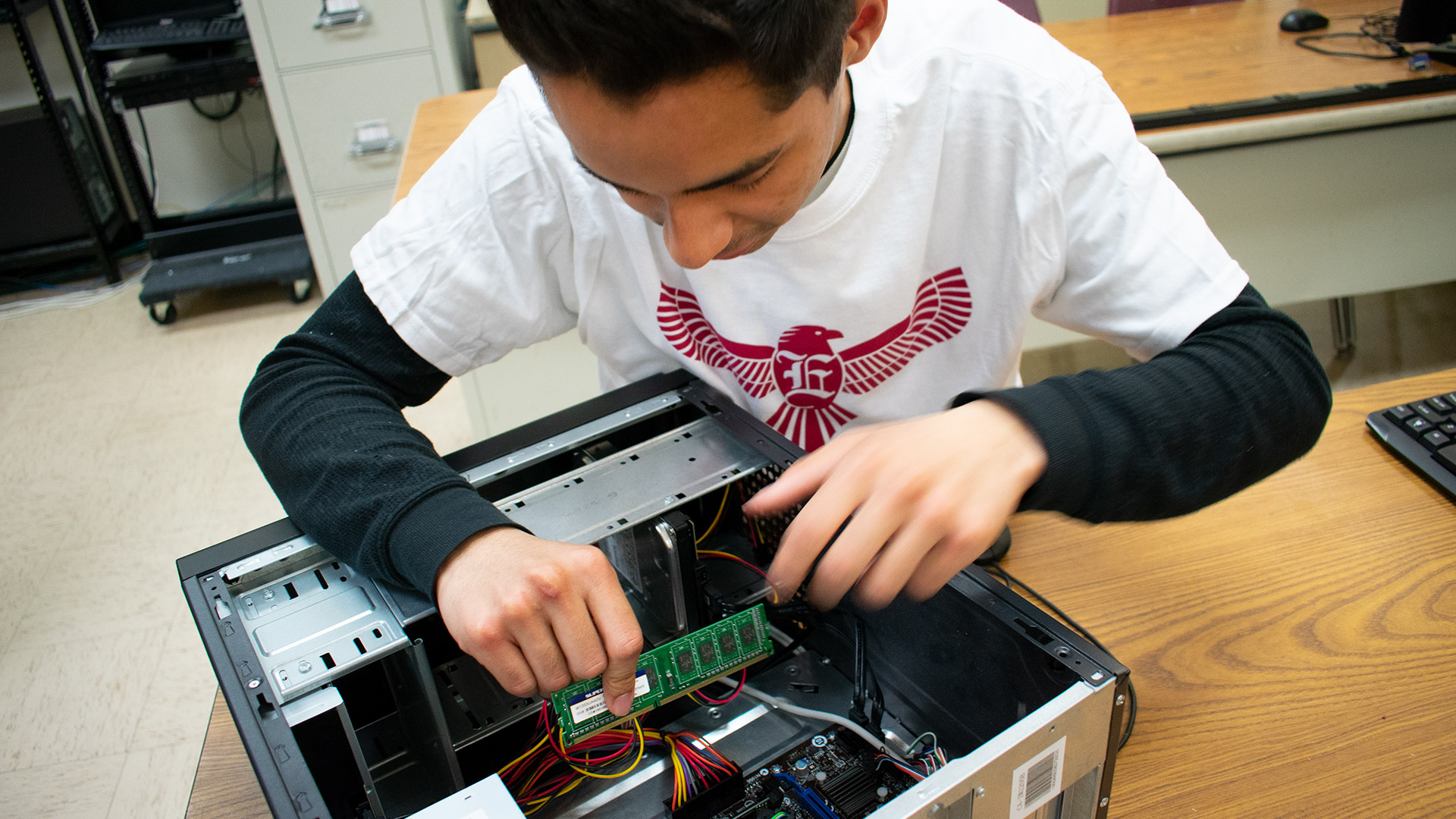
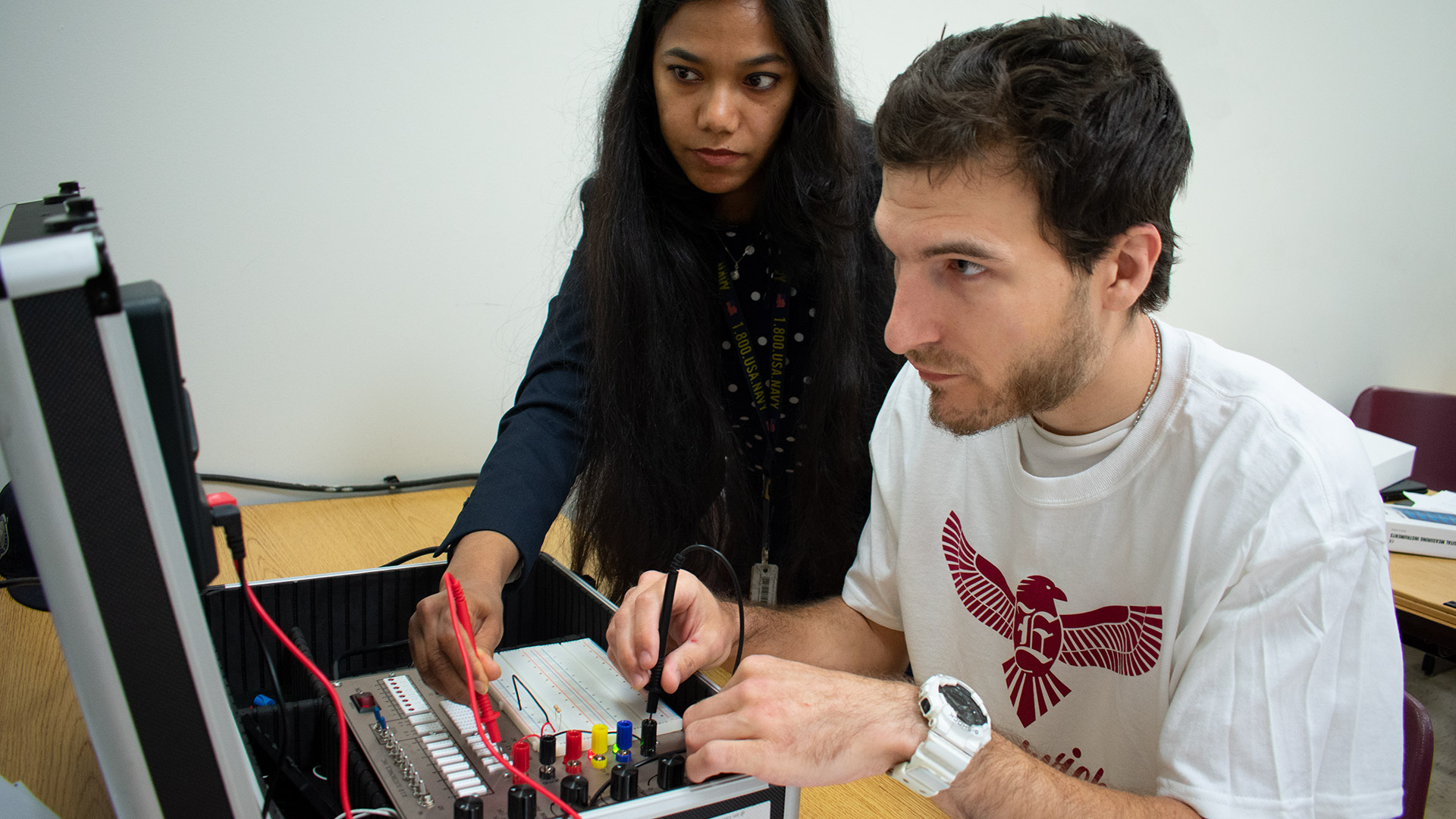
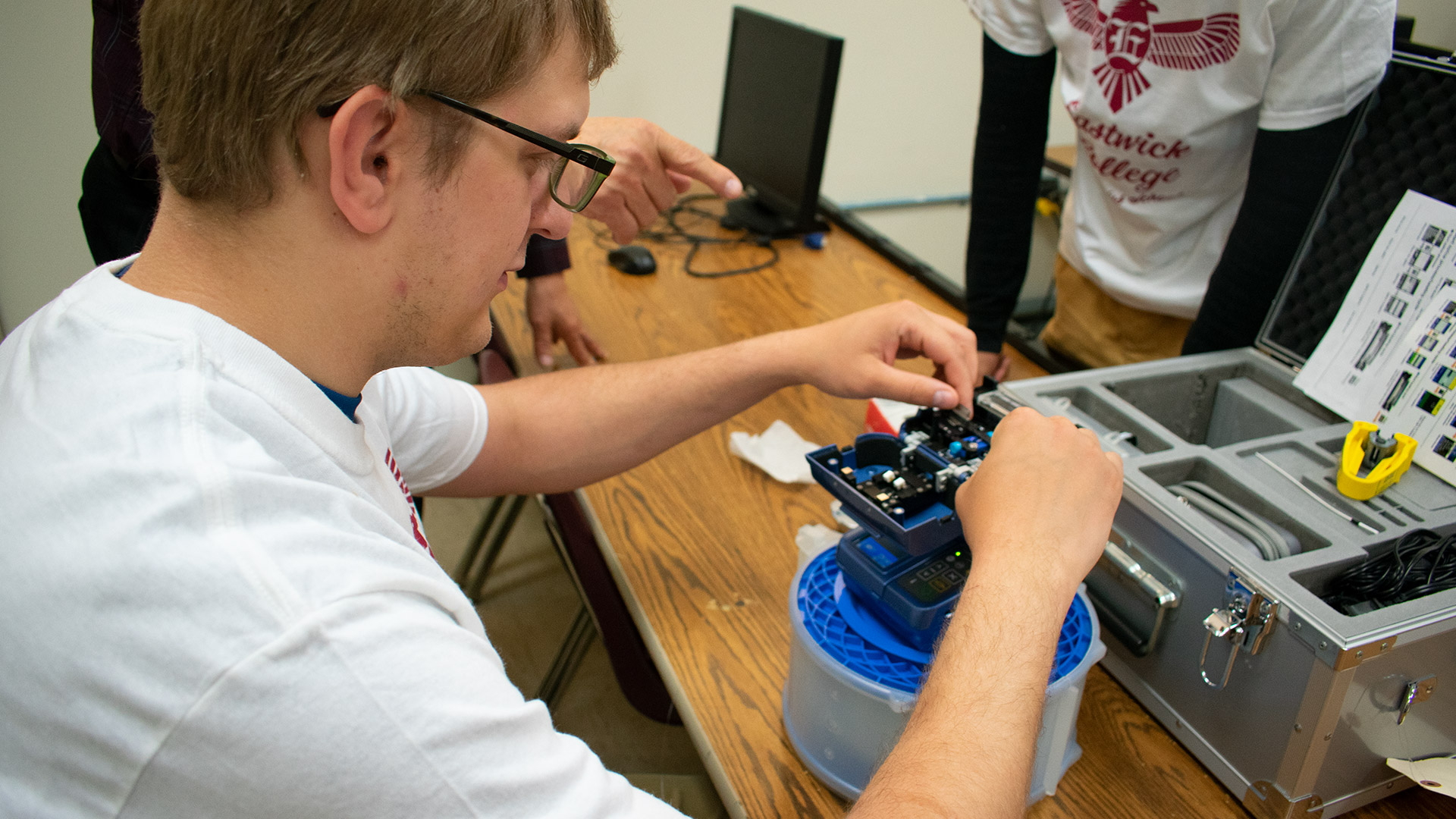
Facilities. The electronics and computer/networking labs include AC and DC power supplies, AF and RF signal generators, analog/digital multimeters, oscilloscopes, patch panels, switches, routers, computer hardware, netbooks, laptops, desktop computers, fiber optics infusion splicers, fiber optics trainer kits, and computer servers. Three computer laboratories ensure each student a workstation for ample hands-on experience.
What sets this Program apart
- Achieve certifications in Comp TIA A+, Network+, Security+, ESA-1-4, Microsoft Azure Fundamentals and Fiber Optics Technician
- CompTIA – A+
- CompTIA – Network+
- CompTIA – Security+
- Microsoft Azure Fundamentals
- FOA – Fiber Optics Technician
- ESA 1-4
Admission Requirements and Process
For admission to Eastwick College, applicants must interview with an admissions representative to obtain information about curriculum characteristics and professional profiles of our programs in each of their areas of interest. Applicants who determine that an Eastwick program is right for them must submit proof of high school completion or GED equivalency, complete an application for admission, and take an admission exam. The director of admissions oversees the admission process, and the campus director makes the final decision for acceptance.
General Requirements
- Admissions interviewApplicants must interview with an admissions representative to obtain information about curriculum characteristics and professional profiles of the programs in their areas of…
- High school completionApplicants must submit proof of high school completion or GED equivalency.
- Application for admissionApplicants who determine that an Eastwick program is right for them must complete an application for admission.
- Accuplacer admission examApplicants take the Accuplacer exam in reading, writing, and mathematics; a total score of 650 (the sum of the three section scores) is required, with no minimum score in any…
- Distance Learning AssessmentStudents who wish to enroll in programs that include distance education courses must take the Distance Learning Assessment.
- New student orientationAttendance at an orientation session for new students is required before starting a program and is held prior to the beginning of each term.
Application Process
- 1Meet with an admissions representativeContact the admissions department at the campus of your choice to schedule a personal session with an admissions representative to discuss the program and your goals.
- 2Submit proof of high school completionProvide proof of high school graduation or GED equivalency.
- 3Complete the application for admissionComplete an application for admission to Eastwick College.
- 4Take the admission examTake the Accuplacer exam (total score of 650 required).
- 5Meet with a financial aid counselorAll applicants are scheduled for a personal meeting with a financial aid counselor to develop a personalized plan; each year aid applicants must submit a FAFSA.
- 6Attend new student orientationAttend the required orientation session for new students held prior to the beginning of each term.
Program Schedule
Program length (catalog): 21 Months, Full-Time (Day); 24 Months, Part-Time (Evening); 99 quarter credits.
Eastwick College’s classes meet Monday through Friday between 8 a.m. and 11 p.m. Classes may also be offered on Saturdays and Sundays from 8 a.m. to 8 p.m. to meet academic requirements or address special group needs. Clinical and laboratory experiences may have earlier starting times and later ending times and may also be offered on Saturdays and Sundays.
The school year is divided into four 12-week terms.
According to the 2026 academic calendar, the Fall Term starts October 19, 2026 and ends January 9, 2027.
Cost of Attendance and Financial Aid Information
Cost of Attendance. Tuition is $375 per quarter credit for 99 quarter credits, for total tuition of $37,125. The application fee is $25 and the registration fee is $100; books and supplies are $2,381, for a total cost of $39,631 (Schedule of Tuition and Fees effective July 1, 2026; subject to change). The cost of tuition does not include the cost of transportation to and from school.
Financing Your Education. Financial aid is available for those who qualify.
- Eastwick College Payment Plan: Quarterly or monthly payments. Cash, checks, and money orders, as well as American Express, Discover, Visa and Master Card charges are accepted.
- Pell Grant: Based on need; grants for the 2025 - 2026 Aid Year range from $767 - $7,395 per academic year. To apply for Title IV aid, a student must complete the Free Application for Federal Student Aid (FAFSA).
- New Jersey Tuition Aid Grant (TAG): degree-seeking students who have lived in New Jersey at least twelve consecutive months may be considered; students must attend full-time.
- Federal Direct Subsidized Loan: If you qualify, you may borrow $3,500 for the first academic year.
- Federal Direct Unsubsidized Loan: If qualified, an independent student may borrow up to $6,000 per academic year.
- FSEOG: awards range from $100 to $4,000 per year depending on the student’s financial aid need.
- Parental Loan (PLUS), College Ave, NJ Class and EdvestinU private loans for those who qualify.
- NJ-GIVS: A State of New Jersey scholarship that will pay up to $2,000 per year to eligible New Jersey residents for the cost of enrollment in an eligible certificate program.
- Scholarships awarded by the Eastwick Foundation, a 501 (c)(3) nonprofit organization.
- Eastwick College Book Grant: a book and laptop grant applied as a tuition/book discount each term for students in good financial standing.
- Waiver of application and registration fees: prospective students may be eligible under the Policy on Application and Registration Fees.
Eastwick College Nutley is approved to train eligible veterans under Title 38, US Code. Federal School Code (FAFSA) for Eastwick College Nutley: 013129. Net Price Calculator.
Required Courses
| Subject # | Name | Credits |
|---|---|---|
| CT101L | PC Technology I Laboratory | 4 |
| CT101T | PC Technology I Theory | 5 |
| FS101N | Fundamentals for Student Success | 1 |
| MATH101 | College Math | 5 |
| CT201L | PC Technology II Laboratory | 4 |
| CT201T | PC Technology II Theory | 5 |
| ET101L | Basic Electronics Laboratory | 2 |
| ET101T | Basic Electronics Theory | 5 |
| ET102L | Electronics I Laboratory | 2 |
| ET102T | Electronics I Theory | 4 |
| PHYS101 | Conceptual Physics | 6 |
| CT202L | Networking and Fiber Optics Laboratory | 4 |
| CT202T | Networking and Fiber Optics Theory | 4 |
| ET201L | Electronics II Laboratory | 2 |
| ET201T | Electronics II Theory | 4 |
| CT203L | Computer Networking and Server Laboratory | 1 |
| CT203T | Computer Networking and Server Theory | 2 |
| ET202L | Digital Technology Laboratory | 2 |
| ET202T | Digital Technology Theory | 4 |
| COM101 | Foundations of Communication | 5 |
| E101 | English Composition I | 5 |
| MATH102 | College Algebra | 5 |
| SOC100N | Introduction to Sociology | 5 |
| CT204L | Computer Security Laboratory | 4 |
| CT204T | Computer Security Theory | 4 |
| ET203L | Communication Electronics/Mobile Technology Laboratory | 1 |
| ET203T | Communication Electronics/Mobile Technology Theory | 3 |
| PD100 | Professional Development | 1 |
| Totals | 99 |
Career Outcomes
Career paths named by the school.
- Entry-level cybersecurity technician
- Network technician
ACCSC Student Achievement (2025 Annual Report, updated December 7, 2025).
- Day session: cohort of 16 students, graduation rate 57%, employment rate 88%.
- Evening session: cohort of 9 students, graduation rate 78%, employment rate 71%.
Student/graduate eligibility for certification examinations (credentialing organizations may change their requirements without notice):
- A+ — Computer Technology Industry Association (CompTIA) (successful program completion)
- Network+ — Computer Technology Industry Association (CompTIA) (successful program completion)
- Security+ — Computer Technology Industry Association (CompTIA) (successful program completion)
- Fiber Optic Technician — Fiber Optic Association (CT202L & CT202T)
- ESA-1 — International Society of Certified Electronic Technicians (ISCET) (ET101L & ET101T)
- ESA-2 — International Society of Certified Electronic Technicians (ISCET) (ET102L & ET102T)
- ESA-3 — International Society of Certified Electronic Technicians (ISCET) (ET201L & ET201T)
- ESA-4 — International Society of Certified Electronic Technicians (ISCET) (ET202L & ET202T)
While we strive to provide students with the best tools to prepare for their careers, we cannot and do not guarantee employment.
What to expect as a Eastwick College student
New student orientation. Attendance at an orientation session for new students is required before starting a program and is held prior to the beginning of each term. College staff present institutional regulations and distribute schedules, and orientation gives new students the opportunity to become familiar with the campus and to meet informally with other new students. Programs with specialized accreditation may require additional orientation activities.
Class schedule. Eastwick College's classes meet Monday through Friday between 8 a.m. and 11 p.m. Classes may also be offered on Saturdays and Sundays from 8 a.m. to 8 p.m. to meet academic requirements or address special group needs. Clinical and laboratory experiences may have earlier starting times and later ending times and may also be offered on weekends. The school year is divided into four 12-week terms, except for the evening Heating, Ventilation, Air Conditioning and Refrigeration Technology program, which is offered in 8-week modules.
Class size. Lecture courses have a maximum of 90 students. The maximum number of students in a laboratory varies with the setting, with a maximum of 10 students for each laboratory instructor.
Dress code. No dress code is required for either the day or evening division, but students are asked to use good judgment and dress in accordance with the business setting. Medical and nursing students must dress in compliance with OSHA regulations to attend laboratory activities, and students at clinical sites must meet the dress code requirements of the affiliated institutions.
Attendance. Lateness and excessive absences are strongly discouraged; documented absences may be justified only for illness or other unavoidable reasons. Instructors explain the attendance policy for each course in the syllabus, and failing to meet attendance requirements in a course with a clinical or laboratory component may result in a failing grade. Students are withdrawn after an absence of 14 consecutive calendar days.
Graduation. To graduate, students must pass all subjects in the prescribed curriculum, earn a minimum cumulative GPA of 2.0 (2.5 in the Bilingual Licensed Practical Nursing, Licensed Practical Nursing, AAS in Nursing [LPN-to-RN Bridge] and BS in Nursing [LPN-to-BSN] programs), and obtain authorization from the financial aid department.
Campus Address
Why Accreditation Is Important
Eastwick College is accredited by the Middle States Commission on Higher Education (MSCHE). Eastwick College Nutley is accredited by the Accrediting Commission of Career Schools and Colleges (ACCSC) and licensed by the New Jersey Office of the Secretary of Higher Education.
- A reliable indicator of quality
- Approved program of study
- Qualified instructors
- Recognition by employers nationwide
Accreditations

Curriculum
The Associate of Applied Science in Cybersecurity and Network Technology requires 99 quarter credits (66 core, 2 foundation and 31 general education), completed in 21 months full-time (day) or 24 months part-time (evening) at the Nutley campus. Core courses pair a theory course with a laboratory: PC Technology I and II, Basic Electronics, Electronics I and II, Networking and Fiber Optics, Computer Networking and Server, Digital Technology, Computer Security, and Communication Electronics/Mobile Technology. General education includes College Math, College Algebra, Conceptual Physics, English Composition I, Foundations of Communication and Introduction to Sociology.
Required Courses
| Subject # | Name | Credits |
|---|---|---|
| CT101L | PC Technology I Laboratory | 4 |
| CT101T | PC Technology I Theory | 5 |
| FS101N | Fundamentals for Student Success | 1 |
| MATH101 | College Math | 5 |
| CT201L | PC Technology II Laboratory | 4 |
| CT201T | PC Technology II Theory | 5 |
| ET101L | Basic Electronics Laboratory | 2 |
| ET101T | Basic Electronics Theory | 5 |
| ET102L | Electronics I Laboratory | 2 |
| ET102T | Electronics I Theory | 4 |
| PHYS101 | Conceptual Physics | 6 |
| CT202L | Networking and Fiber Optics Laboratory | 4 |
| CT202T | Networking and Fiber Optics Theory | 4 |
| ET201L | Electronics II Laboratory | 2 |
| ET201T | Electronics II Theory | 4 |
| CT203L | Computer Networking and Server Laboratory | 1 |
| CT203T | Computer Networking and Server Theory | 2 |
| ET202L | Digital Technology Laboratory | 2 |
| ET202T | Digital Technology Theory | 4 |
| COM101 | Foundations of Communication | 5 |
| E101 | English Composition I | 5 |
| MATH102 | College Algebra | 5 |
| SOC100N | Introduction to Sociology | 5 |
| CT204L | Computer Security Laboratory | 4 |
| CT204T | Computer Security Theory | 4 |
| ET203L | Communication Electronics/Mobile Technology Laboratory | 1 |
| ET203T | Communication Electronics/Mobile Technology Theory | 3 |
| PD100 | Professional Development | 1 |
| Totals | 99 |
Images

Videos
Frequently Asked Questions
Other Programs at Eastwick College Nutley
Eastwick College in Nutley, NJ also offers these 15 programs at 103 Park Avenue, Nutley, NJ 07110.
- BusinessAssociate Degree · 18 months
- Business Administration with Computerized Accounting/BookkeepingCertificate · 9 months
- Business Operations and AccountingCertificate · 6 months
- Diagnostic Cardiovascular SonographyAssociate Degree · 24 months
- Electronics and Computer TechnologyDiploma · 12 months
- Health ScienceAssociate Degree · 18 months
- Health Science (Health Information Technology Concentration)Associate Degree · 15 months
- Heating, Ventilation, Air Conditioning, and Refrigeration TechnologyAssociate Degree · 18 months
- Heating, Ventilation, Air Conditioning, and Refrigeration TechnologyDiploma · 12 months
- Licensed Practical NursingDiploma · 12-21 months
- Medical AssistingCertificate · 9 months
- Medical Billing and CodingCertificate · 9 months
- Nursing (LPN-to-BSN)Bachelor Degree · 30 months
- Nursing (LPN-to-RN Bridge Program)Associate Degree · 18 months
- Patient Care TechnicianCertificate · 6 months