Nuclear Medicine Technology is an Associate Degree program offered by Keiser University in Lakeland, FL. The program takes 24 Months to complete, with tuition of $12,908 per semester.
Program Overview
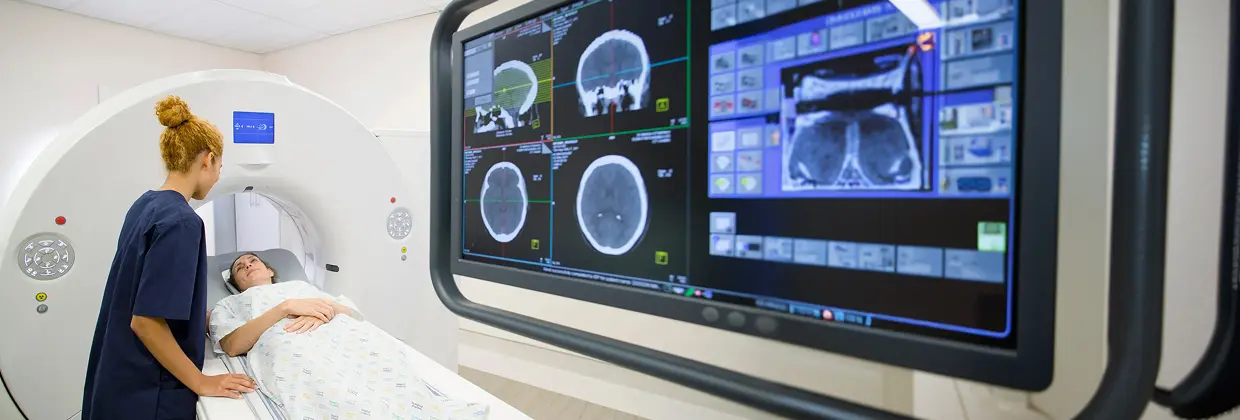
Keiser University’s nuclear medicine technology program teaches you to use radioactive drugs and advanced imaging equipment to help physicians diagnose and treat medical conditions. The program covers radiation safety procedures, patient care, medical procedures, and the physics and chemistry behind nuclear medicine. You’ll learn about the use of radioactive material to visualize, diagnose, and treat pathology through proper utilization of specialized equipment and techniques.
Clinical rotations at affiliated medical facilities give you real-world experience before completion, preparing students to enter the workforce as a competent nuclear medicine technologist.
Program Mission
The Nuclear Medicine Technology Program is committed to equipping students with the knowledge and skills required of a nuclear medicine technologist through quality education, community partnerships and fostering students’ achievement.
Program Goals
- Communication and Collaboration Students will develop communication skills to effectively provide patient care in a team-centered healthcare environment.
- Clinical Competence Students will be able to perform entry-level nuclear medicine technology procedures by program completion.
- Professional Development Students will cultivate the professional and ethical competencies essential for success as entry-level nuclear medicine technologists.
- Safety Protocols Students will adhere to safety and regulatory practices (ALARA) relevant to practice as a nuclear medicine technologist.
Student Learning Objectives/Outcomes
-
Students will develop verbal and written communication skills to effectively interact within a healthcare setting
-
Students will demonstrate knowledge of ALARA practices and regulatory practices relevant to all aspects of radiation safety in Nuclear Medicine Technology
-
Students will demonstrate knowledge of professional ethical practices and appropriate patient care in a team centered healthcare setting
-
Students will demonstrate proficiency in related math and physics content
-
Students will demonstrate successful performance in nuclear medicine procedures
Program Highlights
The program combines classroom instruction with extensive clinical education at affiliated healthcare facilities including hospitals and imaging clinics. Clinical assignments provide hands-on training with real patients, teaching students to explain medical procedures, turn patients for optimal imaging, and maintain detailed records. Students complete clinical rotations, gaining experience across different medical procedures and patient populations. Nuclear medicine technologists work with radioactive isotopes and imaging equipment to treat patients and help physicians treat medical conditions. Students learn to operate imaging equipment and provide technical support to physicians and other healthcare workers. The capstone course prepares students for national certification examinations and professional practice in various educational programs.
What sets this Program apart
Gain Job-Ready Skills for a Nuclear Medicine Career
- Radiation safety procedures to minimize radiation exposure
- Patient care and communication to explain medical procedures
- Medical imaging equipment operation
- Preparing radioactive materials
- Quality control procedures and maintaining detailed records
- Human anatomy and physiology knowledge
- Biology, chemistry, and physics principles
- Clinical documentation skills and detailed records
- Emergency response procedures for nuclear disaster preparedness
- Professional ethics and legal standards
- Critical thinking to treat patients and treat medical conditions
Keiser University offers career-focused degree programs designed to support working adults, traditional students, and career changers. With on-campus and hybrid learning options, experienced faculty under the program director’s leadership, and comprehensive student support, Keiser helps learners achieve their personal and professional goals at all levels across health professions.
Admission Requirements and Process
Applicants desiring to enter Keiser University must submit an application to the Admissions Office well in advance of the start date. This permits proper scheduling and assures availability of classroom space. Applications for winter, spring or fall semesters should be made as early as possible, as these entry dates are normally the time of greatest enrollment.
For students enrolling at Keiser University, credit for courses or degrees completed at another institution is subject to approval by the Dean of Academic Affairs. These courses or degrees must be similar in content and duration to those offered in the program for which an applicant has applied. The Dean of Academic Affairs makes the final decision of accepted transfer credits from the received transcript. However, only courses listed on official transcripts receive permanent official transfer credit. (To grant such credit, Keiser University must receive official transcripts--- those mailed directly to Keiser University by the previous institution---by the end of a student’s first semester.) Keiser University requires that, at a minimum, a student complete the final 25% of a program through the University. Active duty, reservists, and National Guard service members who are students can complete at a minimum 25% of a program at any time through the University and graduate. Transfer students are informed in writing of any credits accepted as transferable. Preliminary notification is presented, in most cases, prior to enrollment but in no case later than the end of a transfer student's first semester. Students are responsible for having official transcripts sent to Keiser University from their former institution(s). It may be necessary for students to forfeit some previously earned credit in the transfer process since college philosophies, objectives and programs may vary and change from year to year. Therefore, Keiser University makes no blanket statement or promise of acceptance of credits from any other institution.
General Requirements
- High School Graduation or EquivalentTo be considered for enrollment at Keiser University, all applicants must supply: • Verification of high school graduation with a standard diploma (transcript, diploma, etc.) or •…
- Earned Degree in Lieu of DiplomaApplicants will not be required to provide proof of high school graduation when they provide the following: Verification of an earned degree from an institution recognized by the…
- Home-Schooled ApplicantsHome-schooled applicants who have a high school diploma are considered for admission.
- Entrance ExaminationAn applicant must make arrangements to take Keiser University’s entrance examination (administered at the University) or provide results of his/her Scholastic Aptitude Test (SAT),…
- Entrance Test ExemptionCandidates seeking general admission to the University are not required to take the general admission test upon providing written proof of an associate or higher degree earned…
- Allied Health Test ExemptionCandidates providing proof of an associate or higher degree with a cumulative grade point average of 3.0 or higher from an accredited college seeking entry into the University’s…
- Allied Health Program RequirementsAll candidates must achieve the required entrance examinations scores and all other requirements for admission to specific bachelor and associate degree allied health programs.
- Background Check and Drug ScreeningBackground check and drug screening when applicable
- Prerequisite CourseworkMinimum grade of “C” for general education courses. Successful completion of the following prerequisite courses: BSC2085C, BSC2086C, PHY2001, MAC2105 and CHEM2045/L.
- Cumulative Grade AverageCumulative grade average of 3.0 on a scale of 4.0
Application Process
- 1Contact an Admissions CounselorContact one of Keiser University’s admissions counselors to talk through the program and your options.
- 2Attend an Open House or Campus VisitAttend an open house or plan a campus visit. Applicants are encouraged to visit the University in person.
- 3Meet With Your Admissions CounselorSchedule a convenient time to meet with your admissions counselor to determine if Keiser University is right for you.
- 4Submit an ApplicationSubmit an application to the Admissions Office well in advance of the start date. Applications for winter, spring or fall semesters should be made as early as possible, as these entry dates are normally the time of greatest enrollment.Apply Now
Program Schedule
Keiser University students take one class at a time. Keiser University term lengths are 4-week, 8-week and 16-week.
Keiser University publishes this program as approximately 24 months and 93 credit hours.
Keiser University lists this program as available on campus.
Tuition is charged per 16-week semester according to the credit hours scheduled.
- October 26th, 2026
- November 23rd, 2026
- January 11th, 2027
- February 08th, 2027
- March 08th, 2027
- April 05th, 2027
- May 10th, 2027
- June 07th, 2027
- July 05th, 2027
- August 02nd, 2027
Cost of Attendance and Financial Aid Information
Keiser University charges tuition per 16-week semester according to the number of credit hours scheduled, not per program. The rates below are the university’s published Tuition and Fee Disclosure, effective Fall Semester 2026, and are subject to annual review.
| Semester credit load | Tuition per semester |
|---|---|
| Full time (12 to 17.99 credits) | $12,908.00 |
| Three-quarter time (9 to 11.99 credits) | $9,681.00 |
| Half time (6 to 8.99 credits) | $6,454.00 |
| Less than half time (0 to 5.99 credits) | $3,227.00 |
| Full time + (18 to 24 credits, approval required) | $16,135.00 |
Required fees
- Application fee — $55.00, one time on enrollment
- Registration fee — $145.00, one time on enrollment
- Education fee — $980.00 per semester, for programmatic participation and facilities resources
- Annual health insurance plan — $2,169.00 where applicable to allied health programs, waived with proof of coverage by a qualified plan
Other fees are charged per occurrence: withdrawal $100.00, re-entry $150.00, transcript $5.00, student ID replacement $15.00, returned check $35.00, late payment $10.00 and library late fee $10.00.
Financial aid
Students seeking aid complete the FAFSA using the university’s federal school code, 015159.
Estimated Student Costs
Required and Optional Fees for Programs: Fees are costs set by the university in addition to tuition (and room and board, if applicable). These fees may be required for your program or optional depending on the courses you take, and they support the costs associated with completing an approved program of study. Fees are defined in the university’s catalog or supplement and listed on the school’s billing statement or invoice. Fees that are optional will not be paid using GI Bill® benefits and will be the responsibility of the student choosing these additional options. For additional guidance, please see your Program Director or Admissions Counselor.
Curriculum
The nuclear medicine technology program at Keiser University prepares students to become skilled healthcare professionals who use radioactive material and specialized equipment to create diagnostic images. Most nuclear medicine technologists work in hospitals and imaging clinics, where they explain medical procedures to patients and collaborate with other healthcare workers to treat patients effectively. Through comprehensive education in radiation safety, medical procedures, and patient care, students gain the technical skills and knowledge needed for certification. The program combines classroom instruction with clinical rotations, giving you hands-on experience in real healthcare settings before completion.
To receive an Associate of Science degree in Nuclear Medicine Technology, students must complete 93 credit hours as described below. The length of this program is approximately 24 months (this will vary if a student transfers in credits).
Required Courses
| Subject # | Name | Credits |
|---|---|---|
Career Outcomes
Graduates of Keiser University’s nuclear medicine program qualify to sit for national certification examinations through the American Registry of Radiologic Technologists (ARRT-N) and the Nuclear Medicine Technology Certification Board (NMTCB). Most employers require certification before hiring nuclear medicine technologists. After passing these exams, certified nuclear medicine technologists may pursue employment in hospitals, outpatient imaging clinics, cancer treatment centers, cardiac care facilities, and research institutions. According to the Bureau of Labor Statistics, the field offers job growth, competitive median annual wage, and the satisfaction of playing a vital role in patient diagnosis and treatment. Nuclear medicine technologists work alongside physicians, radiologic technologists, and other healthcare workers to treat patients and treat medical conditions effectively.
Career Pathways in Nuclear Medicine Technology
- Medical imaging departments in hospitals
- Outpatient diagnostic imaging centers
- Cancer treatment facilities
- Cardiac imaging clinics
- Research medical centers
- University medical centers
- Mobile imaging services
- PET/CT imaging centers
- Surgical centers with imaging capabilities
Placement Rate
Keiser University publishes the following in its 2025 Undergraduate Placement Rates report for AS Nuclear Medicine Technology.
| Eligible | Placed | In Field | Related Field | %Placed | %IF/RF |
|---|---|---|---|---|---|
| 15 | 15 | 15 | 0 | 100% | 100% |
Keiser University’s notes on this report: “Does not include international campuses.” “Report as of April 2026, 16.43% has been verified through 3rd party.”
While Keiser University provides employment placement assistance, it cannot promise or guarantee employment.
What to expect as a Keiser University student
Keiser University’s nuclear medicine technology program equips students with the specialized skills needed to enter this growing healthcare field. With comprehensive training in radiation safety procedures, medical imaging, preparing radioactive drugs, and patient care, you’ll gain the hands-on experience most employers require. Our Nuclear Medicine Tech program combines classroom learning with extensive clinical rotations at affiliated medical facilities, preparing you to pass national certification exams and launch a rewarding career helping physicians diagnose and treat patients through advanced diagnostic imaging.
School Information
Campus Address
Why Accreditation Is Important
Keiser University is accredited by the Southern Association of Colleges and Schools Commission on Colleges (SACSCOC) to award associate, baccalaureate, masters, educational specialist, and doctorate degrees.
Keiser University’s Lakeland campus Associate of Science in Nuclear Medicine Technology Program is accredited by the Joint Review Committee on Educational Programs in Nuclear Medicine Technology 2000 W. Danforth Rd. STE 130, #203 Edmond, OK 73003 Phone: (405) 285-0546 mail@jrcnmt.org. Keiser University’s New Port Richie campus is seeking initial accreditation through JRCNMT.
- Eligible for federal Title IV financial aid
- Credits earned toward a respected credential
Accreditations


Testimonials

Images