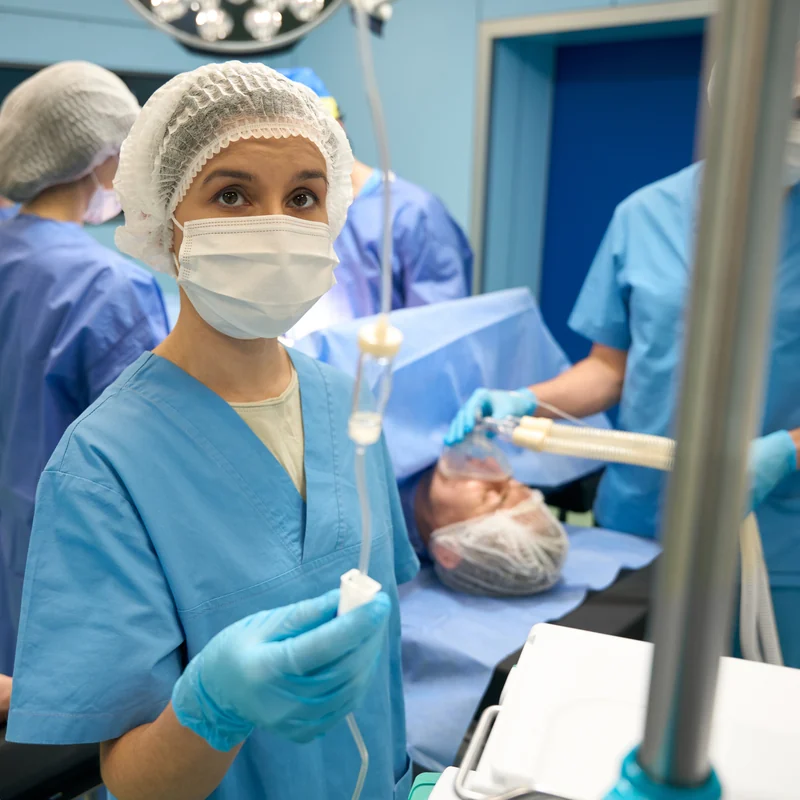
Nurse Anesthesia Practice (Entry into Practice) is a Doctoral Degree program (Hybrid) offered by Keiser University in Naples, FL. The program takes 36 Months to complete, with tuition of $13,584 per semester.
Program Overview
The Doctor of Nurse Anesthesia Practice program graduate will possess advanced competencies for nurse anesthesia practice, faculty, and leadership roles in nurse anesthesia. The program curriculum consists of didactic and the clinical components. The program integrates research, pathophysiology, pharmacology, health assessment, general principles of anesthesia, and anesthesia for surgical procedures for application in the clinical setting.
During the program of study, students will have the opportunity to apply evidence-based practices through the development of anesthesia care plans and hands-on experience in the operating room. Additionally, students will complete a capstone project that culminates with the completion of a scholarly work that demonstrates the ability to translate findings into practice, research, education, and/or administration applicable to nurse anesthesia practice. The curriculum focuses on preparing registered nurses with a bachelor’s degree to become Certified Registered Nurse Anesthetists (CRNA).
Upon completion of the DNAP: Entry into Practice program, graduates who fulfill all program requirements will be eligible to sit for the National Certification Exam through the National Board of Certification and Recertification for Nurse Anesthetists (NBCRNA) and upon passing the exam, will become a CRNA.
Program Mission
The Doctor of Nurse Anesthesia Practice program incorporates a practitioner-scholar model to prepare students as expert clinicians in the full scope of nurse anesthesia practice.
Program Goals
- Clinical Competency: (COA Standard II-E, III-B)
- Critical Thinking and Evidence-Based Practice: (COA Standard II-F, III-D)
- Professionalism, Ethics, and Leadership: (COA Standard II-H, IV-A)
What sets this Program apart
Gain Job-Ready Skills for a Nurse Anesthesia Career
- Advanced physiology and pathophysiology across the lifespan
- Pharmacology principles specific to anesthesia practice
- Airway management and crisis management techniques
- Regional anesthesia and pain management approaches
- Evidence-based practice and scholarly research application
- Clinical decision making across the perioperative continuum
- Healthcare policy, patient safety, and quality improvement
- Leadership in advanced practice nursing and anesthesia services
Keiser University offers career-focused degree programs designed to support working adults, traditional students, and career changers. With on-campus, online, and hybrid learning options, experienced faculty, and comprehensive student support, Keiser helps learners achieve their personal and professional goals at all levels.
Admission Requirements and Process
Applicants desiring to enter Keiser University must submit an application to the Admissions Office well in advance of the start date. This permits proper scheduling and ensures availability of classroom space. Applications for Winter, Spring, Summer, or Fall semesters should be made as early as possible, as these entry dates are normally the time of greatest enrollment.
Credit for courses or degrees completed at another institution is subject to approval by the Dean of Academic Affairs. These courses or degrees must be similar in content and duration to those offered in the program for which an applicant has applied. The Dean of Academic Affairs makes the final decision of accepted transfer credits from the received transcript. However, only courses listed on official transcripts receive permanent official transfer credit. To grant such credit, Keiser University must receive official transcript directly from the previous institution by the end of a student’s first semester. Keiser University requires that, at a minimum, a student complete at least one third of the credit hours required for any graduate or post-baccalaureate professional degree through instruction offered by Keiser University. Active duty, reservists, and National Guard service members who are students can complete at a minimum one third of a program at any time through the University. Transfer students are informed in writing of any credits accepted as transferable. Preliminary notification is presented, in most cases, prior to enrollment but in no case later than the end of a transfer student's first semester. Students are responsible for having official transcripts sent to Keiser University from all former institution(s). It may be necessary for students to forfeit some previously earned credit in the transfer process since college philosophies, objectives and programs may vary and change from year to year. Keiser University does not make any blanket assurances or guarantees regarding the acceptance or transferability of credits from other institutions. Each credit evaluation is conducted on a caseby-case basis in accordance with university policy.
Keiser University may accept transfer credits from a college or university recognized by the by the U.S. Department of Education (USDE). Coursework must be equivalent in content, level, and credit hours to the corresponding Keiser University course/s.
Qualified, accepted doctoral degree seeking students may transfer a maximum of 18 graduate level credits, but no more than two-thirds of the total credit hours (whichever is less), required for the program unless otherwise specified by a programmatic accreditor.
Acceptable courses will be equivalent to a B grade or higher unless otherwise specified by programmatic requirements. Courses represented with a Pass or Satisfactory grade may be transferable at the discretion of the program chair and/or appropriate program Dean.
General Requirements
- Limited, Competitive AdmissionProgram admission is limited and very competitive as the number of applicants typically surpasses the number of students who are accepted for each start.
- Complete Application RequiredEach applicant is responsible for compiling and submitting the completed application and required documentation. Incomplete applications will not be accepted.
- Graduate School Admission RequirementsApplicants must meet Keiser University Graduate School Admission and English Proficiency requirements, as well as requirements for admission to the program major as listed below.
- Registered NurseDoctor of Nurse Anesthesia Applicants must be a Registered Nurse with:
- BSN DegreeBSN from an accredited nursing program.
- Non-Nursing BaccalaureateNon-nursing baccalaureate degrees considered case-by-case.
- Cumulative GPA Above 3.0Cumulative GPA >3.0 (4.0 scale), with emphasis on science coursework. A graduate degree from an institutionally accredited institution has its GPA included in review.
- Nursing CAS ApplicationCompleted Nursing CAS application.
- Three Recommendation LettersThree signed, dated recommendation letters: a. One from your current ICU clinical supervisor, on the KU form. b. One preferred attesting to academic work. c. One assessing…
- Current ResumeCurrent resume.
- 40+ Shadowing Hours40+ shadowing hours with an anesthesia provider, preferably a CRNA. Employment hours do not count; hours must be obtained in the US.
- Personal StatementPersonal statement (three pages, AMA format, excluding cover and references) addressing: a. Your goals and expectations for the program. b. Your understanding of the CRNA role. c.…
- Unrestricted RN LicenseCurrent, unrestricted RN license in a US state or protectorate, with eligibility for Florida RN licensure (required before admission).
- Undergraduate TranscriptsCompleted undergraduate coursework with official transcripts from all institutions. Science prerequisites over 5 years old should be refreshed. Science GPA of 3.0 preferred.
- Prerequisite Courses (B or Better)These courses completed with a B or better: a. Statistics. b. Undergraduate Health Assessment. c. Two Anatomy and Physiology courses. d. General Chemistry I and II. e. One…
- TOEFL for Non-English SpeakersApplicants from non-English-speaking countries, or without a US-accredited bachelor’s degree, must submit a minimum TOEFL of 550 (paper) or 213 (computer).
- Degree Equivalency EvaluationUS evaluation-service confirmation that the bachelor’s degree is equivalent to that required for admission.
- Critical Care RN ExperienceOne+ year as an RN in critical care, currently full-time. Preferred: Medical, Trauma, Neuro ICU, and CVRU. NICU/PICU is not accepted without adult critical care. Orientation does…
- BLS and ACLS CertificationMaintain current BLS and ACLS (American Heart Association only); recertify both twice during the program. PALS required at a later program stage.
- Unrestricted Driver’s LicenseCurrent, unrestricted US driver’s license.
- Background Check and Drug ScreenAcceptable background check and drug screen. Applicants must affirm good health and integrity, freedom from addiction, no Board of Nursing restriction or investigation, and…
- Criminal Background CheckCriminal background checks are conducted before, during, and after matriculation. The university may deny an application. Students whose clearance is later compromised will be…
- Health and Technical StandardsCandidates must possess the physical, sensory, motor, cognitive, and behavioral capabilities to perform safely, with or without reasonable accommodation, across observation and…
- Accident & Health InsuranceKeiser University requires that all students enrolled in the Doctor of Nurse Anesthesia Practice program participate in the university-sponsored accident & health insurance…
- Required InterviewApplicants who meet all requirements and clear initial screening may be invited to interview. The interview is required.
- Official Transcript DeadlineFailure to provide an official transcript by the end of the first semester of attendance will lead to dismissal from the program and Graduate School.
Application Process
- 1Contact an Admissions CounselorContact one of Keiser University’s friendly admissions counselors.
- 2Attend an Open House or Campus VisitAttend an Open House or plan a campus visit.
- 3Meet With Your Admissions CounselorSchedule a convenient time to meet with your admissions counselor to determine if Keiser University is right for you.
- 4Submit an ApplicationSubmit an application and complete your enrollment profile and application.Apply Now
- 5Review Program RequirementsReview the Graduate School admission requirements for your program.
- 6Upload Your Admission DocumentsIn the Student Enrollment Portal, click on “My Documents” and upload the corresponding documents to fulfil the admission requirements. Then submit the Letter of Recommendation Form and your Personal Statement.
- 7Schedule Your Financial Aid AppointmentYour admissions counselor will connect you to your dedicated Financial Aid Officer to schedule your appointment and receive assistance completing the FAFSA. Keiser University’s FAFSA school code is 015159.
- 8Class RegistrationOnce you have accepted your financial aid funding plan, the registrars will schedule your courses throughout your entire degree plan from start to completion.
- 9Order BooksYour admissions counselor will assist you in ordering your books through the online bookstore. Standard receipt is 3–5 business days unless you order priority.
- 10Attend OrientationOnline programs offer a self-paced orientation through Blackboard, or a scheduled live session before each class start date. For campus programs, speak with your admissions counselor about orientation requirements at your location.
- 11Begin ClassesThe class week runs Monday through Sunday, midnight EST. You must log in by Wednesday of week one to confirm attendance, and participate a minimum of three logins per week in the Blackboard classroom for each course.
Program Schedule
- October 26th, 2026
- January 11th, 2027
- March 08th, 2027
- May 10th, 2027
- July 05th, 2027
Cost of Attendance and Financial Aid Information
Keiser University charges tuition and fees by the semester for the scheduled credit hours. Each semester is 16 weeks. The rates below are the university’s published Tuition and Fee Disclosure for the Nurse Anesthesia Program, effective Fall Semester 2026, and are subject to annual review and modification.
| Semester credit load | Tuition per semester |
|---|---|
| Doctor of Nurse Anesthesia Practice (Entry into Practice), per semester | $13,584.00 |
Required fees
- Application fee — $55.00, one-time
- Registration fee — $145.00, one-time
- Deposit — $1,500.00, non-refundable, applied towards tuition
- Education fee — $575.00 per semester, DNAP (Entry into Practice or Completion), for comprehensive programmatic participation and facilities resources
- Required textbooks, laptop, webcam and microphone — $3,450.00
Other fees for the Entry into Practice track, per occurrence: recertification of ACLS, BLS and PALS $1,000.00; AANA associate membership $200.00, non-refundable; clinical site name badge replacement $75.00; annual health insurance $2,169.00; education conferences (optional) $4,400.00; CAS $70.00; scrubs $60.00; lab coat $50.00. Student ID replacement $15.00, re-entry fee $150.00, late payment fee $250.00, returned check fee $40.00; transcripts variable.
Financial aid
Keiser University participates in federal Title IV financial aid. Grants are not available at the graduate level, but federal student loans and scholarships are available to those who qualify. Students seeking aid complete the FAFSA using the university’s federal school code, 015159.
Curriculum
Keiser University’s Doctor of Nurse Anesthesia Practice: Entry-Into-Practice program prepares registered nurses with a bachelor’s degree to become board-certified, licensed Certified Registered Nurse Anesthetists. This doctoral-level DNAP program covers the full scope of nurse anesthesia practice through rigorous didactic instruction, advanced physiology, advanced pharmacology, regional anesthesia, airway management, and structured clinical training. Students apply evidence-based practice principles throughout their clinical rotations, developing the critical thinking and clinical decision-making skills that future nurse anesthetists need.
To receive a Doctor of Nurse Anesthesia Practice degree, students must earn 90 graduate semester credit hours including didactic courses (63 Credits), DNAP Capstone courses (12 credits), and clinical practice courses (15 credit hours). Courses in the DNAP: Entry into Practice program are 16 weeks in length and scheduled two to five courses concurrently. The length of this program is approximately 36 months.
Required Courses
| Subject # | Name | Credits |
|---|---|---|
Career Outcomes
Career Pathways in Nurse Anesthesia
Graduates of Keiser University’s DNAP program earn the credentials and clinical experience needed to step into the full scope of nurse anesthesia practice across a wide range of health care facilities. From community hospitals and surgical centers to academic medical centers and military service roles, the DNAP degree supports both direct anesthesia care and leadership in nurse anesthesia education, anesthesia services coordination, and healthcare policy. Registered nurses who complete this program gain board certification eligibility through the NBCRNA and open the door to some of the most respected roles in advanced practice nursing.
- Certified Registered Nurse Anesthetist
- Clinical Nurse Anesthetist in hospital or surgical center settings
- Lead CRNA and anesthesia team supervisor
- Anesthesia department director
- Nurse anesthesia educator and faculty member
- Program director for DNAP or nurse anesthesia programs
- Regional anesthesia specialist
- Perioperative care specialist
- Nurse anesthesiology researcher and scholarly project lead
While Keiser University provides employment placement assistance, it cannot promise or guarantee employment.
What to expect as a Keiser University student
Keiser University’s Doctor of Nurse Anesthesia Practice: Entry-Into-Practice program serves registered nurses ready to commit to one of the most advanced and respected roles in health sciences. With structured clinical training, a COA-accredited curriculum, and a faculty of experienced nurse anesthesia educators, this DNAP program gives students everything needed to pursue board certification, deliver exceptional anesthesia care, and build a meaningful career in nurse anesthesia practice.
School Information
Campus Address
Why Accreditation Is Important
Keiser University is accredited by the Southern Association of Colleges and Schools Commission on Colleges (SACSCOC) to award associate, baccalaureate, masters, educational specialist, and doctorate degrees.
The Keiser University Nurse Anesthesia Program is accredited by the Council on Accreditation of Nurse Anesthesia Educational Programs (COA), 10275 West Higgins Road, Suite 906, Rosemont, Illinois 60018-5603 (224) 275-9130.
- Eligible for federal Title IV financial aid
- Credits earned toward a respected credential
Images