

Forensic Investigations (Investigations Concentration) is a Bachelor Degree program offered by Keiser University in Orlando, FL. The program takes 38 months to complete, with a total tuition of $1,042.27.
Program Overview
Keiser University's Bachelor of Science in Forensic Investigations (Investigations Concentration) provides students with a comprehensive background in the forensic investigative procedures and techniques used by working forensics professionals. Students learn to recognize, document, collect, preserve, and analyze physical evidence, and to apply modern investigative methods while building a foundation in basic scientific concepts drawn from the natural and physical sciences.
The Investigations Concentration is oriented toward the field and the crime scene rather than the analytical laboratory bench. Coursework combines classroom instruction with hands-on laboratory experiences in areas such as forensic photography, fingerprint identification, and crime scene digital image processing, and progresses into upper-division topics including forensic anthropology, medico-legal death investigation, and advanced forensic science. Students also study criminal statutes, rules of criminal procedure, and rules of evidence so they can document their work accurately and communicate findings effectively.
Graduates are prepared to pursue roles in crime scene investigation, evidence handling, and criminal investigation with law enforcement and government agencies, and the program's emphasis on written and oral communication helps prepare them to present investigative findings clearly, including as expert witnesses in legal proceedings.
What sets this Program apart
- Flexible learning with on-campus and hybrid delivery options
- Classroom instruction combined with laboratory experiences in forensic photography, fingerprint identification, and crime scene digital image processing
- Training in forensic communications, forensic legal concepts, and advanced evidence presentation
- Upper-division coursework covering forensic anthropology, medico-legal death investigation, and advanced forensic science topics
- Optional courses in cyber crimes, computer systems forensic analysis, and forensic psychology
- Keiser's one-class-at-a-time model over four-week terms, with small classes and a low student-to-faculty ratio
Admission Requirements and Process
Admission includes Keiser University's general requirements plus any program-specific requirements listed below, followed by the university's monthly-start application process.
School Information
Location
Why Accreditation Is Important
Attending an accredited institution means your education has met rigorous, independently reviewed quality standards designed to protect students.
This program: Keiser University is institutionally accredited by the Southern Association of Colleges and Schools Commission on Colleges (SACSCOC).
- A reliable indicator of educational quality
- Eligible for federal Title IV financial aid
- Recognized by employers nationwide
- Credits earned toward a respected credential
General Requirements
- High school diploma or GED (foreign credentials must be evaluated by a NACES-member service)
- Wonderlic score of 18 or above (or a comparable entrance exam score)
- Level 2 criminal background check
- Personal interview with the campus BS in Forensic Investigations Program Director
- Successful completion of all lower-division General Education courses with a grade of 'C' or better for entry into upper-division coursework
- Minimum cumulative GPA of 2.5 on a 4.0 scale required for graduation
- Completed application and FAFSA (FAFSA School Code 015159)
Application Process
- 1Submit ApplicationComplete the online application form with your personal information and educational background.Apply Now
- 2Submit TranscriptsProvide official high school transcripts or GED certificate. Some programs may require additional documentation.
- 3Financial AidComplete the FAFSA to determine eligibility for federal financial aid. Meet with a financial aid advisor to review your options.FAFSA Code for Orlando Campus: 015159Complete FAFSA Application
- 4EnrollmentOnce accepted, complete enrollment paperwork, register for classes, and attend orientation.
Program Schedule
Students take one class at a time in four-week terms, with new classes starting every month. The program totals 126 semester credit hours across approximately 38 courses and takes about 38 months to complete, depending on transfer credits and scheduling.
The program is delivered on-campus and in a hybrid format at select Florida campuses (including West Palm Beach/Flagship, Fort Myers, Orlando, Pembroke Pines, Port St. Lucie, and Tampa). Laboratory sessions in areas such as forensic photography, fingerprint identification, and crime scene digital image processing are integrated into the coursework. Advancing to upper-division courses requires completing all lower-division General Education courses with a grade of 'C' or better, and a cumulative GPA of 2.5 or higher is required to graduate.
- September 28th, 2026
- October 26th, 2026
- November 23rd, 2026
- January 11th, 2027
- February 08th, 2027
- March 08th, 2027
- April 05th, 2027
- May 10th, 2027
- June 07th, 2027
- July 05th, 2027
- August 02nd, 2027
Curriculum
The curriculum pairs a foundation in the natural and physical sciences with specialized forensic investigation coursework, progressing from crime scene and evidence fundamentals to advanced topics such as forensic anthropology and medico-legal death investigation. Representative courses are listed below.
Required Courses
| Name | Credits |
|---|---|
| Lower Division Forensic Investigations (Invest. Concentration) Major Courses (31.0 credit hours) | |
| Forensic Photography | 4.0 |
| Forensic Imaging and Processing | 4.0 |
| Introduction to Forensic Science Technology | 4.0 |
| Field Investigative Procedures and Presentation of Evidence | 4.0 |
| Forensic Communication | 4.0 |
| Financial Management | 4.0 |
| Forensic Legal Concepts | 3.0 |
| Fingerprint Identification and Development | 4.0 |
| Introduction to Biological Evidence | 4.0 |
| General Education Courses (47 credit hours) | |
| Introduction to Psychology | 3.0 |
| Sociology | 3.0 |
| Communications (3.0 credit hours) | |
| Speech Communications | 3.0 |
| Computers (3.0 credit hours) | |
| Introduction to Computers | 3.0 |
| English (6.0 credit hours) | |
| English Composition I | 3.0 |
| English Composition II | 3.0 |
| Humanities/Fine Arts (3.0 credit hours) | |
| American Literature | 3.0 |
| English Literature | 3.0 |
| Mathematics (6.0 credit hours) | |
| College Algebra | 3.0 |
| Statistics | 3.0 |
| Calculus I | 3.0 |
| Natural Science (6.0 credit hours) | |
| Biology I | 3.0 |
| Biology I Laboratory | 1.0 |
| Biology II | 3.0 |
| Biology II Laboratory | 1.0 |
| General Chemistry | 3.0 |
| General Chemistry Laboratory | 1.0 |
| Advanced Chemistry | 3.0 |
| Advanced Chemistry Laboratory | 1.0 |
| General Physics | 3.0 |
| General Physics Laboratory | 1.0 |
| Upper Division Forensic Investigation (Invest. Concentration) Major Courses (38.0 credit hours) | |
| Fundamentals of Forensic Anthropology | 4.0 |
| Forensic Biology | 4.0 |
| Forensic Chemistry | 4.0 |
| Advanced Topics in Forensic Science | 4.0 |
| Medico-Legal Death Investigation | 4.0 |
| Advanced Evidence Documentation | 4.0 |
| Criminalistics I | 4.0 |
| Criminalistics II | 4.0 |
| Advanced Legal Procedure and Evidence | 3.0 |
| Advanced Evidence Presentation | 3.0 |
| Upper Division Optional Courses (6.0 credit hours) | |
| Deviant Behavior | 3.0 |
| Human Exploitation | 3.0 |
| Conflict Resolution | 3.0 |
| Cyber Crimes | 3.0 |
| Computer Systems Forensic Analysis | 3.0 |
| Forensic Psychology | 3.0 |
Cost of Attendance and Financial Aid Information
Tuition is charged per 16-week semester based on your scheduled credit hours. At the full-time rate (12–17.99 credits), tuition is approximately $12,408 per semester (per Keiser's Undergraduate Tuition & Fee Disclosure; subject to annual review). Across the 126 credit hours required for this degree, estimated program tuition is roughly $104,000 at a typical full-time course load; your actual total depends on transfer credits, pace, and any per-course resource or lab fees, which are not published as a single figure and should be confirmed with a financial-services advisor. New students also pay a one-time $55 application fee and a one-time $145 registration fee at enrollment (subject to annual review).
Financial aid is available for those who qualify. Options include federal Pell Grants, FSEOG, Direct Subsidized and Unsubsidized Loans, Direct PLUS Loans, and Federal Work-Study, along with Florida programs such as the Florida Student Assistance Grant (FSAG) and EASE, institutional scholarships, and veterans and military education benefits. Complete the FAFSA (School Code 015159) each year, and use the Keiser Net Price Calculator (https://www.keiseruniversity.edu/NPC-index.html) for a personalized estimate.
Estimated total program tuition of about $104,227 (full-time semesters at ~$12,408/semester); actual cost varies with pace and transfer credit.
Career Outcomes
Graduates of the Investigations Concentration pursue field- and agency-based forensic roles, including crime scene investigators, crime scene technicians, forensic technicians, evidence technicians, forensic identification specialists, criminal investigators with federal agencies, digital forensics specialists, and bloodstain pattern analysis specialists. The program's grounding in criminal statutes, rules of procedure, and rules of evidence, together with its emphasis on written and oral communication, also prepares graduates to document investigations rigorously and to testify effectively as expert witnesses.
This program does not lead to a specific state license or a single national certification exam; graduates may pursue voluntary professional credentials (for example, through the International Association for Identification) as their career and employer requirements dictate.
What to expect as a Keiser University student
Expect a focused, one-course-at-a-time rhythm in four-week terms, moving from foundational science and general education into hands-on forensic coursework. You will spend time in laboratory settings practicing forensic photography, fingerprint identification, and crime scene digital image processing, and progress to advanced subjects such as forensic anthropology and medico-legal death investigation.
Because the field involves handling sensitive evidence and working alongside law enforcement, you must clear a Level 2 criminal background check, complete a personal interview with the campus Program Director, and meet the Wonderlic entrance-exam threshold before beginning the program. To advance into upper-division courses you must earn a 'C' or better in your lower-division General Education courses, and you must maintain a cumulative GPA of at least 2.5 to graduate. Coursework strongly emphasizes accurate documentation and clear written and oral communication, reflecting the real demands of investigative work.
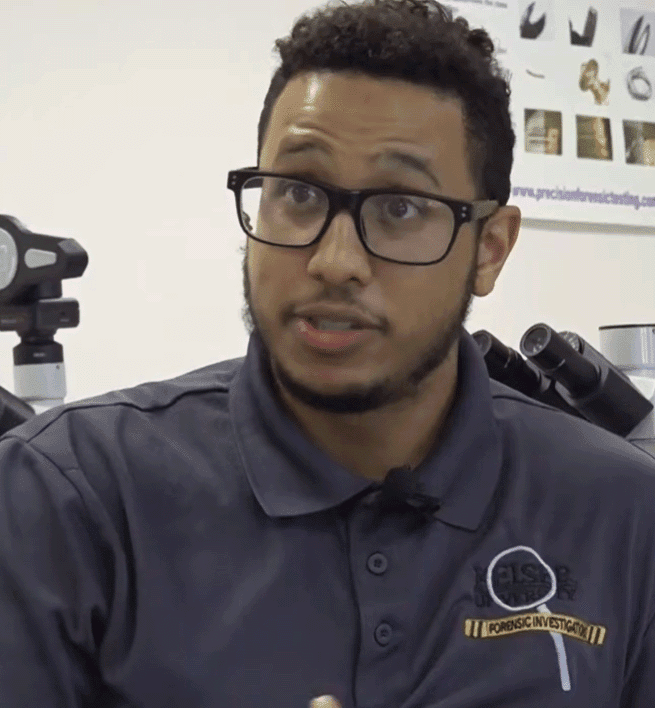
Testimonials

Frequently Asked Questions
School Information
Location
Why Accreditation Is Important
Attending an accredited institution means your education has met rigorous, independently reviewed quality standards designed to protect students.
This program: Keiser University is institutionally accredited by the Southern Association of Colleges and Schools Commission on Colleges (SACSCOC).
- A reliable indicator of educational quality
- Eligible for federal Title IV financial aid
- Recognized by employers nationwide
- Credits earned toward a respected credential