

Campus (formerly MTI College)

Paralegal Studies

Sacramento
Sacramento, CA
Associate Of Arts · 100% Online
Paralegal Studies
Campus is accredited by ACCJC, and its Paralegal Studies program is approved by the American Bar Association.
Online: live, synchronous classes with professors and classmates, which you attend remotely from wherever you are.
Program tuition is $19,520 ($2,440 per quarter at 7–12 credits), with books and supplies included in tuition.
This program takes about 2 years (96 instructional weeks) to complete when attending all four quarters each year.
No application fee is charged; a $20 enrollment deposit reserves your seat and may be refunded once catalog conditions are met.
Pell Grants, Cal Grants and other aid are available to those who qualify (FAFSA code 008680); Federal Direct Loans are not available for this program.

Paralegal Studies is an Associate Of Arts program (100% Online) offered by Campus (formerly MTI College) in Sacramento, CA. The program takes 96 weeks to complete, with a total tuition of $19,520.

Program Overview

The Paralegal Studies program at Campus prepares students for employment as paralegals working under the supervision of an attorney. The program is designed to strengthen the student’s ability to reason, understand, and apply correct principles of law by emphasizing analytical and critical thinking skills as well as practical application of substantive and procedural law.

The Associate of Arts in Paralegal Studies is a career-focused degree designed to prepare students for paralegal and legal support roles across today’s legal employment landscape. The program reflects how legal organizations function in practice, emphasizing legal reasoning, research, professional writing, ethical judgment, document production, and the responsible use of legal technology including artificial intelligence tools.

Students progress through three deliberate tiers. The Foundation Core (Tier I) builds the analytical, ethical, research, writing, technology literacy, and professional communication skills that fortify all legal work. The Substantive Law tier (Tier II) applies those skills to eight distinct areas of law and culminates in a dedicated Legal Operations & AI course. The Applied Practice & Integration tier (Tier III) delivers three courses of sustained, professional-standard work within one of four specialization tracks chosen by the student.

The program embeds preparation for the Westlaw Legal Research Certification and the Clio Certified Administrator credential. Every course in the program produces Portfolio Assessments (professional documents built from simulated legal matters) that students carry through the program.

Who the program is for. Two years, no legal background required. You'll learn the tools and workflows legal teams use now, and finish with an ABA-approved degree and a portfolio of practice-based work samples. This degree does not lead to a law license; paralegals are not licensed to practice law.

What sets this Program apart

  • In 2 years you can have an Associate of Arts in Paralegal Studies.
  • 100% live classes: every class meets live with your professor and classmates.
  • For students eligible for a full Pell Grant award, tuition costs may be fully covered.
  • ABA-approved: vetted against a national standard for paralegal education.
  • Rather than limiting AI to a single elective, we built it into the whole program, grounded in ABA Formal Opinion 512.

Admission Requirements and Process

Applicants must demonstrate academic readiness through review of application materials and participation in the admissions process. Applicants enrolling in distance education programs must demonstrate readiness for online learning, which may include completion of a readiness assessment, as well as access to a device with camera, audio, and video capabilities and reliable internet connectivity.

Applicants are required to complete a short application and an admissions interview with a member of our admissions team. Standardized test scores are not required. Campus does not participate in the Ability-to-Benefit program.

No legal experience or bachelor's degree is needed to start; the program assumes no prior legal background. This program requires students to complete a minimum of nine semester credits (or the equivalent) of legal specialty coursework through synchronous instruction.

General Requirements

  • Completed application
    You must submit a completed application for admission and meet all program-specific admissions requirements.
  • High school diploma or equivalent
    You must possess documentation of high school graduation or equivalent: a standard high school diploma, an evaluated foreign secondary credential, a GED certificate, a CHSPE…
  • Admissions interview
    You must complete an online interview with a member of the admissions team; submission of standardized test scores is not required.
  • Online learning readiness and technology
    You must demonstrate readiness for online learning, which may include a readiness assessment, and have a device with camera, audio and video capabilities plus reliable internet.
  • English proficiency
    Instruction for all programs is conducted in English, Campus does not offer ESL instruction, and all applicants must understand, read, speak and write fluently in English.
  • Academic readiness
    Admission decisions are based on an evaluation of your academic readiness, communication skills and ability to successfully complete the program.

Application Process

  1. 1
    Apply
    Submit a completed admission application. For most students this will take about 10-15 minutes.
  2. 2
    Complete an admissions interview
    Applicants are required to complete an online interview with a member of the Campus admissions team; standardized test scores are not required.
  3. 3
    Take placement assessment
    Meet any program-specific admissions requirements, which may include assessments, prerequisite education, prior experience, supporting documentation or a structured interview.
  4. 4
    Upload documents
    Provide documentation of high school graduation or equivalent, such as a standard high school diploma or a GED, HiSET or CHSPE certificate.
  5. 5
    Apply for financial aid
    Financial aid is available to those who qualify; complete the FAFSA using Campus FAFSA code 008680 (Cal Grant code 01291200).

Program Schedule

Distance education programs are offered during daytime and evening hours, Monday through Friday, across multiple U.S. time zones. Standard class meeting times may include 8:00 a.m. to 12:00 p.m., 1:00 p.m. to 5:00 p.m. and 6:00 p.m. to 10:00 p.m. Pacific Time, or 9:00 a.m. to 1:00 p.m. and 6:00 p.m. to 10:00 p.m. Eastern Time. Actual meeting times vary by course, program, and term.

The program requires 96 instructional weeks (88 weeks before Winter Term 2027).

Upcoming quarters (12-week terms) begin January 4, 2027 (Winter), March 29, 2027 (Spring), July 5, 2027 (Summer) and September 27, 2027 (Fall); orientation runs the first week and online synchronous courses begin the following week. The priority application deadline for Winter 2027 is November 13.

New cohorts start regularly throughout the year. Our start dates are as follows:
  • January 04th, 2027
  • March 29th, 2027
  • July 05th, 2027
  • September 27th, 2027

Cost of Attendance and Financial Aid Information

Cost and Financial Aid Information is an estimate for general reference only. It is not an offer or guarantee of financial aid or of any price, and what a School charges you may differ.
Total Program Tuition
≈ $19,520
Total Program Cost
≈ $19,535
FAFSA Code
Net Price Calculator

Tuition and fees. Program tuition is $19,520 for the entire program (96 quarter credits). The enrollment deposit is $20, books, supplies and equipment are included in tuition, and the Student Tuition Recovery Fund assessment is $0. The catalog lists estimated total charges of $19,535 for the entire educational program.

Per-credit and quarterly cost. Students enrolled in 7–12 credits per quarter are charged a flat tuition rate of $2,440. Students taking 6 credits or fewer are charged $200 per credit. Students enrolling in more than 12 credits are charged the flat rate of $2,440, plus $200 per credit for each additional credit above 12. The annual cost is $7,320 for three quarters (academic year) or $9,760 for four quarters (calendar year).

Federal Direct Loans. Students enrolled in this program are not eligible to receive Federal Direct Loans (Subsidized, Unsubsidized, or Parent PLUS). The Federal Direct Loan borrowing limit for this program is $0 for any academic year.

Financial aid. Campus participates in federal and state financial aid programs, which may include the Federal Pell Grant, the Federal Supplemental Educational Opportunity Grant (FSEOG), Federal Work-Study and the Cal Grant. Students seeking aid must complete the FAFSA. FAFSA Code: 008680. Cal Grant Code: 01291200. If you are eligible for a full Pell Grant award, you can attend Campus with no out-of-pocket tuition cost.

Scholarships and grants. Institutional awards include the Campus Grant (one-time grants from $100 to $4,000 for current students with demonstrated need and a cumulative GPA of 2.5 or higher) and the $500 Friends and Family Scholarship for new students referred by a current or former student, faculty member or employee.

Payment plans. Campus may offer institutional payment arrangements that allow tuition charges to be paid in installments, subject to institutional approval and applicable terms; availability may depend on credit considerations.

Military and veterans. This program is approved by the California State Approving Agency for Veterans Education (CSAAVE) for VA education benefits. Campus honors the Post-9/11 GI Bill (Chapter 33), Montgomery GI Bill (Chapters 30 and 1606), DEA (Chapter 35), Tuition Assistance and Top-Up, the California GI Bill, and Veteran Readiness and Employment (Chapter 31).

Cost of attendance (2026-27). Campus determines its cost of attendance in alignment with the California Student Aid Commission 2026-27 student expense budgets: books and supplies $1,305 per academic year; for students living with parents, food $12,537, transportation $1,206 and personal/miscellaneous $4,563 per year; for students in off-campus housing, housing $16,677, food $7,884, transportation $1,656 and personal/miscellaneous $5,706 per year.

Required Courses

Subject #NameCredits
AI.110Intro to AI4
COLL.140Purpose Driven Life4
COMM.115Applied Presentation & Communication4
ENGL.125English Composition4
ENGL.200Advanced Composition4
GE.150Introduction to Logic & Critical Thinking4
LGL.100Foundations of Paralegal Practice4
LGL.105Foundations of Ethical Practice4
LGL.110Legal Texts, Reasoning and Interpretation4
LGL.115Legal Research Methods & Analysis4
LGL.120Applied Legal Writing4
LGL.200Foundations of Family Law4
LGL.205Foundations of Criminal Law4
LGL.210Foundations of Corporate Law4
LGL.215Foundations of Contract Law4
LGL.216Foundations of eDiscovery4
LGL.220Foundations of Administrative Law4
LGL.222Foundations of Real Property Law4
LGL.225Legal Ops & AI4
LGL.230Employment Law4
LGL.235Torts4
LGL.240Trial Preparation & eDiscovery4
MATH.125Quantitative Reasoning4
SOC.100Introduction to Sociology4
Totals96

Career Outcomes

Paralegals and legal assistants work in law firms and legal services, corporate legal departments, local, state, and federal government agencies, and finance and insurance. Career outcomes and salaries vary by experience, employer, and location, and employment is not guaranteed.

Job titles reported by Campus graduates include Paralegal, Legal Assistant, Litigation Paralegal, Corporate Paralegal, Family Law Paralegal, Legal Administrative Assistant, Legal Secretary and eDiscovery Specialist. Standard Occupational Codes: 23-2011.00, 43-4031.00, 43-4071.00, 43-4171.00 and 43-6012.00.

Institutional outcomes. Campus reports a 72.1% graduation rate within 150% of normal time for its 2022 full-year cohort of first-time, full-time students, and institutional job placement rates for Campus programs of 58.8% unadjusted and 75.0% adjusted for the award year July 1, 2024 to June 30, 2025 (Student Right-to-Know Act Disclosure, published 07/01/2026).

What to expect as a Campus (formerly MTI College) student

Live classes. Classes in the Campus Scholars programs are live so that you can directly interact with professors and peers. We keep things engaging by holding lively discussions and debates, breakout sessions, forums, and more.

Tutoring. Students have unlimited access to 1:1 tutoring at no additional cost. Our tutoring services are accessible 24/7 so that you can get the academic support you need, wherever and whenever.

Office hours. Benefit from unprecedented access to professors from world-class universities and accomplished TAs through live 1:1 office hours. Faculty are available every week so you can make connections, build rapport, and deepen your knowledge.

Success coach. Before classes begin, you'll be matched with a personal success coach who will serve as your confidant, cheerleader, and advisor all the way through graduation.

Tech pack. Eligible online degree students who demonstrate need may receive a laptop and mobile Wi-Fi access at no additional cost. Campus also provides e-textbooks and digital course materials at no additional cost.

Social network. Through Campus, you'll meet like-minded individuals and create deep, meaningful relationships with your peers through student clubs and curated social events.

Events. Explore your career options through exclusive Campus-hosted events featuring industry experts from companies like Google, TikTok, and Spotify. Also enjoy game nights, trivia nights, and themed social events.

Campus Address

Sacramento
5221 Madison Ave.
Sacramento, CA 95841

Why Accreditation Is Important

Campus is accredited by the Accrediting Commission for Community and Junior Colleges (ACCJC), an institutional accrediting body recognized by the Council for Higher Education Accreditation and the U.S. Department of Education, and is approved to operate by the California Bureau for Private Postsecondary Education (BPPE). The Paralegal Studies program is approved by the American Bar Association (ABA), Standing Committee on Paralegals, under the Guidelines for the Approval of Paralegal Education Programs. ABA approval applies only to the specific program identified and does not extend to the institution or to any other programs offered.

  • A reliable indicator of quality
  • Approved program of study
  • Qualified instructors
  • Recognition by employers nationwide

Accreditations

ACCJC

Curriculum

You'll build the skills legal teams rely on every day, in the practice areas where paralegals actually work. You'll learn how to:

  • Conduct legal research on traditional and AI-powered platforms — and verify and cite what you find
  • Draft and manage legal documents to professional standards: memos, correspondence, pleadings, discovery
  • Apply core legal concepts across family, criminal, corporate, contract, administrative, and real property law
  • Handle professional responsibility in practice — confidentiality, privilege, conflicts of interest, and recognizing the line between paralegal work and work that requires attorney judgment
  • Evaluate legal technology and AI tools: what they can do, where they fail, what has to be disclosed, and when a person needs to step in
  • Manage case and file workflows, including deadlines and procedural timelines
  • Communicate professionally with clients, courts, agencies, and opposing parties

By graduation, you'll have completed the coursework required to be eligible to sit for the Westlaw Legal Research Certification exam and the Clio Certified Administrator exam.

Required Courses

Subject #NameTotalCredits
AI.110Intro to AI304
COLL.140Purpose Driven Life304
COMM.115Applied Presentation & Communication4
ENGL.125English Composition304
ENGL.200Advanced Composition304
GE.150Introduction to Logic & Critical Thinking304
LGL.100Foundations of Paralegal Practice404
LGL.105Foundations of Ethical Practice404
LGL.110Legal Texts, Reasoning and Interpretation404
LGL.115Legal Research Methods & Analysis404
LGL.120Applied Legal Writing404
LGL.200Foundations of Family Law404
LGL.205Foundations of Criminal Law404
LGL.210Foundations of Corporate Law404
LGL.215Foundations of Contract Law404
LGL.216Foundations of eDiscovery404
LGL.220Foundations of Administrative Law404
LGL.222Foundations of Real Property Law404
LGL.225Legal Ops & AI404
LGL.230Employment Law404
LGL.235Torts404
LGL.240Trial Preparation & eDiscovery404
MATH.125Quantitative Reasoning304
SOC.100Introduction to Sociology4
Totals82096

Images

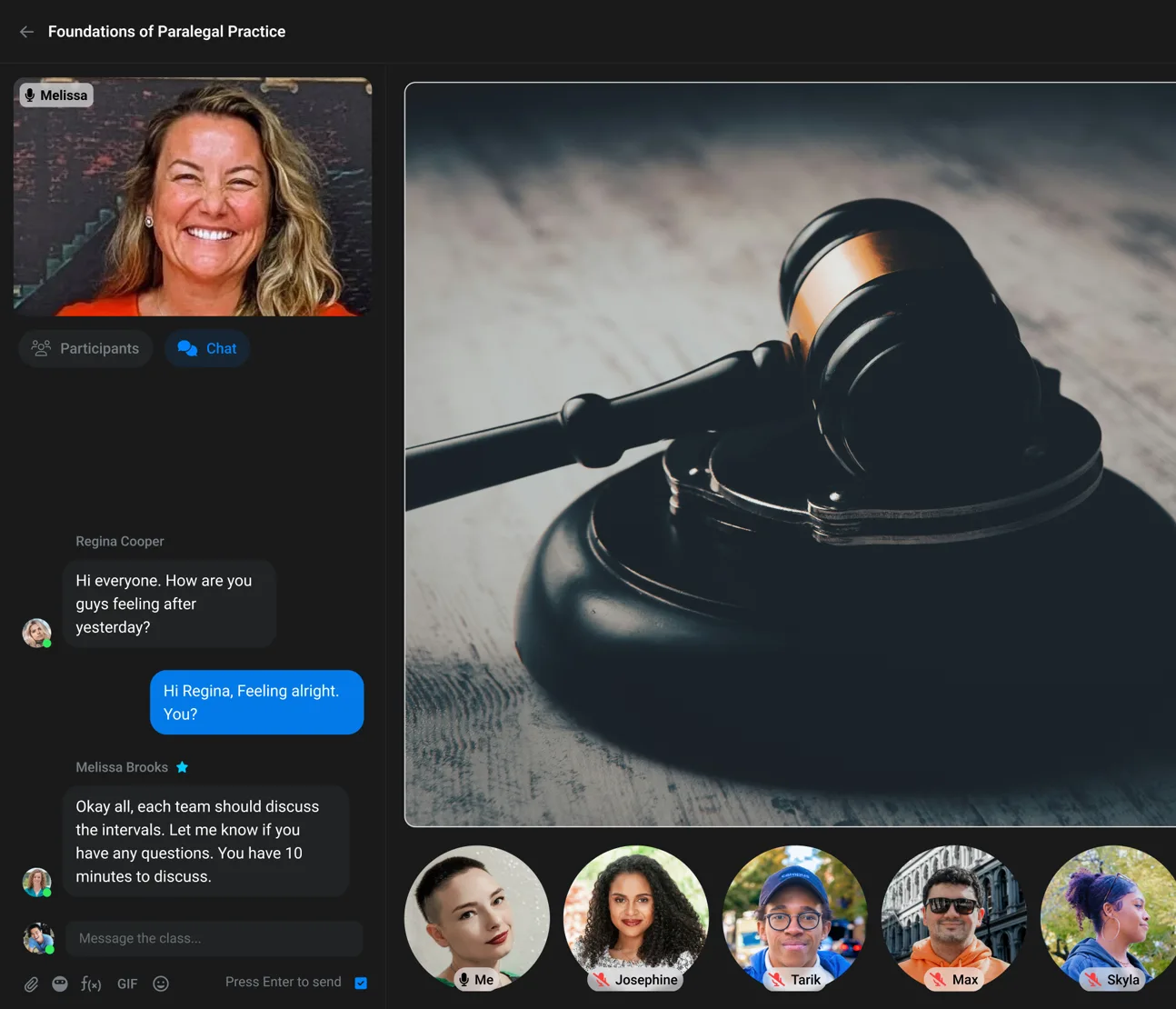
Live online Foundations of Paralegal Practice class

Frequently Asked Questions

Is Campus's paralegal program ABA-approved?
Yes. Campus’s Paralegal Studies program is approved by the American Bar Association’s Standing Committee on Paralegals under the Guidelines for the Approval of Paralegal Educational Programs. ABA approval applies to this program; the ABA does not accredit Campus or certify individual students or graduates.
Is Campus accredited?
Campus is institutionally accredited by the Accrediting Commission for Community and Junior Colleges (ACCJC), which is recognized by the U.S. Department of Education.
Can I become a lawyer with this degree?
No. Paralegals are not licensed to practice law, and this degree does not lead to a law license. What it can do is start you toward one: credits may apply toward a bachelor’s degree, and most law schools require a bachelor’s degree. Think of it as the first step on a longer path, not a shortcut around it. Graduates of this program are not licensed to practice law. Paralegals may not provide legal advice or legal services directly to members of the public, except as otherwise permitted by law.
What's the difference between a paralegal degree and a paralegal certificate?
A certificate is shorter — usually six to twelve months — and covers legal coursework only. If you already have a bachelor's degree, it's a legitimate and faster way in. An associate degree can take two years and includes general education alongside deeper legal coursework, plus the specialization track and portfolio. You finish with a full college degree rather than a credential that sits on top of one you already had. Which is better depends on where you're starting. If you don't already hold a degree, the associate can be a stronger foundation.
What does "live online" actually mean?
It means scheduled classes, in real time, with a professor and classmates who are there at the same time. Not recorded lectures you watch whenever. You'll need to be available when your classes meet, and you'll be expected to participate. This program requires students to complete a minimum of nine semester credits (or the equivalent) of legal specialty coursework through synchronous instruction.
Do I need legal experience or a bachelor's degree to start?
No. The program assumes no prior legal background. Tier I starts from how the legal system is structured and builds from there.
How much does it cost, and can I use financial aid?
Full program tuition for the entire degree program is $19,520, plus a $20 enrollment deposit, with books and supplies included. That works out to $2,440 per quarter at 7–12 credits. Yes, financial aid applies. Eligibility is determined through the FAFSA. Full Pell Grant recipients can attend with little to no out-of-pocket tuition costs. Financial aid is available to those who qualify. Eligibility is determined through the FAFSA and may vary by student. Campus does not guarantee financial aid or student loan approval.
Will I earn the Westlaw and Clio credentials?
By graduation, you'll have completed the coursework required to be eligible to sit for the Westlaw Legal Research Certification exam and the Clio Certified Administrator exam. Earning either credential requires passing its exam and is not automatic.
How is AI used in the curriculum?
It runs through the whole program rather than sitting in one elective. You'll work with AI research and drafting tools from your first quarter, learn about the ethical issues addressed in ABA Formal Opinion 512, disclose your use of them on written assignments, and finish by designing AI-assisted workflows in the capstone. The goal is judgment, not enthusiasm — knowing what these tools do well, where they fail, what you're obligated to disclose, and when a person has to make the call.
Can I transfer these credits toward a bachelor's degree?
The program is designed with transfer opportunities to four-year legal studies and related bachelor's programs in mind, and we'll help you through the process. Transfer credit is determined by the receiving institution; admission is not guaranteed. Have questions? Talk to admissions. Our admissions advisors are here to answer questions and help you navigate the admissions process. Get in touch with us Apply now for the next term If you're savvy, ambitious, and looking to knock out the first two years of college while learning from some of the best professors in the country, we should talk. Apply now

Other Programs at Sacramento

Campus (formerly MTI College) in Sacramento, CA also offers these 20 programs at 5221 Madison Ave., Sacramento, CA 95841.

Campus (formerly MTI College)

Barbering

Certificate

On-CampusFinancial Aid
Sacramento
Sacramento, CA
Next start
Jan 4, 2027
Duration
30 Weeks
1,000 clock hours / 40 quarter credits
App fee
None
Tuition
$14,000 for the Program
Campus (formerly MTI College)

Business Administration

Associate Of Arts

OnlineFinancial Aid
Sacramento
Online · 100% remote
Next start
Jan 4, 2027
Duration
96 Weeks
96 quarter credits
App fee
None
Tuition
$19,520 for the Program
Campus (formerly MTI College)

Business Administration with Applied AI Concentration

Associate Of Arts

OnlineFinancial Aid
Sacramento
Online · 100% remote
Next start
Jan 4, 2027
Duration
96 Weeks
96 quarter credits
App fee
None
Tuition
$19,520 for the Program
Campus (formerly MTI College)

Business Administration with Digital Marketing & Creator Economy Concentration

Associate Of Arts

OnlineFinancial Aid
Sacramento
Online · 100% remote
Next start
Jan 4, 2027
Duration
96 Weeks
96 quarter credits
App fee
None
Tuition
$19,520 for the Program
Campus (formerly MTI College)

Business Administration with Healthcare Concentration

Associate Of Arts

OnlineFinancial Aid
Sacramento
Online · 100% remote
Next start
Jan 4, 2027
Duration
96 Weeks
96 quarter credits
App fee
None
Tuition
$19,520 for the Program
Campus (formerly MTI College)

Business Administration with Salon Management Concentration

Associate Of Arts

OnlineFinancial Aid
Sacramento
Online · 100% remote
Next start
Jan 4, 2027
Duration
96 Weeks
96 quarter credits
App fee
None
Tuition
$19,520 for the Program
Campus (formerly MTI College)

Cosmetology

Certificate

On-CampusFinancial Aid
Sacramento
Sacramento, CA
Next start
Jan 4, 2027
Duration
30 Weeks
1,000 clock hours / 40 quarter credits
App fee
None
Tuition
$14,000 for the Program
Campus (formerly MTI College)

Cosmetology and Barbering

Certificate

On-CampusFinancial Aid
Sacramento
Sacramento, CA
Next start
Jan 4, 2027
Duration
36 Weeks
1,200 clock hours / 48 quarter units
App fee
None
Tuition
$16,800 for the Program
Campus (formerly MTI College)

Healthcare Administration

Associate Of Science

OnlineFinancial Aid
Sacramento
Online · 100% remote
Next start
Jan 4, 2027
Duration
96 Weeks
96 quarter credits
App fee
None
Tuition
$19,520 for the Program
Campus (formerly MTI College)

Healthcare Administration with Applied AI Concentration

Associate Of Science

OnlineFinancial Aid
Sacramento
Online · 100% remote
Next start
Jan 4, 2027
Duration
96 Weeks
96 quarter credits
App fee
None
Tuition
$19,520 for the Program
Campus (formerly MTI College)

Information Technology

Associate Of Science

OnlineFinancial Aid
Sacramento
Online · 100% remote
Next start
Jan 4, 2027
Duration
96 Weeks
96 quarter credits
App fee
None
Tuition
$19,520 for the Program
Campus (formerly MTI College)

Information Technology with Applied AI Concentration

Associate Of Science

OnlineFinancial Aid
Sacramento
Online · 100% remote
Next start
Jan 4, 2027
Duration
96 Weeks
96 quarter credits
App fee
None
Tuition
$19,520 for the Program
Campus (formerly MTI College)

Information Technology with Cybersecurity Concentration

Associate Of Science

OnlineFinancial Aid
Sacramento
Online · 100% remote
Next start
Jan 4, 2027
Duration
96 Weeks
96 quarter credits
App fee
None
Tuition
$19,520 for the Program
Campus (formerly MTI College)

Medical Assistant

Certificate

HybridFinancial Aid
Sacramento
Sacramento, CA
Next start
Jan 4, 2027
Duration
33 Weeks
44 quarter credits
App fee
None
Tuition
$14,940 for the Program
Campus (formerly MTI College)

Medical Assistant with Phlebotomy

Certificate

HybridFinancial Aid
Sacramento
Sacramento, CA
Next start
Jan 4, 2027
Duration
38 Weeks
50 quarter credits
App fee
None
Tuition
$18,100 for the Program
Campus (formerly MTI College)

Medical Billing and Coding Professional

Certificate

HybridFinancial Aid
Sacramento
Sacramento, CA
Next start
Jan 4, 2027
Duration
37 Weeks
42 quarter credits
App fee
None
Tuition
$14,800 for the Program
Campus (formerly MTI College)

Medical Billing and Coding Specialist

Certificate

OnlineFinancial Aid
Sacramento
Online · 100% remote
Next start
Jan 4, 2027
Duration
33 Weeks
37 quarter credits
App fee
None
Tuition
$14,800 for the Program
Campus (formerly MTI College)

Phlebotomy

Certificate

On-CampusFinancial Aid
Sacramento
Sacramento, CA
Next start
Jan 4, 2027
Duration
12 Weeks
6 quarter credits
App fee
None
Tuition
$4,250 for the Program
Campus (formerly MTI College)

Professional Foundations

Certificate

OnlineFinancial Aid
Sacramento
Online · 100% remote
Next start
Rolling enrollment
Duration
36 Weeks
34 quarter credits
App fee
None
Tuition
$6,800 for the Program
Campus (formerly MTI College)

Vibe Coding 101

Continuing Education

OnlineFinancial Aid
Sacramento
Online · 100% remote
Next start
Rolling enrollment
Duration
8 Weeks
8 weekly live classes
App fee
None
Tuition
$1,500 for the Program
Ready to get started?
Request information about Paralegal Studies at Sacramento.
Paralegal Studies