New Castle School of Trades

Electrical Technology

New Castle Main Campus
New Castle, PA
Associate In Specialized Technology Degree · Hybrid
Electrical Technology
Accredited by ACCSC (Accrediting Commission of Career Schools and Colleges); licensed by the Pennsylvania State Board of Private Licensed Schools.
Hybrid: hands-on training at the New Castle, PA campus with day or evening classes, plus some non-technical courses delivered online through Canvas.
Tuition is $23,984.
This program takes about 60 weeks to complete. Published lengths are instructional weeks; actual length is typically longer due to holidays and breaks.
A $25 registration fee is charged to enroll.
Financial aid is available for those who qualify, including Pell Grants, FSEOG, PA State Grant and Direct Loans (FAFSA school code 007780).

Electrical Technology is an Associate In Specialized Technology Degree program (Hybrid) offered by New Castle School of Trades in New Castle, PA. The program takes 60 weeks to complete, with a total tuition of $23,984.

Program Overview

This program is designed to provide students with entry level knowledge and skills to install and service electrical applications within the residential/ commercial and industrial fields. The program covers in practice and theory residential/commercial wiring, machine control, programmable controllers, telecommunications, solid state and electronic control.

New Castle School of Trades offers an industry-recognized course for electricians taught by instructors with years of industry experience.

Enrolling in an electrician training program will help an individual gain the skills and experience needed to begin a rewarding career as an electrician. New Castle, PA has developed its programs to meet the needs of companies around the Pennsylvania and Ohio area looking for entry-level employees with a firm grasp of electrical and electronic service techniques.

What sets this Program apart

Equipment. Throughout the program, students will work with the following types of equipment: various types of meters, conduit benders, all phases of motor control equipment, 3-phase motors, single phase motors, assorted residential, commercial, and industrial components, oscilloscope and programmable logic controllers.

Graduate career services. The New Castle School of Trades qualified staff offers students the following career services: Professional development advising, assistance with employment applications and resumes, cover letters, extending invitations to prospective employers and contacting potential employers.

Admission Requirements and Process

Applicants must possess a high school diploma or General Equivalence Diploma (GED) or earned an associate degree or higher from a post-secondary school to meet the basis of admissions; and must pass an entrance evaluation. For all programs the minimum evaluation score is 75. Applicants must also demonstrate, through a personal interview, the desire to complete the course and benefit from the training. The school makes the final decision on all applicants based on the information submitted on the applicant’s qualification form, test results and the representative’s recommendation.

Online Readiness Assessment: Applicants of programs containing distance education courses are assessed for readiness during the school’s admission process. If a candidate scores in the developing range, the school will provide additional online training with the instructor in Core Competencies or be given the option to enroll in programs that do not have distance education.

General Requirements

  • High school diploma or GED
    Applicants must possess a high school diploma or General Equivalence Diploma (GED), or have earned an associate degree or higher from a post-secondary school.
  • Entrance evaluation
    Applicants must pass an entrance evaluation with the minimum score of 75; previous New Castle School of Trades graduates are not required to retake it when entering a new program.
  • Personal interview
    Applicants must demonstrate, through a personal interview with an admissions representative, the desire to complete the course and benefit from the training.
  • Campus tour
    Applicants tour the school as part of enrollment; the school states that touring the campus is mandatory before enrollment.
  • Online readiness assessment
    Because this program contains distance education courses, applicants are assessed for online readiness during the admission process, and the school provides orientation to…
  • School policies
    Applicants must have the willingness to work within the school policies and procedures.

Application Process

  1. 1
    Visit the school
    Applicant visits the school and fills out an Enrollment Information Sheet.
  2. 2
    Admissions interview
    Applicant is interviewed by an Admissions Representative and receives a web link to access the school catalog.
  3. 3
    Tour the school
    Applicant tours the school; the tour is mandatory before enrollment.
  4. 4
    Enrollment assessment
    Applicant takes the enrollment assessment (minimum evaluation score of 75).
  5. 5
    Complete the enrollment paperwork
    Applicant fills out the enrollment paperwork.
  6. 6
    Financial aid interview
    Applicant is interviewed by Financial Aid; students complete the FAFSA using NCST federal school code 007780.
  7. 7
    Enrollment agreement
    Applicant accepts or rejects the Enrollment Agreement.
  8. 8
    Pay the registration fee
    Applicant pays the $25 registration fee.

Program Schedule

Classes are scheduled between 8:00 A.M.-1:30 P.M., 5:30 P.M.-11:00 P.M., Monday through Thursday. Students will attend class five and one-half hours per day.

The Electrical Technology Program is available for both day or evening training at the New Castle Campus.

Upcoming class start: December 9, 2026 (evening classes, New Castle Campus). New students may enter class no later than the third day of the quarter.

All published program lengths reflect instructional weeks and actual program lengths are typically longer due to scheduled holidays and breaks. Classes are in continuous session during all months of the calendar year.

New cohorts start regularly throughout the year. Our start dates are as follows:
  • December 09th, 2026

Cost of Attendance and Financial Aid Information

Cost and Financial Aid Information is an estimate for general reference only. It is not an offer or guarantee of financial aid or of any price, and what a School charges you may differ.
Total Program Tuition
≈ $23,984
Total Program Cost
≈ $25,245
FAFSA Code
Net Price Calculator

Tuition and books. Tuition is $23,984 and books are $1,261 (Tuition and Fees Schedule, revised 1/1/2026). Total tuition cost for the programs includes tools/equipment and uniform shirts.

Required fees. The only required fee is the $25 Registration Fee that covers the administrative cost of enrolling a student.

Program cost and median debt. This program will cost $25,245 if completed within normal time. There may be additional costs for living expenses. Of the students who completed this program within normal time, the typical graduate leaves with $9,852 of debt (Median Loan Debt Disclosure, revised July 1, 2026).

Books and supplies. Books, kits, and supplies are available through NCST and can be rolled into the financial plan each student creates during the admissions process. The 2026 list for this program includes: Chromebook; Access to Canvas Learning Management System; Disc Exercise; Cengage Unlimited; Residential Construction Academy: House Wiring, 5e; Delmar's Standard Textbook of Electricity, 8e; National Electrical Code, 1e; Illustrated Guide to the National Electrical Code, 9e; Understanding Motor Controls, 4e; Introduction to Electronics, 6e; Electrical Wiring Industrial, 18e; Technician's Guide to Programmable Controllers, 6e; Introductory Technical Mathematics, 7e; 21st Century Business: Intro to Business, 2e; Business Law: Text & Exercises, 9e; 21st Century Business: Customer Service, 2e; Personal Finance, 14e; Ugly's Electrical References, 2026 Edition; Troubleshooting Electric Motors, 5e.

Payment. Quarterly tuition is due on the first day of class. However, a monthly payment plan is available; monthly tuition is calculated by prorating the amount of tuition owed for the quarter. The school provides a voluntary prepayment plan to help reduce the balance due upon entry, and students who take the school’s private financing plan for the balance not satisfied by Federal Student Financial Aid pay an annual interest rate of 12%.

Financial aid. Grants: Federal Pell Grant, Federal Supplemental Education Opportunity Grant (FSEOG), PA State Grant. Loan programs: Federal PLUS Loan, Subsidized and Unsubsidized Federal Direct Loans, Alternative Loan Program (Tuition Financing). In order to be considered for any of these grants or loan programs, a prospective student must complete a FAFSA. NCST Federal School Code: 007780. Financial aid is available for those who qualify.

Veterans and other funding. New Castle School of Trades is approved to train veterans under Vocational Rehabilitation (Chapter 31), VEAP (Chapter 32), Post 9/11 (Chapter 33), Montgomery GI Bill® (Chapter 30) and Selected Reserve (Chapter 1606). Other programs include the Pennsylvania Office of Vocational Rehabilitation (OVR), the Workforce Innovation and Opportunity Act (WIOA) and the Trade Adjustment Act (TAA).

Net Price Calculator. https://www.ncstrades.edu/net-price-calculator/

Required Courses

Subject #NameCredits
E105Electricity & Residential Wiring12
E106Circuitry, Services & Conduit9
E205AC/DC & Motors12
E206Motor Control15
E207Solid State Electronics12
E208Programmable Logic Controllers12
DEM150Core Competencies3
DEM205Technical Math3
DEM206Applied Math3
DER228Business Management3
DER229Service & Finance3
DER230Computers & Job Search3

Career Outcomes

Graduates of the Electrical Technology program will be able to assume entry level positions as panel builders and testers, machine repair technicians, electrical assemblers, electrical helper, electrical apprentice, industrial maintenance technician.

Graduation and employment rates. Per the ACCSC 2025 Annual Report, the graduation rate was 76% (72 of 95 students) and the employment rate was 85% (58 of 68 graduates); includes graduates that started the program between June 1, 2022 and May 31, 2023.

The following States do not have licensure requirements for this profession: Pennsylvania, Ohio, and West Virginia.

No ethical school can guarantee employment. Employment success is greatly influenced by the student’s attendance record, academic performance, previous employment history/record and overall attitude.

Campus Address

New Castle Main Campus
4117 Pulaski Road
New Castle, PA 16101

Why Accreditation Is Important

New Castle School of Trades is accredited by ACCSC (Accrediting Commission of Career Schools and Colleges). Licensed by the Pennsylvania State Board of Private Licensed Schools, Pennsylvania Department of Education, and approved for the training of eligible veterans.

  • A reliable indicator of quality
  • Approved program of study
  • Qualified instructors
  • Recognition by employers nationwide

Accreditations

Accrediting Commission of Career Schools and Colleges (ACCSC)

Student Demographics

These are demographics for all students at the New Castle Main Campus (IPEDS, 2024).

Gender Distribution
Women12%(84)
Men88%(616)
Race/Ethnicity Distribution
Primary Ethnic Group
White
74.1% · 519 students
White74.1% · 519
Black/African American17.1% · 120
Two or More Races4.7% · 33
Hispanic/Latino2.4% · 17
International Students1.1% · 8
Asian0.3% · 2
American Indian/Alaska Native0.1% · 1
Native Hawaiian/Pacific Islander0% · 0

Curriculum

The Electrical Technology program consists of 90 quarter credits (1,320 clock hours). The order in which the courses are offered is at the discretion of the school.

Course descriptions.

  • E105 Electricity & Residential Wiring (12 credit hours). This is the study of the fundamental principles of electricity, the history of electricity, structure of matter, and their elements. The theory of basic electricity relative to atoms, electric charges, electron theory, how electricity is produced, alternating and direct current, the effect of electricity and magnetism, the use of multimeters, circuit components, Ohm’s Law pertaining to series and parallel circuits. This course studies the fundamentals of switching circuits, preventing overloads, single and multi-pole switches, and other various types of controlling devices for domestic, commercial and industrial facilities. Students practice the fundamentals of circuit applications through the use of various electrical components in this lab class. Switches, receptacles, wiring, etc. are used to set up project circuits related to different types of specific field operations that the student may encounter.
  • E106 Circuitry, Services & Conduit (9 credit hours). This course continues dealing with circuit applications and the usage of various devices, applying the National Electric Code regulations and grounding methods that apply to local codes. The student will also study calculation and installation of residential services, the types of bends angle and length of conduit, the how’s and why’s to use a given size service for a specific home, and the parts of a service from the service drop down through the watt-hour meter to the panel to the branch circuits. Prerequisite: E105.
  • E205 AC/DC & Motors (12 credit hours). This class is the study of power sources. Kirchhoff’s Law, series parallel circuits, inductive and capacitance AC/DC circuits, power factors and transformer fundamentals, with hands-on projects. A fundamental study involving definitions, NEMA Standards and the construction of various types of single-phase motors. The study of operations, characteristics of split phase motors, three phase motors and troubleshooting various motors. Prerequisite: E105.
  • E206 Motor Control (15 credit hours). A study of theory relative to various types of controls, used in industry to include the practical understanding of logic and safety conditions required for the efficient control of single machines or a complex system. The course applies the various types of controls, design methods of motor controls, control transformers, fuses, disconnect circuit breakers, relay timers, solenoids and motor starters, extensive applications relative to the types of controls limit switches, temperature controls and switches, timer’s counters, and the types of motor starters for different types of electrical systems. Troubleshooting control devices and their circuits are also emphasized in this course. Prerequisite: E105.
  • E207 Solid State Electronics (12 credit hours). This theory is the study of solid-state components, diodes, transistors, operational amplifiers, timers, SCR’s and their application. Upon completion of this course the student will be able to troubleshoot electronic circuits. An in-depth study of electronic theory, electronic components through the building of discrete electronic circuits, power supplies, a robot and other basic electronic components. Students will also use various types of test equipment, to include: oscilloscopes, breadboards, multimeters and signal generators. Prerequisite: E105.
  • E208 Programmable Logic Controllers (12 credit hours). This course will focus on the underlying principles of how PLCs operate and also provide practical information about installing, programming, and maintain a PLC system. No previous knowledge of PLC systems or programming is assumed. Prerequisite: E105.
  • DEM150 Core Competencies (3 credit hours). This course will offer students the strategies they need to succeed in school, life and their professional career. Students will learn to balance areas of their lives, know themselves better, and discover their personal route to achieve and much more. Students will also study the mathematics and learn how to apply this material toward their respective trade.
  • DEM205 Technical Math (3 credit hours). This course includes basic algebraic operations to include; solving single and multiple variable equations, solving word problems, scientific notation and powers and exponents of variables and their application. Operations with signed numbers are also applied. Prerequisite: M150.
  • DEM206 Applied Math (3 credit hours). This course provides the student with experiences in using basic plane and solid geometry along with right angle trigonometry, with the usage of algebra, in the solution of math problems. Prerequisite: M150.
  • DER228 Business Management (3 credit hours). This course involves the study of economic systems and then focuses on a free enterprise system, problems relative to business, business finance, business start-up, record keeping, organizing, planning as well as personal financial skills.
  • DER229 Service & Finance (3 credit hours). This course prepares the student for the key concepts needed to build their own financial plans and their career. Understanding personal finances, evaluating and making financial decisions, anticipating shortages and problems that can disrupt financial plans are the main areas of focus. In addition, communication skills needed by a technician to deal in a positive manner with a customer are studied. In general, while studying basic human behavior, the student will become a more valuable asset to an employer by being better able to handle customer complaints.
  • DER230 Computers & Job Search (3 credit hours). This course provides effective job search techniques with emphasis placed on the written and verbal aspects of job placement. Topics include the final resume, employment applications, interviewing techniques, and how to find job openings. Computer usage to create a resume and carry out employment research is required.

Required Courses

Subject #NameCredits

Images

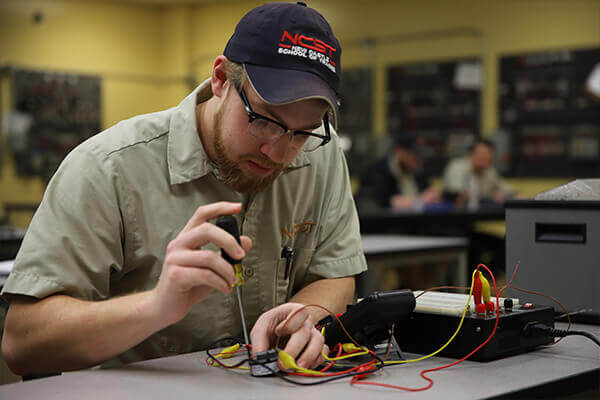
Electrician student with screwdriver in hand working on an open piece of equipment
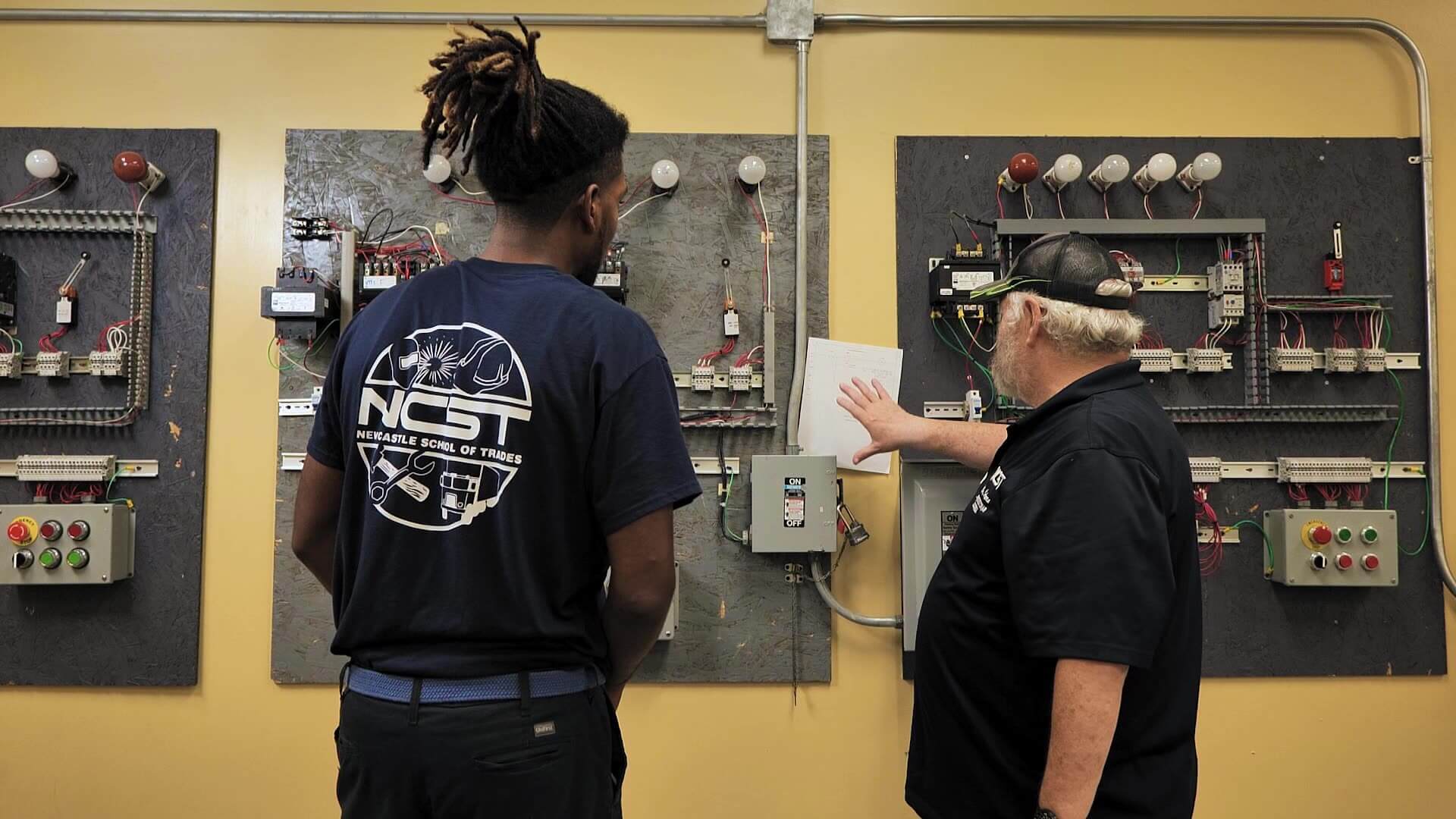
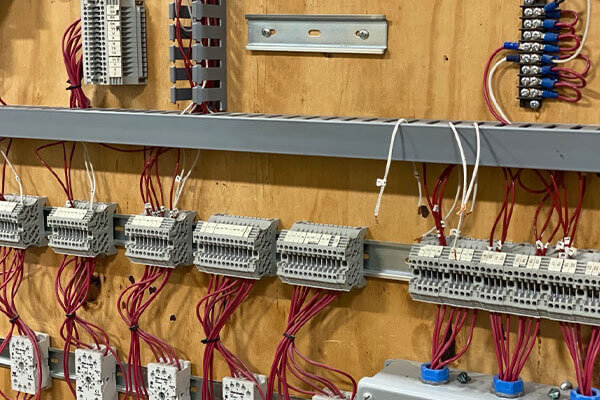
Wall covered in electrical wiring
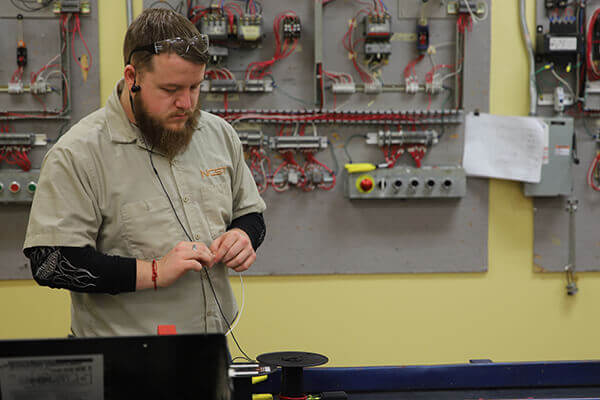
Electrician student working on wiring
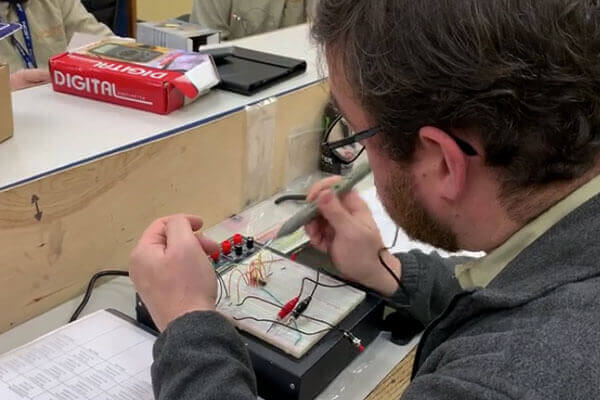
Electrical student working on a wiring part in the classroom

Videos

Other Programs at New Castle Main Campus

New Castle School of Trades in New Castle, PA also offers these 13 programs at 4117 Pulaski Road, New Castle, PA 16101.

New Castle School of Trades

Automotive Technology

Associate In Specialized Technology Degree

HybridFinancial Aid
New Castle Main Campus
New Castle, PA
Next start
Dec 9, 2026
Duration
60 Weeks
90 quarter credits, 1,320 clock hours
App fee
$25
Tuition
$25,289 for the Program
New Castle School of Trades

Building Technology

Associate In Specialized Technology Degree

HybridFinancial Aid
New Castle Main Campus
New Castle, PA
Next start
Dec 9, 2026
Duration
60 Weeks
90 quarter credits, 1,320 clock hours
App fee
$25
Tuition
$22,894 for the Program
New Castle School of Trades

Combination Welding

Diploma

HybridFinancial Aid
New Castle Main Campus
New Castle, PA
Next start
Dec 9, 2026
Duration
50 Weeks
75 quarter credits, 1,200 clock hours
App fee
$25
Tuition
$22,339 for the Program
New Castle School of Trades

Commercial Driving Class B

Diploma

On-CampusFinancial Aid
New Castle Main Campus
New Castle, PA
Next start
Dec 10, 2026
Duration
2.2 instructional weeks
4.5 quarter credits, 82.5 clock hours
App fee
$25
Tuition
$2,189 for the Program
New Castle School of Trades

Commercial Truck Driving

Diploma

On-CampusFinancial Aid
New Castle Main Campus
New Castle, PA
Next start
Dec 10, 2026
Duration
6 Weeks
13 quarter credits, 225 clock hours
App fee
$25
Tuition
$6,470 for the Program
New Castle School of Trades

Diesel & Heavy Equipment Repair Technology

Associate In Specialized Technology Degree

HybridFinancial Aid
New Castle Main Campus
New Castle, PA
Next start
Oct 27, 2026
Duration
60 Weeks
100.5 quarter credits, 1,680 clock hours
App fee
$25
Tuition
$27,651 for the Program
New Castle School of Trades

Heavy Equipment Operations with Commercial Truck Driving

Diploma

On-CampusFinancial Aid
New Castle Main Campus
New Castle, PA
Next start
Oct 27, 2026
Duration
30 Weeks
50 quarter credits
App fee
$25
Tuition
$19,156 for the Program
New Castle School of Trades

Industrial Electro-Mechanical Technology

Associate In Specialized Technology Degree

HybridFinancial Aid
New Castle Main Campus
New Castle, PA
Next start
Oct 27, 2026
Duration
60 Weeks
90 quarter credits, 1,320 clock hours
App fee
$25
Tuition
$25,211 for the Program
New Castle School of Trades

Machinist & CNC Manufacturing

Diploma

HybridFinancial Aid
New Castle Main Campus
New Castle, PA
Next start
Rolling enrollment
Duration
44 Weeks
60 quarter credits, 1,056 clock hours
App fee
$25
Tuition
$18,117 for the Program
New Castle School of Trades

Motorcycle & Power Equipment Technology

Associate In Specialized Technology Degree

HybridFinancial Aid
New Castle Main Campus
New Castle, PA
Next start
Oct 27, 2026
Duration
60 Weeks
90 quarter credits, 1,320 clock hours
App fee
$25
Tuition
$24,918 for the Program
New Castle School of Trades

Pennsylvania Emissions Training Class

Continuing Education

On-CampusFinancial Aid
New Castle Main Campus
New Castle, PA
Next start
Dec 8, 2026
Duration
2 Days
2 evenings, 4:00 PM – 8:00 PM
App fee
$40
Tuition
$175 for the Program
New Castle School of Trades

Pennsylvania State Inspection Class

Continuing Education

On-CampusFinancial Aid
New Castle Main Campus
New Castle, PA
Next start
Rolling enrollment
Duration
Evening class sessions, 4:00 PM to 8:00 PM
Evening sessions, 4:00–8:00 PM
App fee
—
Tuition rate
$180 / course
not a program total
New Castle School of Trades

Refrigeration & A/C Technology

Associate In Specialized Technology Degree

HybridFinancial Aid
New Castle Main Campus
New Castle, PA
Next start
Dec 9, 2026
Duration
60 Weeks
90 quarter credits, 1,320 clock hours
App fee
$25
Tuition
$23,945 for the Program
Ready to get started?
Request information about Electrical Technology at New Castle Main Campus.
Electrical Technology