Electrical Technology is a Diploma program offered by Porter and Chester Institute in Waterbury, CT. The program takes 12 months to complete, with a total tuition of $27,260.
Program Overview
The Electrical Technology program consists of 1200 hours of instruction (74 quarter credit hours) in Connecticut and is available in two schedules. Both the Day and Evening sessions require twelve months for completion on the basis of approximately 22-27 hours of instruction per week. All terms of the program are independent, thus the sequence in which they are offered to students may vary.
This program is currently taught residentially (all classes and labs on campus) in CT and MA, and, in CT only, in a Hybrid format (lecture material on-line and hands-on skills on-campus). As part of their materials, students receive a device which is fully compatible with the Learning Management System (LMS) used in both delivery methods. Veterans’ Benefits are only available for the residential version of this program.
This program intensively covers the installation and maintenance of industrial, commercial, and residential electrical systems. Students will develop an understanding of the national electric code and how it applies to safe electrical systems function. Emphasis is placed on acquiring proficiency in the use of analytical instruments, as well as the mastery of the principles under which electrical systems function.
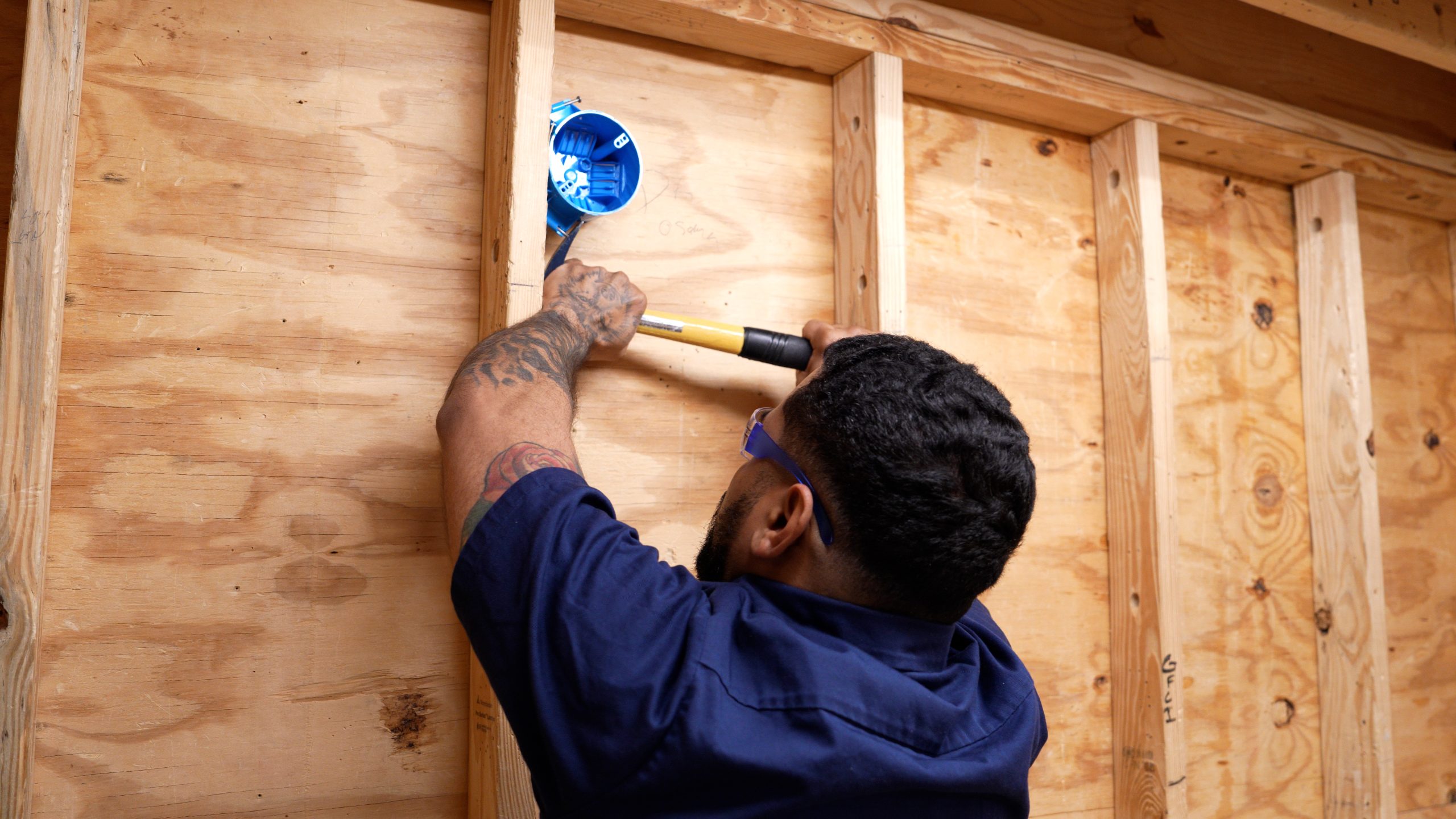
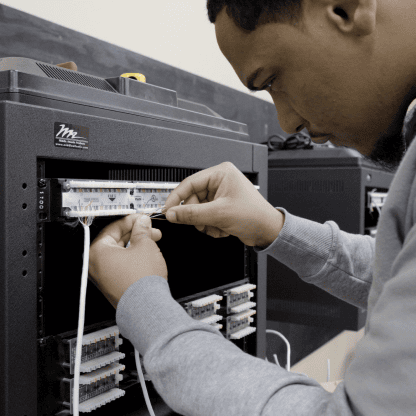
The Electrical labs are equipped with the same kinds of equipment currently in use in residential, commercial, and industrial buildings. In addition to this, students utilize a variety of analytical equipment, meters, gauges, and different kinds of specialized hand tools needed for this occupation.
Delivery at this campus. On-Ground Electrical Technology Program (lectures and labs on campus). On-ground availability is anticipated for classes beginning 01/11/27.
What sets this Program apart
If you like working with your hands and learn best by actually getting up and performing a task, electrician training from Porter and Chester Institute could give you the results you want:
Concrete Skills. We’ll teach you the fundamentals you need to know about electricity, electrical code and safety. Then, we’ll teach you a whole lot more –like how to install electrical power distribution systems, how to wire and connect circuitry and how to work on motors, transformers, generators and the electronic systems in mechanical tools.
Hands-on Training. It’s not just what you learn; it’s also how you learn it. If you’re a hands-on learner, then you’ll appreciate all the time you’ll get to spend in the lab working on real electrical units with actual industry equipment.
Road to Licensure. At our Connecticut campuses, our electrician classes will help you understand the National Electrical Code and help you prepare to take the L-6 Limited Electrical Journeyperson and the E-2 Unlimited Electrical Journeyperson licensure exams.
Qualified Instructors. Our instructors are all professionals from the electrical industry. They know how to teach, but more importantly they know what you’re likely to encounter once you’re out on the job. Their years of experience and connections to employers make them an invaluable resource to you and your career.
Admission Requirements and Process
Prior to enrollment at the Institute, an applicant must have graduated from high school or have acquired a state high school equivalency diploma or graduated from a college degree program. Instruction is only offered in English, requiring proficiency in written and spoken English.
Applications for admission are accepted throughout the year. Students may begin classes in the Spring, Summer, Fall or Winter. Students are encouraged to make early application for admission, as some forms of financial aid give preference to early applicants; and whenever aid is limited, it is made available to the first applicants.
General Requirements
- High school diploma or equivalentProvide proof of high school graduation or the equivalent (HS equivalency diploma based on performance on GED, HiSET or other state approved test; or college degree).
- Admissions interviewEvery applicant must complete a successful interview with an Admissions Representative to determine compatibility for the program and receive a positive recommendation from the…
- English proficiencyInstruction is only offered in English, requiring proficiency in written and spoken English.
- Readiness QuestionnaireAll applicants complete a Readiness Questionnaire to assess their preparedness for managing school, and the On-Line Readiness Survey to prepare for the electronic Learning…
- Ability to finance tuitionDemonstrate the ability to financially afford the tuition through loans, grants, personal payments, or other means.
- Steps to SuccessAgree to follow Porter and Chester Institute’s student professionalism code, via acknowledgement of the “Steps to Success” document.
Application Process
- 1Request informationRequest information online or speak with an Admissions Representative to learn about programs and enrollment.
- 2Interview with an Admissions RepresentativeComplete a successful interview with an Admissions Representative to determine compatibility for the program and receive a positive recommendation.
- 3Apply onlineComplete the application for admission using PCI’s automated application portal, where you can upload your documents and start the financial aid process.
- 4Apply for financial aidCreate your FSA ID and file the FAFSA using Porter and Chester Institute’s FAFSA code 010779; an Educational Funding Specialist can help you with the process.FAFSA Code for Waterbury: 010779Complete FAFSA Application
- 5Complete enrollmentComplete the enrollment requirements and the Institute’s Enrollment Agreement, then attend the mandatory online or on-campus New Student Orientation held each term.
Program Schedule
On-Ground program. Lectures and labs on campus. On-ground availability is anticipated for classes beginning 01/11/27.
This program is currently taught residentially (all classes and labs on campus) in CT and MA, and, in CT only, in a Hybrid format (lecture material on-line and hands-on skills on-campus).
Classes in the residential versions of Automotive Technology, CADD, CNT, Electrical Technology, HVACR and Plumbing meet Monday - Thursday from 7:00 AM-2:00 PM or 4:00 PM to 10:00 PM at selected campuses only.
Day Schedule: Automotive Technology, Electrical Technology, HVACR, Low Voltage Technology, and Plumbing are typically scheduled over seven (7) hours per day (e.g., 7:00 AM to 2:00 PM) Monday-Thursday and include up to 60 minutes of scheduled breaks. Students receive approximately 360 minutes (6 hours) of instruction per day.
Students will need approximately 25 hours per week for instruction (whether online or on campus), activities and simulations and for on-campus lab work, with an additional six hours per week for reading assignments and other homework activities.
Upcoming class starts published in the catalog's Program and Term Schedule are January 11, 2027; March 22, 2027; May 31, 2027; August 16, 2027; October 25, 2027; January 17, 2028; and March 27, 2028. If, in the opinion of the Institute, there is insufficient enrollment to make the class start of a program session or section feasible, the Institute reserves the right to cancel that class.
- January 11th, 2027
- March 22nd, 2027
- May 31st, 2027
- August 16th, 2027
- October 25th, 2027
- January 17th, 2028
- March 27th, 2028
Cost of Attendance and Financial Aid Information
Tuition is $5,452 per term for 5 terms, for total tuition of $27,260. The Materials Fee is $3,620. Program fee by term: Term 1: $3,200; Terms 2–4 ($100 per term): $300; Term 5: $120.
Program fees may include materials, laboratory, technology, and graduation expenses. These fees are applied at various points throughout the student’s training, depending on the specific requirements of the program. All applicable fees are disclosed in the student’s Enrollment Agreement and are included as part of the overall cost of attendance. The Materials Fee covers all books, devices, tools, instruments, uniforms, supplies, and other materials that the students will receive from PCI during the course of their attendance in their program. Even if costs increase, students will never pay more than the fee specified in their Enrollment Agreement.
There are no additional charges for programs delivered via Distance Education (Hybrid or fully Online). After deducting all anticipated educational funding from the total charges for each term, any balance due to the Institute must be paid by the student out-of-pocket prior to the start of each term. Or, the student may request a monthly payment plan. The first payment on a monthly payment plan is due prior to the start of the first term.
Financial aid is available for those who qualify. Federal Title IV programs available to qualified students include Federal Direct Subsidized Loans, Federal Direct Unsubsidized Loans, Federal Direct PLUS Loans, Federal Pell Grants and the Federal Supplemental Educational Opportunity Grant (FSEOG). PCI also participates in the Imagine America scholarship program and offers institutional grants and awards to specific student populations.
Veterans’ Benefits are only available for the residential version of this program. All Porter and Chester Institute campuses are approved to train veterans and their qualified dependents who are eligible for Veterans Administration educational benefits.
FAFSA code: 010779 (all PCI campuses other than Hamden). Use the Porter and Chester Institute Net Price Calculator to estimate how much your total career training program will cost you.
Cost of Attendance (COA). For federal student aid purposes, postsecondary institutions must estimate a student’s total cost of attending the institution for a specified period of time, as established by law. The COA includes tuition and fees; room and board (or an allowance for housing and food); an allowance for books, supplies, transportation, loan fees, and dependent care (if applicable); disability related expenses, and some miscellaneous expenses as well. Below is Porter and Chester’s estimate of a student’s cost of attendance, including estimated living expenses.
- Tuition and Fees: Actual (student living with parents); Actual (student with dependents)
- Books and Equipment: Included in the Student Services Fee (student living with parents); Included in the Student Services Fee (student with dependents)
- Room and Board: $906/month (student living with parents); $1576/month (student with dependents)
- Personal Expenses: $231/month (student living with parents); $353/month (student with dependents)
- Transportation: $348/month (student living with parents); $348/month (student with dependents)
- Loan Fees (other): $25/month (student living with parents); $25/month (student with dependents)
- Disability Costs: Actual (student living with parents); Actual (student with dependents)
Curriculum
The Electrical Technology program consists of 1200 hours of instruction (74 quarter credit hours) in Connecticut and is available in two schedules. Both the Day and Evening sessions require twelve months for completion on the basis of approximately 22-27 hours of instruction per week. All terms of the program are independent, thus the sequence in which they are offered to students may vary.
Required Courses
| Subject # | Name | Credits |
|---|---|---|
Career Outcomes
Graduates from the Electrical Technology program will have sufficient knowledge and skill for entry-level employment as an electrical helper or apprentice. Because electricians work wherever electricity is used, the career opportunities are diverse. Graduates may be hired for new construction or maintenance in the following locations:
- Office Buildings
- Manufacturing Plants
- Shopping Malls
- Warehouses
- Homes
- Resorts and Hotels
- Transportation Terminals
- Hospitals and Clinics
- Food Preparation and Packaging
- Retail Stores and Wholesalers
Licensing and certification. This program has been approved at the CT campuses for the 720 “Related Instruction” hours required for the Connecticut E-2 license. Only courses passed with a grade of 75 or higher are counted toward Related Instruction hours. Candidates also need to accrue 8,000 hours of work in the field (approximately four years) prior to being eligible to apply to sit for the licensing exam. As part of their program, PCI students have the opportunity to earn their OSHA 30 certification.
Graduation and employment rates. From the 2025 ACCSC annual report, for the 10/2022-9/2023 start cohort at this campus, Electrical Technology reported a graduation rate of 71% and an employment rate of 73% (starting population 73, graduate population 52).
How these rates are calculated. Porter and Chester Institute calculates a Graduation Rate and an Employment Rate for each program using formulas specified by our accrediting agency, the Accrediting Commission for Career Schools and Colleges (ACCSC). The graduation rate formula uses a cohort of students who began school during a given 12 month reporting period as the denominator, and as the numerator uses the number of students from that group who graduated within 150% of the program length. The employment rate formula uses a cohort of students who began school during a given 12 month reporting period and proceeded to graduate as the denominator. Those of the cohort whose self-reported employment in their field of training, or a related field has been verified by the school, form the numerator. The rate is calculated for the cohort after 150% of the program length has elapsed for all students in the cohort, with an additional three month allowance for placement related activities.
Graduation rate for the student body. The graduation rate for first-time full-time students who began their studies at Porter Chester Institute in Fall 2019 (310 students) and graduated within 150% of their program length (178 students) is 57.4%.
Where graduates work. Waterbury campus graduates are working at employers such as Aerial Electric, Gleason Electric, Trinity Solar.
What to expect as a Porter and Chester Institute student
The Waterbury campus consists of approximately 62,500 square feet of space. All classrooms are air-conditioned, brightly illuminated and tiled or carpeted. There are approximately 300 parking spaces on the premises. Each curriculum division operates its own reference library which contains appropriate resource materials and multimedia. All student workstations are equipped with the same kinds of tools, equipment, and instrumentation in current use by advanced industrial and commercial firms.
Each term, each campus holds a mandatory online or on-campus New Student Orientation, specifically for the incoming student body. Key staff are on hand to share important information.
Campus Address
Why Accreditation Is Important
Porter and Chester Institute is accredited by the Accrediting Commission of Career Schools and Colleges (ACCSC). Porter and Chester Institute is authorized by the Connecticut Office of Higher Education to operate as a private career school in Connecticut.
- A reliable indicator of quality
- Approved program of study
- Qualified instructors
- Recognition by employers nationwide
Accreditations
Images