




Southern California Institute of Technology
A.S. Biomedical Engineering Technology
On-CampusFinancial Aid
Anaheim
Anaheim, CA
General Electrician is a Diploma program offered by Southern California Institute of Technology in Anaheim, CA. The program takes 8 Months to complete.
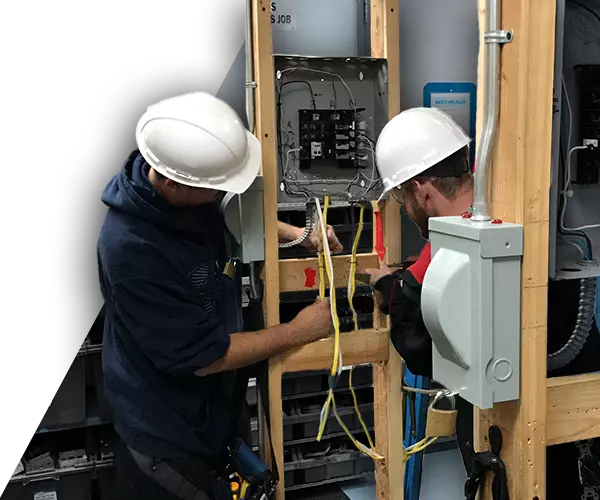
Learn residential, commercial and industrial electrical installation accordant with the National Electrical Code (NEC) in an 8 month, hands-on program aimed at preparing you for a range of electrical professions.
The General Electrician program is an accelerated 8 month training program designed for students to learn electrical installation and troubleshooting for three broad sectors: Residential, Commercial and Industrial. Students learn how to interpret and apply the National Electrical Code (NEC) through a combination of lecture and extensive hands-on lab work. SCIT is approved by the California Department of Industrial Relations (DIR), Division of Apprenticeship Standards to offer the Whole General Electrician Curriculum.
FULLY ONLINE
All courses are taken fully online with trainers utilized for labs completed at home.
The first step is to request information for an Admissions Advisor to educate you about the school and the process. Most programs start every 5 weeks* and applications are accepted on a continual basis.
We strive to keep the cost of education affordable and transparent. Our program costs include all books and materials, and are structured where the costs are locked when a student enrolls. Financial aid is available to those who qualify and, for most eligible students, covers a large portion of the costs. Program costs are subject to change and may take time to be published on our website. Please contact the Admissions Office for the most up-to-date cost for each program.
| Tuition* | Course Fees | Books & Materials | Total |
|---|---|---|---|
| 17,160 | 2100 | 1830 | 21,090 |
* Based on $390 per unit cost and includes available discounts.
| Tuition* | Course Fees | Books & Materials | Total |
|---|---|---|---|
| 17,050 | 2600 | 1440 | 21,090 |
* Based on $390 per unit cost and includes available discounts.
| Tuition* | Course Fees | Books & Materials | Total |
|---|---|---|---|
| 17,550 | 2100 | 1135 | 20,785 |
* Based on $390 per unit cost and includes available discounts.
| Tuition* | Course Fees | Books & Materials | Total |
|---|---|---|---|
| 19,500 | 0 | 1470 | 20,970 |
* Based on $390 per unit cost and includes available discounts.
| Tuition* | Course Fees | Books & Materials | Total |
|---|---|---|---|
| 36,660 | 3800 | 2620 | 43,080 |
* Based on $390 per unit cost and includes available discounts.
| Tuition* | Course Fees | Books & Materials | Total |
|---|---|---|---|
| 35,490 | 3750 | 2725 | 41,965 |
* Based on $390 per unit cost and includes available discounts.
| Tuition* | Course Fees | Books & Materials | Total |
|---|---|---|---|
| 70,980 | 1575 | 4995 | 77,550 |
* Based on $390 per unit cost and includes available discounts.
| Tuition* | Course Fees | Books & Materials | Total |
|---|---|---|---|
| 70,980 | 1275 | 4390 | 76,645 |
* Based on $390 per unit cost and includes available discounts.
| Tuition* | Course Fees | Books & Materials | Total |
|---|---|---|---|
| 70,200 | 1175 | 4075 | 75,450 |
* Based on $390 per unit cost and includes available discounts.
| Tuition* | Course Fees | Books & Materials | Total |
|---|---|---|---|
| 71,675 | 500 | 3415 | 75,675 |
* Based on $390 per unit cost and includes available discounts.
Program tuition is locked when you enroll and does not increase throughout the time of your enrollment.*
Discounts when enrolling in two or more programs designed as a pathway to go from training for a trade to earning a degree.
Pell Grants are awarded on the basis of financial need and do not have to be repaid. They are provided by the federal government and are awarded to students who demonstrate the greatest financial need and have completed their financial aid application.
The federal government will pay interest on this loan while you are enrolled in college at least half-time. Eligibility is based on financial need and repayment begins six months after leaving school or dropping below half-time enrollment.
Unsubsidized loans are available to all eligible students and are not based on financial need. You will accrue interest for the life of the loan, which begins accruing once the loan funds have been disbursed. You can defer paying this interest while in school, grace and periods of deferment and forbearance. If you make in-school interest payments you will have a lower monthly payment once in repayment.
Through the Parent Loan for Undergraduate Students (PLUS) program, parents of undergraduate students may borrow up to the annual cost of attendance minus any financial aid. The Federal PLUS loan program is designed to assist parents of dependent undergraduate students who are unable to meet their expected parental contribution or have additional financial need that is not met with other financial aid resources. Your parents may borrow up to the cost of your education for the academic year less any estimated financial aid you receive each academic year. This loan is limited to parents who have a positive credit check.Award Amounts cannot exceed the student's cost of education minus other aid received. Repayment begins 60 days after the loan is fully disbursed in the same academic year.
Work-study is money that students may earn by working a part time job while attending school. The program allows you to gain work experience and pay for a part of your educational expenses as you earn your award. Funds for this program come from the federal government as well as the school and are awarded based on need.
Applying for financial aid can be confusing and some of the questions on the FAFSA may be unclear. Our Financial Aid Office assists students (and parents) throughout the process. Our goal is to simplify and streamline the process so that you can review any aid you are eligible to receive to fund your education. Our office will work with you once you begin the admissions process.
Cal Grants are grants provided by the State of California for qualified educational institutions. Due to the need for educational institutions to recertify eligibility to receive Cal Grants, please check with the Financial Aid Office for the current awards available.
Cal Grant A awards can be used for tuition and fees. Applicants must be working toward a two-year or four-year degree.
Cal Grant B awards provide low-income students with a living allowance and assistance with tuition and fees. The minimum course length is one academic year.
Cal Grant C awards help pay for tuition and training costs at occupational or career colleges. To qualify, you must enroll in a vocational program that is at least four months long. Funding is available for up to two years, depending on the length of your program.
The program's curriculum is designed for students to build their knowledge and skills toward entering the electrical field for any of the three major sectors: Residential, Commercial and Industrial. Students begin with principles of electricity and then move toward learning and applying the National Electrical Code (NEC) for residential and commercial electrical installation, culminating with a team project to wire a mock home based on electrical blueprints. Following the NEC wiring courses, students complete the industrial applications portion of their training by studying and performing a multitude of lab projects related to electric motor control and programmable logic controllers (PLC). Students are also introduced to various specialty electrical installation concepts including alarm system installation, low voltage wiring, and installation of renewable energy sources (e.g. wind and solar power installation).
Students learn about basic electrical theory and electronic circuits. Topics include: AC/DC concepts, circuit elements and analysis, semiconductor electronic concepts, digital electronic concepts, op-amps, and more. Students work on multiple electronic projects that reinforce concepts learned in the classroom.
As the name implies, residential electrical wiring is the wires and components that are installed in homes. Students learn how to install wiring and electrical devices that adhere to the national electrical code (NEC): the common standard used for the safe installation of electrical wiring and equipment. When one asks whether or not an electrical wiring job “meets code”, they are usually referring to the NEC code.
Students learn how to wire switches, receptacles (e.g. outlets you plug things into), light fixtures, panels, and more. Additionally, students are introduced to conduit bending with electrical metallic tubing (EMT), which is the metal that encases electrical wiring; students learn about ninety degree bends, saddle bends and kicks.
Students learn to install large conduit and cabling in metal framed environments in addition to electrical components that are more common in commercial settings, such as fluorescent lighting fixtures. Commercial wiring is similar to residential wiring, but it is often on a much larger scale to meet commercial needs. Instead of a home, imagine the electrical wiring and components necessary for steel high-rise structures that require working with higher voltages and amperage.
Students are introduced to special electrical topics such as renewable energy installation (e.g. solar panels and wind turbine installation), low voltage electrical installations (e.g. data cabling), alarm/fire system installation, and other topics related to the field.
Students learn electric motor installation and control techniques by completing multiple lab projects involving DC and AC motors. Electric motors play a vital role in many applications, including manufacturing lines, factories and elevator systems. There are various types of electric motors and control mechanisms to ensure proper operation of electric motors.
Students train to program Allen Bradley PLC units for various real-world simulations and applications. Examples of PLC applications include traffic light control, elevator control, manufacturing line control, and much more.
The following are some key topics studied in the General Electrician program:
Learn how to apply the NEC code as it relates to electrical installation of residential and commercial job sites by wiring switches, receptacles, light fixtures, electrical panels, and much more.
Study a wide range of the NEC, branching into a variety of specialty topics to include installation of renewable energy sources (i.e. solar panels and wind turbines), low voltage wiring, alarm system installation, and more.
Train to install, control and troubleshoot electric motors used in a variaty of commercial and industrial applications.
Learn to perform ladder logic programming of Allen Bradley programmable logic controllers (PLC) to perform a variety of industrial simulations involving a broad range of electrical and electromechanical inputs and outputs.
An Electrical Engineering bachelor’s degree may also reduce the amount of work experience that the State of California requires for those wanting to take the C-10 Electrical Contractor Licensing Test.
The Student Services and Career Services Offices support you on your educational path to greater career opportunities.
Academic Support: Advisement, academic monitoring, tutoring, and more...
Career Support: Resume assistance, career workshops, job leads, and more...

Last updated
Southern California Institute of Technology in Anaheim, CA also offers these 9 programs at 525 North Muller Street, Anaheim, CA 92801.
Diploma
Diploma
Diploma