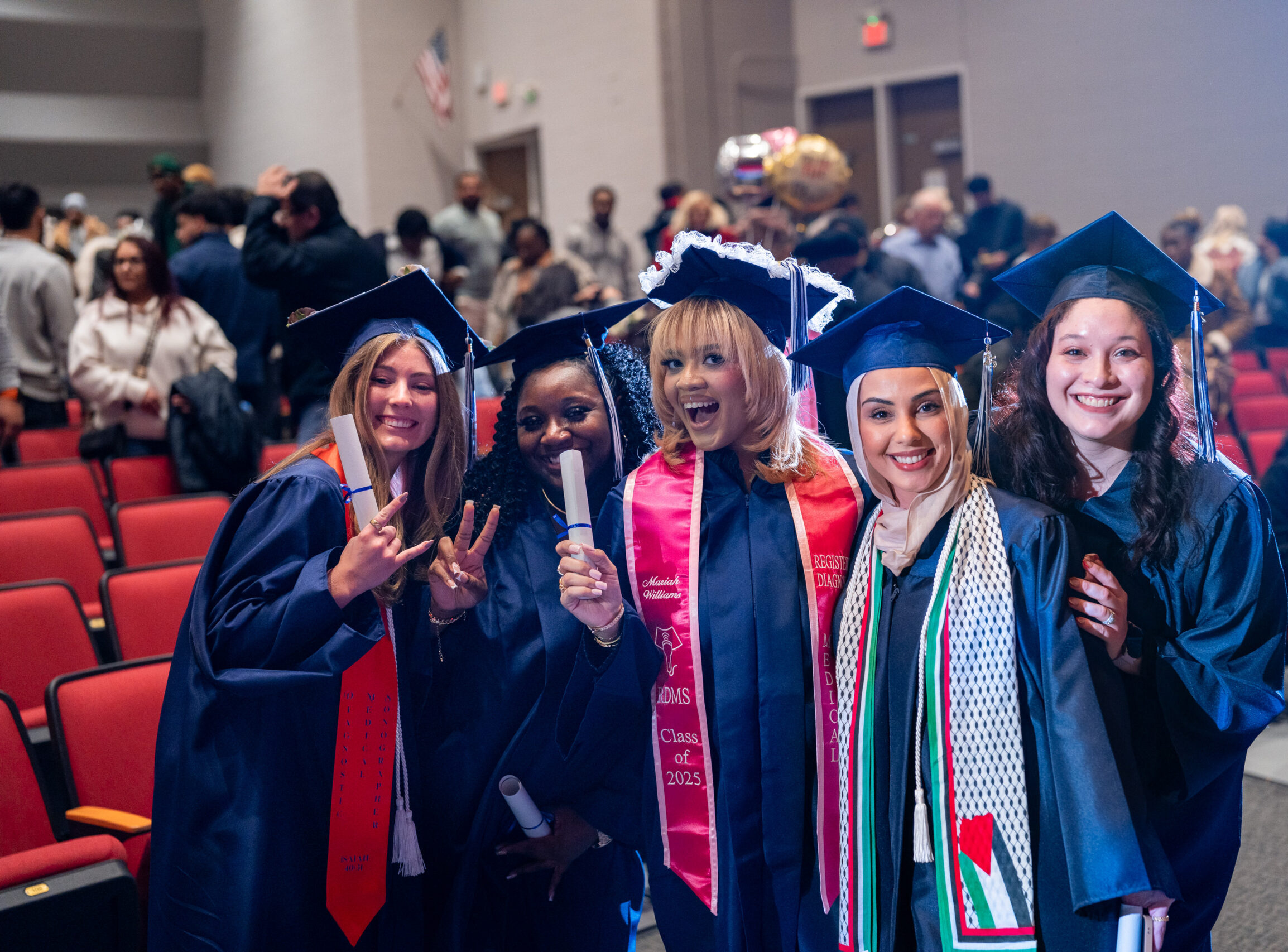

Surgical Technology is an Associate Degree program (Hybrid) offered by Stautzenberger College in Maumee, OH. The program takes 18 months to complete, with a total tuition of $28,000.
Program Overview
The Associate of Applied Science degree in Surgical Technology program curriculum has been carefully designed to blend didactic instruction, hands-on training in the lab and clinical work to ensure that learners develop the requisite knowledge, skills, and behaviors necessary to gain employment as entry-level surgical technologists and become contributing members of the multidisciplinary health care workforce. In addition to attendance in all courses, students will be required to complete out-of-class assignments. These assignments include, but are not limited to, reading and problem solving exercises, projects, research, written papers, and presentations. A student can anticipate out-of-class activities that equal about two (2) hours for every one (1) hour of lecture. Students are encouraged to obtain entry- level employment as a surgical technologist in the medical industry.
Program Outcomes. Upon successful completion of this program, students should be able to:
- Demonstrate knowledge of basic sciences related to surgical technology. (Cognitive).
- Recognize and assist with emergency situations. (Cognitive, psychomotor).
- Demonstrate application and knowledge of competencies of aseptic technique (Cognitive, psychomotor).
- Practice within ethical and legal standards in relation to patient, physician, hospital, and personnel. (Cognitive, psychomotor and affective).
- Demonstrate skills in oral and written communications including the application of ethical and legal principles (Cognitive, psychomotor and affective).
- Apply knowledge of anatomy and physiology to surgical procedures. (Cognitive, psychomotor and affective).
- Prepare and function as a Surgical Technologist during pre-, intra-, and post-surgical procedures. (Cognitive, psychomotor and affective).
- Demonstrate application and knowledge related to workplace and patient safety (Cognitive, psychomotor and affective).
- Establish and maintain effective interpersonal relationships. (Affective).
- Demonstrate continuing educational growth. (Cognitive).
- Demonstrate employability skills. (Cognitive, psychomotor and affective).
What sets this Program apart
Why Choose the Surgical Technology Program at Stautzenberger College
- Hands-On Surgical Training: Practice operating room setup, instrument handling, and sterile technique in fully equipped lab environments.
- Supervised Clinical Experience: Gain real-world experience during a hospital externship that prepares you for high-pressure surgical settings.
- Expert Faculty Support: Learn from certified surgical professionals with real OR experience and a passion for teaching.
- Career-Focused Services: Get help with job placement, resume building, and interview prep through our dedicated career services team.
Admission Requirements and Process
All students must demonstrate completion of a high school diploma, a recognized equivalency certificate (GED), a State-authorized examination recognized as the equivalent of a high school diploma (such as HiSET or TASC), a qualifying home-school diploma, or official transcripts of a conferred Associate, Bachelor’s, Master’s, or Doctoral degree from an accredited postsecondary institution. All students must also pass a Digital Learning Readiness Assessment (DLRA) with a technical competency score of 70 or higher, must be at least seventeen (17) years of age, and must be interviewed by an admissions advisor prior to enrollment.
Students applying for this program must successfully pass the Wonderlic entrance examination with a minimum score of 22. An applicant who does not achieve the required score may be given a second attempt after a minimum 24-hour waiting period; if unsuccessful, the waiting period increases to 14 days, and failure on the third attempt will result in the inability to enroll at the College.
- Complete required health screenings, immunizations, a background check, and drug screening.
General Requirements
- Minimum ageYou must be at least seventeen (17) years of age; students under eighteen (18) must have a parent or legal guardian sign the enrollment agreement.
- High school diploma or equivalentYou must document a high school diploma, a recognized equivalency certificate (GED), a State-authorized equivalency examination such as HiSET or TASC, a qualifying home-school…
- Digital Learning Readiness AssessmentEvery student must pass the Digital Learning Readiness Assessment (DLRA) with a technical competency score of 70 or higher, because all students use the College’s Learning…
- Admissions interviewBefore enrolling, every prospective student is interviewed by an admissions advisor to determine whether they have the maturity, motivation, commitment and dedication to succeed…
- Wonderlic entrance examPass the Wonderlic entrance examination with a minimum score of 22. An applicant who does not pass may retest after 24 hours and again after 14 days; failing the third attempt…
- Health screenings and background checkComplete required health screenings, immunizations, a background check, and drug screening.
Application Process
- 1Complete Your ApplicationOur admissions team is here to guide you through the application process, making it as quick and easy as possible.
- 2Meet with an Admissions AdvisorEvery applicant meets with an admissions advisor, who will answer your questions, walk you through the process and help you determine if this is the right path for your goals and lifestyle.
- 3Gather Your Academic RecordsWe’ll help you collect any required transcripts or documents from previous schools, so we can recommend a program path that aligns with your background, goals, and ambitions.
- 4Take Your Placement TestThis isn’t a test to stress over—it’s just a tool to help us better understand your current skills and place you in the courses where you’ll thrive.
- 5Meet with Financial AidOur experienced financial aid specialists are here to walk you through the options—grants, scholarships, and loans—to help make your education affordable and accessible. Start by completing the FAFSA (school code 004866).
Program Schedule
Concentration courses are delivered on-ground at the Maumee campus, general education courses are delivered online, and the remaining student-success courses are delivered on-ground or online (catalog delivery method: Blended).
Most programs are blended, combining scheduled on-campus classes with online coursework. You’ll typically take two classes every five weeks and should plan for 12–15 hours per week of homework and studying. Instructors also offer live virtual office hours for extra support.
The school’s program page does not list the next start date; contact admissions for upcoming starts.
Cost of Attendance and Financial Aid Information
Estimated tuition for this program is $28,000 (based on the current term rate; tuition rates are subject to change for future terms), with estimated fees of $4,775 and estimated books of $800. Estimated first-term costs are $5,075.
Fees include a $200 Administrative Fee, a $150 Academic Success Fee, and a $200 Technology Fee for each and every 10-week term, and a $150 Graduation Fee. A one-time $225 Fee is applied to programs with an externship or clinical component.
Students are billed each quarter based on the number of credit hours in which they are enrolled for the quarter and the cost per credit hour for their program. Tuition payments are billed on a quarterly basis and are due at the beginning of each term unless alternative arrangements have been approved; you’re only charged for the quarters in which you are enrolled.
Financial aid is available for those who qualify. The following financial aid programs are available to qualifying students at Stautzenberger College: Federal Pell Grant, Federal Supplemental Educational Opportunity Grant (FSEOG), Direct Subsidized and Unsubsidized Loans, Federal PLUS Loans, Federal Work Study, Workforce Investment Act (WIA), private rehabilitation benefits, alternative loan / cash payment programs and U.S. Department of Veterans Affairs benefits. Students seeking financial aid must first complete the Free Application for Federal Student Aid (FAFSA); the school code for Stautzenberger College is 004866.
Stautzenberger College assists the student and their family in developing a payment plan to enable the student to complete their program. The College also makes available a Retail Installment Contract financing option for students who have not been able to obtain sufficient financing through federal, state, or alternative financial aid options.
In honor of the College’s Centennial, prospective students may apply for a $250 Stautzenberger 100th Anniversary Scholarship by submitting an essay or video; see an admissions advisor for procedures and deadlines.
Estimate your costs with the Stautzenberger Net Price Calculator: https://sctoday.clearcostcalculator.com/student/
Curriculum
Hands-On Surgical Training for Real OR Experience
- Surgical Techniques & Procedures: Learn how to assist during surgeries, maintain sterile fields, and anticipate the surgeon’s needs.
- Anatomy, Physiology & Microbiology: Understand the human body, infection control, and principles of aseptic technique.
- Medical Terminology & Pharmacology: Build the language and drug knowledge required in clinical and surgical settings.
- Surgical Instrumentation & Equipment: Identify and handle surgical tools safely and accurately for a variety of procedures.
- Clinical Externship: Participate in supervised training at a local hospital or surgical center to apply what you’ve learned.
Required Courses
| Subject # | Name | Credits |
|---|---|---|
Career Outcomes
Surgical technologists are critical to the success of surgical teams, ensuring every procedure runs smoothly and safely. As the need for surgeries increases and healthcare technology advances, skilled surgical techs are consistently in demand across hospitals, outpatient surgery centers, and specialty clinics.
Graduates of the Surgical Technology AAS program may pursue roles such as:
- Surgical Technologist
- Operating Room Technician
- Central Sterile Processing Technician
- Surgical First Assistant (with additional credentials)
- Endoscopy or Ambulatory Surgery Technician
Most recent graduation and employment rates reported to ACCSC (published January 2026) for this program: graduation rate 36% and employment rate 89% (cohort time frame July 2022 – June 2023).
Campus Address
Why Accreditation Is Important
Stautzenberger College is institutionally accredited by the Accrediting Commission of Career Schools and Colleges (ACCSC) and licensed by the Ohio State Board of Career Colleges and Schools (Maumee registration 99-10-1523T). The Surgical Technology Associate Degree program at the Maumee campus is programmatically accredited by the Accrediting Bureau of Health Education Schools (ABHES).
ACCSC placed the College on Warning in October 2025 and continued that Warning on May 26, 2026; the College states it remains accredited.
- A reliable indicator of quality
- Approved program of study
- Qualified instructors
- Recognition by employers nationwide
Accreditations
Testimonials
Images