

Electro-Mechanical Technologies is a Diploma program (Hybrid) offered by Tulsa Welding School in Phoenix, AZ. The program takes 38 weeks to complete, with a total tuition of $22,000.
Program Overview
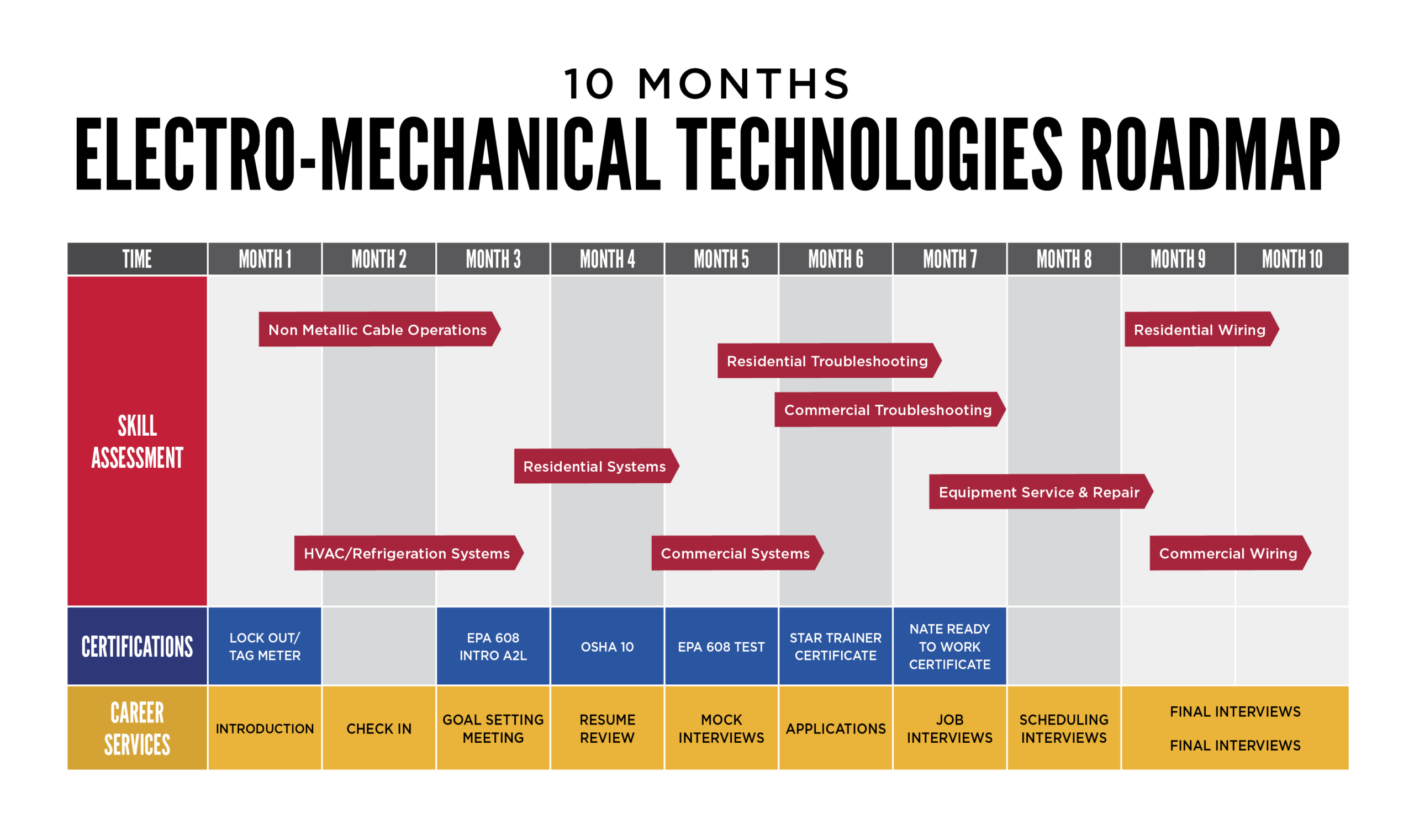
Complete your Electromechanical Technologies training in 10 months. Our program blends cutting-edge training in HVAC/R, electrical systems, and solar energy to prepare you for today's most in-demand roles.
Start your electromechanical technician training today
Installation, service and maintenance technicians can get their start by enrolling in the ten-month Electromechanical Technologies program offered at the TWS campuses of Tulsa, Jacksonville, Houston and Phoenix.
Along with HVAC/R, our Electromechanical Technologies program teaches the fundamentals of electricity, residential and commercial wiring, comfort systems, solar energy technology, and provides an overview of photovoltaic (PV) science.
From the 2026–2027 School Catalog. The Electro-Mechanical Technologies (EMT) program contains nine (9) courses, 38 weeks, and 36 semester credit hours. The objective of the EMT program is to train and prepare students for entry as service and maintenance technicians in jobs that utilize technologies employed in the fields of air conditioning (both heating and cooling), and refrigeration. Students completing this program should have an understanding of mechanical and electrical principles and will have practical exposure to diagnosing, servicing and repairing common types of problems in related equipment. Upon successful completion of this program, students will receive a Diploma.
What sets this Program apart
Multiple Career Paths Across Various Industries
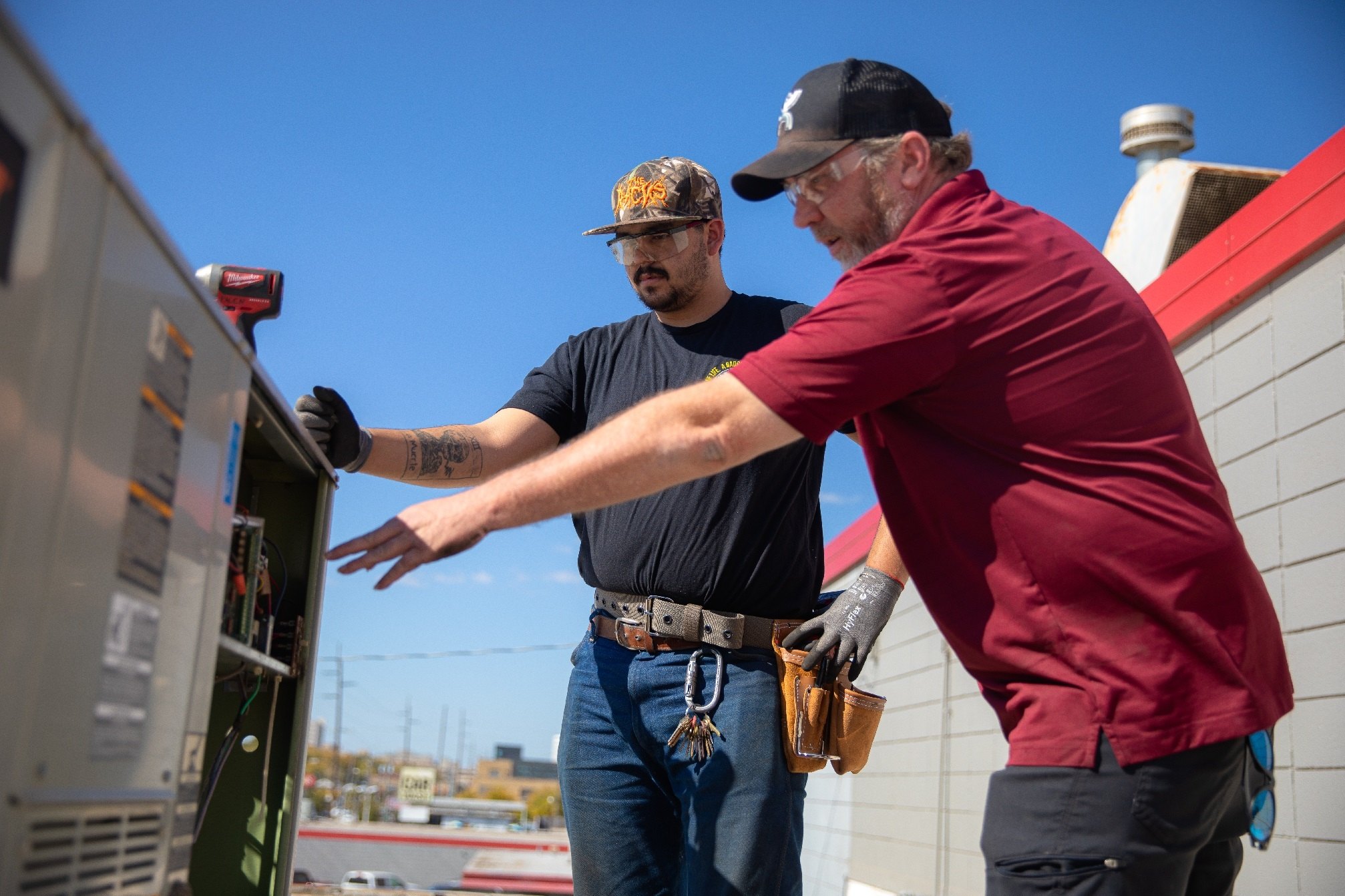
TWS’ electromechanical technician training is led by industry-seasoned instructors who use a mix of different teaching methods — including Virtual Reality to simulate troubleshooting.
Graduates of the EMT training program will be ready to pursue a number of different career paths:
- HVAC/R technician
- Power plant field technician
- Commercial Service Technician
- Air Conditioning Technician
- Maintenance Electrician
- HVAC Service Technician
- Refrigeration Service Technician
- Commercial Refrigeration Technician
- Low-Temperature Field Technician
- Restaurant & Retail Refrigeration Technician
Trained by Pros. Hired by Pros. We believe quality training starts with quality instructors. Our faculty brings over,000 years of combined industry experience to our labs. You’ll learn the techniques used in the field from professionals who have done the work themselves.
Real Skills for an Essential Future. Our programs are built for quality and outcomes, allowing you to graduate and prepare for entry-level opportunities in as few as 7 months. To accommodate your personal and professional commitments, we offer flexible scheduling options with weekday, weekend, and evening classes available.
A Legacy of Success and Stability Investing in your education should lead to a life of purpose. Join a legacy of over 50,000 graduates who have used their TWS training to build more stable, secure futures for themselves and their families. With a national network and lifelong career services support, we are committed to your long-term success.
Hybrid training. At TWS, we know you’re here to build real-world skills, not spend endless hours in a classroom. That’s why we offer a flexible online hybrid model, allowing you to complete the theoretical parts of your program online, as long as it’s done by the deadline. When you’re on campus, your time is spent where it counts: hands-on in the lab with tools, equipment, and expert instructors. This approach gives you the freedom to balance school with other responsibilities, while still getting the hands-on training you need for a successful career in the skilled trades.
What sets TWS apart. For more than 76 years, Tulsa Welding School has been dedicated to one goal: providing the training required for students to succeed in the field. Through hands-on lab work and classroom instruction, we help you develop the skills to move your future forward.
- TWS graduates have obtained employment in all 50 states.
- TWS has over 60,000 graduates combined at all locations.
- Over 16,000 employers across the 50 states.
- $7,000,000 in scholarships annual funding.
- Tulsa Welding School in Houston and Jacksonville were ranked among the top 5% of 4,600 institutions nationwide for the 10-year return on investment, according to a 2022 study by Georgetown University’s Center on Education and the Workforce.
School Information
Campus Location
Why Accreditation Is Important
Accredited by the Accrediting Commission of Career Schools and Colleges (ACCSC).
- Licensed by the Arizona State Board for Private Postsecondary Education.
Admission Requirements and Process
Admission requirements. An applicant shall meet certain requirements prior to full admittance and enrollment into an academic program. These requirements are derived from a combination of accreditation, state, and federal requirements to solidify the importance and determination of a student’s ability to successfully complete the applicable programs.
General Requirements
- U.S. citizen or eligible non-citizenBe a U.S. citizen or eligible non-citizen.
- High school graduation or equivalentBe a high school graduate with a standard or higher-level diploma; or possess a General Equivalency Diploma (GED) or high school equivalency; or proof of eligible home school program.
- AgeBe at least 18 years of age or older. Applicants who have already earned their high school diploma, GED, or high school equivalency may enroll if they have met their state's Compulsory Age Requirements, or exemptions. Applicants under the age of 18 must sign the Enrollment Agreement jointly with parent, guardian, or guarantor.
- English languageBe able to understand, read, and write in the English language (all course materials and instruction will be provided in English).
- Entrance interviewComplete an entrance interview with a school official.
- Enrollment agreementComplete review and execution of an enrollment agreement.
- Government-issued identificationProvide government issued identification.
- Hybrid and distance education readinessPossess working knowledge of a basic device (such as a smartphone, tablet, or computer), regular accessibility to a device, and internet connectivity. Before enrollment, prospective students complete an online enrollment process designed to verify the technical skills, computer competency, and access to the equipment, internet connectivity, and technology needed for distance education courses.
Application Process
- 1Contact Us & Work With a RepresentativeWhether you are ready to start ASAP or you are weighing your options, our team can help. We will answer all of your questions and help you make the right choice for your future.
- 2Find the Program That’s Right for You
- 3Lock In Your Training Schedule
- 4Take an In-Person or Virtual Tour
- 5Complete the Entrance Interview and Enrollment AgreementComplete an entrance interview with a school official, then review and execute an enrollment agreement.
- 6Start Your Training
Program Schedule
Program length. 900 Contact Hours / 36 Semester Credit Hours / 38 Weeks / 9 Months.
Catalog note. Effective 11/30/26, Changing to Align with Phoenix Version.
Upcoming start dates at Phoenix. Sep. 30, 2026 & Oct. 19, 2026.
Flexible Schedule Options for the Jacksonville, FL and Phoenix, AZ Campuses
Weekday Schedule (Mon - Fri)
- Morning 7:30am-12:30pm
- Afternoon 12:45pm-5:45pm
- Evening 6:00pm-11:00pm
Flexible class schedules. Morning, Afternoon and Evening Classes Available TWS offers flexible schedules whether you are just graduating from high school, changing your career, or transitioning from military to civilian life. We work hard to find the right program and the right schedule to help you succeed. Experiences & Opportunities
Hybrid delivery. At TWS, we know you’re here to build real-world skills, not spend endless hours in a classroom. That’s why we offer a flexible online hybrid model, allowing you to complete the theoretical parts of your program online, as long as it’s done by the deadline. When you’re on campus, your time is spent where it counts: hands-on in the lab with tools, equipment, and expert instructors. This approach gives you the freedom to balance school with other responsibilities, while still getting the hands-on training you need for a successful career in the skilled trades.
Curriculum
Electro-Mechanical Technologies program courses. The Electro-Mechanical Technologies (EMT) program contains nine (9) courses, 38 weeks, and 36 semester credit hours.
Required Courses
| Subject # | Name | Lecture | Lab | Total | Credits |
|---|---|---|---|---|---|
| HVE100 | Fundamentals of Electricity | 60 | 40 | 100 | 4 |
| HVE110 | Fundamentals of Solar | 60 | 40 | 100 | 4 |
| HVE120 | Electrical Wiring - Residential | 60 | 40 | 100 | 4 |
| HVE130 | Electrical Wiring - Commercial | 60 | 40 | 100 | 4 |
| HVR100 | Fundamentals of Refrigeration | 60 | 40 | 100 | 4 |
| HVR110 | Comfort Systems - Residential | 60 | 40 | 100 | 4 |
| HVR120 | Comfort Systems - Commercial | 60 | 40 | 100 | 4 |
| HVR130 | Refrigeration Systems & Practices | 60 | 40 | 100 | 4 |
| HVR200 | Advanced Trouble-Shooting Techniques | 60 | 40 | 100 | 4 |
| Totals | 540 | 360 | 900 | 36 |
Cost of Attendance and Financial Aid Information
Tuition and costs. Published program costs for Electro-Mechanical Technologies (standard pricing):
| Item | Amount |
|---|---|
| Tuition | $22,000 |
| Registration Fee | $25 |
| Technology Fee | $500 |
| Lab Fees | $2,000 |
| Course Materials/Textbooks | $1,600 |
| Gear Package | $1,800 |
| Accident Insurance | $100 |
| Total Program Cost | $28,025 |
Military Pricing (MTP) is 90% of Tuition Price. The registration fee is due at time of enrollment. TWS requires students to purchase accident insurance as part of their program costs; this is a secondary (supplemental) accident insurance policy that only covers accidents while students are in class, and it is not a health insurance plan.
Financial aid. Financial aid available to those who qualify.
Federal grants. Federal grants are often called “gift aid” because they don’t have to be repaid once you complete the program; grants are typically awarded based on financial need.
Scholarships. Scholarships are another form of “gift aid”, but they’re usually merit-based. This means students must meet certain qualifications in order to be considered for an award.
Military benefits. Funding to help with the cost of trade school is available to active duty, reserve and veterans under the Post-9/11 GI Bill®, Reserve GI Bill and Montgomery GI Bill (MGIB).
Net training cost calculator. Use the TWS Phoenix net price calculator to discover what students with similar financial profiles paid to attend TWS after subtracting scholarships and grants from the total cost. Price is calculated based on the 2020-2021 school year.
Cost of attendance at Phoenix (monthly budget, 25/26 and 26/27). Estimated non-institutional costs: $2,063.92 per month living with parents, or $3,075.89 per month off-campus, derived from the U.S. Bureau of Labor Statistics Consumer Expenditure Survey.
Career Outcomes
HVAC/R Career Pathways
Graduating from Tulsa Welding School can open the door to a wide range of career opportunities in industries that keep our world moving. With skills that are in demand nationwide, explore the entry level careers our training prepares you for, work types and example employers below. Your training from TWS can take you across industries and across the country.
Career Titles
- Helper/apprentice HVAC technician
- Service technician
- Maintenance technician
- Install technician
- Service technician
- Refrigeration technician
- Facilities maintenance
- Ductwork installer
- Building technician
Work Types
- New construction/remodeling
- Property management
- Trouble shooting
- Swap outs
- Hospitality
- Food service
- Manufacturing
- Sports arenas
- Mortuaries
- Education
- Casinos
- Entertainment
Employers
- HVAC/R contractors/distributors
- General contractors
- Private industry
- Property management companies
- School districts
- Casinos
- Sports arenas
- Hospitals and healthcare facility maintenance departments
- Data centers and server farms
- Manufacturing plants and industrial facilities
- Government agencies and municipal building departments
- Utility companies and utility services contractors
- Hospitality/resort developments
Graduate employment. Graduates in good standing are provided assistance in resume writing, completing employment applications and job search preparation as well as ongoing access to employer job openings. The Career Services Department maintains a database of employers and employment opportunities and works with employers seeking qualified graduates. Due to individual differences and personal attributes, neither this school nor any other institution can guarantee graduate employment.
What to expect as a Tulsa Welding School student
Tulsa Welding School – Phoenix, AZ Campus
Get Welding, HVAC/Refrigeration, and Electrical career training at one of the best trade schools in Phoenix, Arizona.
In 1965, the Tulsa Welding School (TWS) Phoenix Campus started out as a Phoenix, AZ trade school specializing in HVAC and Refrigeration career training only. Since then, we’ve expanded to include career programs for Welding and Electrical/Electrical-Mechanic technologies.
The TWS Phoenix campus is located in the Phoenix metropolitan area and includes 26,000 square feet of training facilities, including classrooms, labs, support services, and shops.
Hours of operation.
- Mon-Thu: 8AM to 8PM
- Fri: 8AM to 4 PM
- Sat: 9AM to 1PM
- Sun: CLOSED
The right tools for the job. When you begin your education at TWS, we provide you with an extensive gear package. You get the high quality professional tools you need to succeed.
Online coursework. The schools use a fully hosted, fully integrated Learning Management System (LMS) to deliver online and hybrid courses.
Testimonials
Frequently Asked Questions
School Information
Campus Location
Why Accreditation Is Important
Accredited by the Accrediting Commission of Career Schools and Colleges (ACCSC).
- Licensed by the Arizona State Board for Private Postsecondary Education.