
Airframe and Powerplant Technician is a Certificate program offered by Universal Technical Institute in Canton, MI. The program takes 85 weeks to complete, with a total cost, including fees, of $52,999.
Program Overview
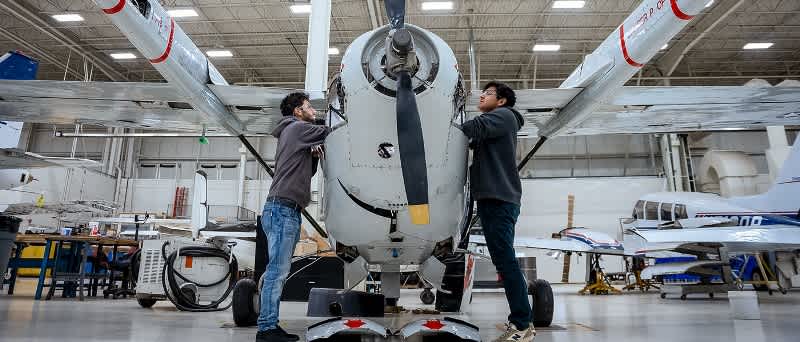
UTI's aviation program prepares you for entry-level aviation careers through hands-on training in aircraft troubleshooting, hydraulics and pneumatics, powerplant lubrication systems, and turbine engine operation. Graduates become eligible to apply and test for FAA Airframe and Powerplant (A&P) certification. At UTI’s Canton, MI campus this program runs about 85 weeks and awards a certificate.
What sets this Program apart
- 660+ hours of hands-on lab training
- Learn from experienced A&P instructors
- Skills valued across the aviation industry
- Hands-on training in airframe and powerplant systems
- Graduates become eligible to apply and test for FAA Airframe & Powerplant (A&P) certification
Admission Requirements and Process
Getting started at UTI may be simpler than you think. Most students need to meet UTI's age and education requirements below. UTI does not require entrance exams, essays or ACT/SAT scores to apply and start, and you do not need previous trade training or industry experience. Not sure if you qualify? UTI's Admissions team can help: call 800-834-7308.
General Requirements
- Age requirementBe 18 or older, or at least 16 with guardian consent. Students enrolling under the age of 18 need a parent or guardian to sign the Enrollment Agreement. A student must be at least…
- Proof of educationA high school diploma, GED certificate or equivalent. UTI accepts a standards-based high school diploma recognized by your state (a copy of the diploma, a transcript from the high…
- English language proficiencyAll instruction at UTI is in English. You can show proficiency by graduating from a U.S. high school, graduating from a high school in a country where English is the primary…
- No entrance exams or minimum GPAUTI does not require entrance exams, essays or ACT/SAT scores, or a minimum GPA, to apply and start.
- Physical requirementsStudents must be able to work at heights up to 25 feet, work safely in confined spaces and near moving parts such as engines and propellers, routinely move or lift items of no…
- Criminal background reviewApplicants who have been convicted of a felony or violent crime, or who must register as a sex offender, are reviewed by UTI before acceptance, and certain convictions make an…
Application Process
- 1Apply onlineIt just takes a few minutes to fill out UTI's online application form, and UTI can begin processing your application right away.
- 2Talk with your Admissions RepresentativeAn Admissions Representative will typically contact you within 24 hours to answer your questions and guide you through the next steps.
- 3Submit your education documentsProvide proof of education. In most cases your high school can send your transcripts directly to UTI, and your Admissions Representative will guide you step by step. UTI recommends allowing at least 30 days for document evaluation.
- 4Sign your Enrollment AgreementYour enrollment is official once all requirements are met and verified and your Enrollment Agreement is signed, reviewed and approved. You may receive conditional acceptance, which saves your spot while your documents are reviewed.
- 5Apply for financial aidComplete the Free Application for Federal Student Aid (FAFSA) using the school code below. The FAFSA determines your eligibility for federal grants, educational loans and possible work-study programs, and UTI's Financial Aid team can help you through it.FAFSA Code for Canton Michigan Campus: 013603Fill Out the FAFSA
- 6Start your trainingClasses are scheduled approximately every six weeks, and some start dates may be limited. Check with the Admissions Office at your campus or your Admissions Representative regarding availability.
Program Schedule
This program is completed in about 85 weeks at the Canton, MI campus, using UTI’s hands-on, lab-based training model. UTI offers multiple program start dates throughout the year.
Cost of Attendance and Financial Aid Information
The total cost for the Airframe and Powerplant Technician program at UTI’s Canton, MI campus is $52,999 (tuition and fees), per UTI’s catalog Tuition Chart for enrollments on or after August 1, 2026. Cost can vary by campus and enrollment date, so use the Net Price Calculator above (select the Canton, MI campus) for a personalized estimate after aid. UTI participates in federal financial aid — file the FAFSA using the Canton campus Federal School Code 013603, and connect with UTI’s Financial Aid team about scholarships and grants (UTI awarded more than $27 million in scholarships and grants in 2025), loans, tuition reimbursement, and VA education benefits.
Curriculum
The required courses below are from UTI's course catalog. 824Didactic (Theory) Hours 1,216 Lab (Hands-on) Hours; Delivery: Traditional. Credits shown are quarter credit hours.
Required Courses
| Subject # | Name | Credits |
|---|---|---|
Career Outcomes
Aviation graduates pursue roles such as aviation maintenance technician, powerplant technician, and field technician, advancing to avionics technician, helicopter mechanic, aircraft structural/sheet-metal mechanic, and more. UTI cites 11,000+ estimated average annual aviation technician job openings in the U.S.
Photos

Location
Why Accreditation Is Important
When you attend an accredited institution, you are attending a school that has undergone a rigorous process that evaluates educational quality. It's not easy to become or remain an accredited institution. The rules and regulations are strict, precise and designed to protect students. Here are some of the benefits:
Accreditations

Accrediting Commission of Career Schools and Colleges (ACCSC)