Airframe & Powerplant Technician is a Diploma program offered by Universal Technical Institute in Long Beach, CA. The program takes 78 weeks to complete, with a total cost, including fees, of $53,595.
Program Overview
UTI's aviation program prepares you for entry-level aviation careers through hands-on training in aircraft troubleshooting, hydraulics and pneumatics, powerplant lubrication systems, and turbine engine operation. Graduates become eligible to apply and test for FAA Airframe and Powerplant (A&P) certification. At UTI’s Long Beach, CA campus this program runs about 78 weeks and awards a diploma.
What sets this Program apart
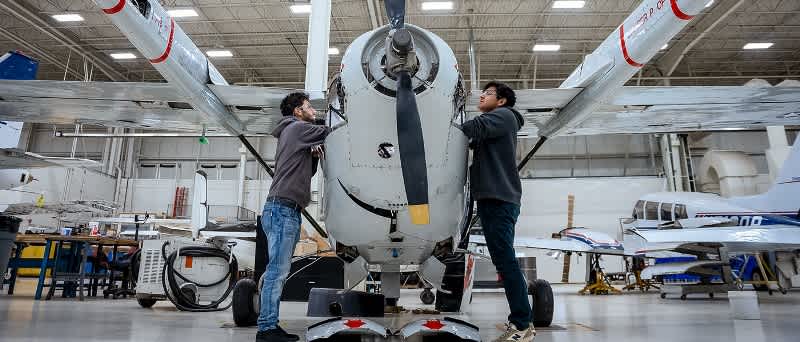
- 660+ hours of hands-on lab training
- Learn from experienced A&P instructors
- Skills valued across the aviation industry
- Hands-on training in airframe and powerplant systems
- Graduates become eligible to apply and test for FAA Airframe & Powerplant (A&P) certification
Admission Requirements and Process
UTI has a supportive, straightforward admissions process. Prospective students complete an online enrollment form (or Request Information to connect with an admissions representative), provide proof of high school graduation or equivalency (high school diploma or GED), and complete an admissions interview and enrollment agreement. There is no application fee; a registration fee of up to $50 applies at enrollment.
General Requirements
- High school diploma or equivalentProvide proof of high school graduation or a GED/HSED.
- Complete your enrollmentSubmit UTI’s online enrollment form (Apply / Enroll Now) or Request Information to connect with an admissions representative.
- Admissions interviewMeet with an admissions representative to review the program, schedule, and enrollment agreement.
- Financial aid planningComplete the FAFSA using the Long Beach campus Federal School Code E40549 and meet with UTI’s Financial Aid team about grants, scholarships, loans, and VA benefits.
Application Process
- 1Request InformationSubmit the Request Information form and a UTI admissions representative will reach out to walk you through the program, start dates, and enrollment.
- 2Apply / EnrollComplete UTI’s enrollment form to start your application, then work with your admissions representative to finalize your enrollment agreement. There is no application fee (a registration fee of up to $50 applies at enrollment).
- 3Financial AidComplete the FAFSA using the Long Beach campus Federal School Code E40549, and connect with UTI’s Financial Aid team about grants, scholarships, loans, tuition reimbursement, and VA education benefits.FAFSA Code for Long Beach Campus: E40549Fill Out the FAFSA
- 4Start Your ProgramChoose from multiple start dates offered throughout the year and begin your hands-on training at the Long Beach, CA campus.
Program Schedule
This program is completed in about 78 weeks at the Long Beach, CA campus, using UTI’s hands-on, lab-based training model. UTI offers multiple program start dates throughout the year.
- December 07th, 2026
Cost of Attendance and Financial Aid Information
The total cost for the Airframe & Powerplant Technician program at UTI’s Long Beach, CA campus is $53,595 (tuition and fees), per UTI’s catalog Tuition Chart for enrollments on or after August 1, 2026. Cost can vary by campus and enrollment date, so use the Net Price Calculator above (select the Long Beach, CA campus) for a personalized estimate after aid. UTI participates in federal financial aid — file the FAFSA using the Long Beach campus Federal School Code E40549, and connect with UTI’s Financial Aid team about scholarships and grants (UTI awarded more than $27 million in scholarships and grants in 2025), loans, tuition reimbursement, and VA education benefits.
Curriculum
Training blends instructor-led coursework with hands-on lab work. Core courses and modules include:
Required Courses
| Subject # | Name | Credits |
|---|---|---|
| AS10-101 | Human Factors, Math & Basic Physics | 3 |
| AS10-102 | Drawings, FARs and Ground Control | 2.5 |
| AS10-103 | Materials and Processing, Cleaning and Corrosion, Inspection Concepts | 3 |
| AS10-104 | Fluid Lines, Fittings, Tools, Safety, and Weight and Balance | 2.5 |
| AS10-105 | Basic Electricity I | 3 |
| AS10-106 | Basic Electricity II | 2.5 |
| AF10-201 | Basic Sheet Metal | 2.5 |
| AF10-202 | Advanced Sheet Metal | 2.5 |
| AF10-203 | Non-Metallic Structures and Repair | 2.5 |
| AF10-204 | Non-Metallic Structures and Aircraft Finishes | 2.5 |
| AF10-205 | Assembly and Rigging; Fuel Systems | 2.5 |
| AF10-206 | Airframe Electrical I | 2.5 |
| AF10-207 | Airframe Electrical II, Airframe Instruments and Airframe Fire Protection | 2.5 |
| AF10-208 | Navigation and Communication Systems | 2.5 |
| AF10-209 | Hydraulics and Pneumatics; Landing Gear Systems | 2.5 |
| AF10-210 | Airframe Environmental Systems and Performance Analysis | 3 |
| PP10-201 | Reciprocating Engine and Engine Instruments | 3 |
| PP10-202 | Reciprocating Engine Fuel Metering System, Induction, Exhaust | 3 |
| PP10-203 | Reciprocating Engine Ignition Systems | 2.5 |
| PP10-204 | Powerplant Lubrication and Propellers | 2.5 |
| PP10-205 | Reciprocating Engine Inspection and Overhaul | 2.5 |
| PP10-206 | Powerplant Fire Protection, AD Research, Measurements and Troubleshooting | 2.5 |
| PP10-207 | Basic Physics for Turbine Designs and Operations | 3 |
| PP10-208 | Turbine Engine Accessories | 3 |
| PP10-209 | Turbine Inspection, Overhaul, and Maintenance | 2.5 |
| PP10-210 | Turbine Engine Instruments and Troubleshooting | 2.5 |
| Totals | 69 |
Career Outcomes
Aviation graduates pursue roles such as aviation maintenance technician, powerplant technician, and field technician, advancing to avionics technician, helicopter mechanic, aircraft structural/sheet-metal mechanic, and more. UTI cites 11,000+ estimated average annual aviation technician job openings in the U.S.
Photos
Location
Why Accreditation Is Important
When you attend an accredited institution, you are attending a school that has undergone a rigorous process that evaluates educational quality. It's not easy to become or remain an accredited institution. The rules and regulations are strict, precise and designed to protect students. Here are some of the benefits:
Accreditations

Accrediting Commission of Career Schools and Colleges (ACCSC)