




New Castle School of Trades
Electrical & Industrial Maintenance
Diploma
HybridFinancial Aid
East Liverpool Branch Campus
East Liverpool, OH
Next start
Dec 9, 2026
Duration
50 Weeks
75 quarter credits
App fee
$25
Tuition
$21,009 for the Program
Combination Welding is a Diploma program (Hybrid) offered by New Castle School of Trades in East Liverpool, OH. The program takes 50 weeks to complete, with a total tuition of $22,339.
The Combination Welding Program is a series of comprehensive courses to provide graduates with a well - rounded back-ground in various welding applications and techniques based on ASME and AWS specifications. Students will be prepared to participate in a variety of projects with a reasonable chance to pass qualification tests. This program provides the training for entry level employment in many facets of the welding field.
The experienced welding training received from the New Castle School of Trades instructors will give trainees the skills needed to stand out in a vibrant workforce. The East Liverpool Campus Combination Welding course is available to students with little to no welding experience. At NCST’s welding trade school, students will gain a wide range of experience working with a variety of welding techniques and metals to prepare them for an entry-level welder position.
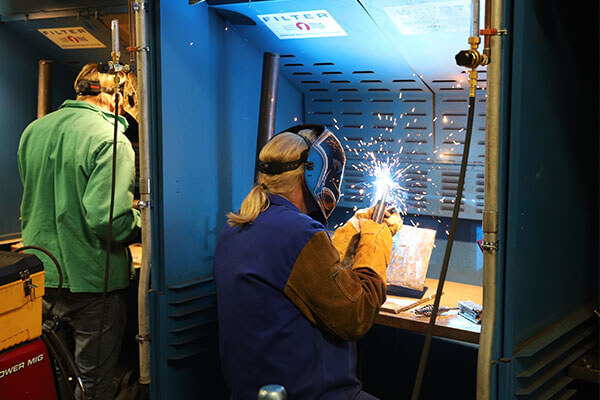
When an individual commits to attending a welding trade school, they commit to learning the different types of welding training practices. These include ARC welding, MIG welding, TIG welding, and the various subsets of each of these types.
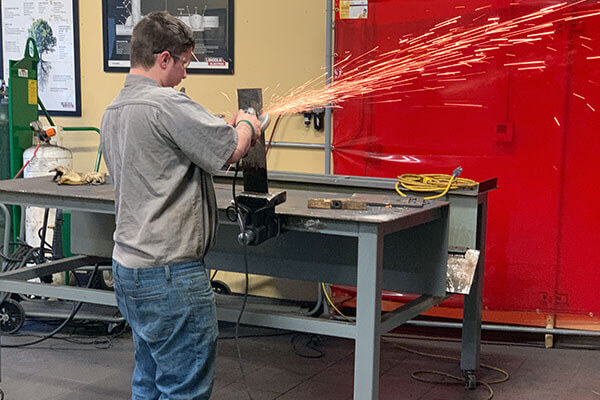
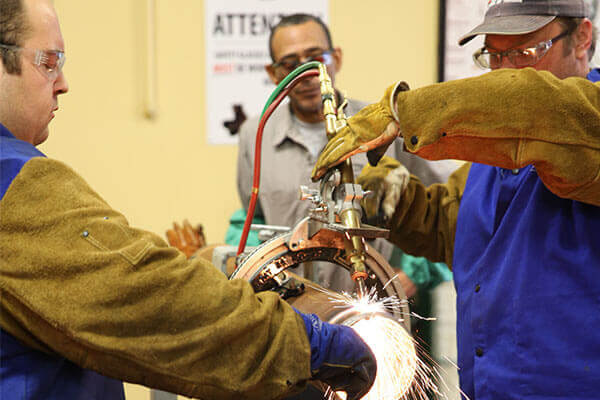
Equipment. During the course of this program, students will be introduced to and use oxy fuel equipment, electric arc welders, gas metal arc welders, flux cored arc welders, gas tungsten arc welders, portable and semi-automatic burning equipment, carbon and plasma arc cutting equipment, hydraulic shear, horizontal band saw, grinders and beveller.
ASME and AWS based. The materials taught through New Castle School of Trade’s welding classes are based on the American Society of Mechanical Engineers (ASME) and American Welding Society (AWS) specifications. By receiving welding training through New Castle School of Trades, students will be prepared to pass the ASME and AWS tests and get an edge on the job market.
Graduate career services. The New Castle School of Trades qualified staff offers students the following career services: Professional development advising, assistance with employment applications and resumes, cover letters, extending invitations to prospective employers and contacting potential employers.
Applicants must possess a high school diploma or General Equivalence Diploma (GED) or earned an associate degree or higher from a post-secondary school to meet the basis of admissions; and must pass an entrance evaluation. For all programs the minimum evaluation score is 75. Applicants must also demonstrate, through a personal interview, the desire to complete the course and benefit from the training. The school makes the final decision on all applicants based on the information submitted on the applicant’s qualification form, test results and the representative’s recommendation.
Online Readiness Assessment: Applicants of programs containing distance education courses are assessed for readiness during the school’s admission process. If a candidate scores in the developing range, the school will provide additional online training with the instructor in Core Competencies or be given the option to enroll in programs that do not have distance education.
Combination Welding classes are scheduled between 8:00 A.M. – 1:45 P.M, Monday through Thursday.
The Combination Welding Program is available for daytime training at the East Liverpool Campus.
Upcoming class starts: December 9, 2026. New students may enter class no later than the third day of the quarter.
Some non-technical courses are delivered online through distance education (course codes beginning with DE). All Veterans using GI Bill Benefits are required to complete all courses in an in-person modality.
All published program lengths reflect instructional weeks and actual program lengths are typically longer due to scheduled holidays and breaks. Classes are in continuous session during all months of the calendar year.
Tuition and books. Tuition is $22,339 and books are $760 (Tuition and Fees Schedule, revised 1/1/2026). Total tuition cost for the programs includes tools/equipment and uniform shirts.
Required fees. The only required fee is the $25 Registration Fee that covers the administrative cost of enrolling a student.
Program cost and median debt. This program will cost $23,099 if completed within normal time. There may be additional costs for living expenses. Of the students who completed this program within normal time, the typical graduate leaves with $9,322 of debt (Median Loan Debt Disclosure, revised July 1, 2026).
Books and supplies. Books, kits, and supplies are available through NCST and can be rolled into the financial plan each student creates during the admissions process. The 2026 list for this program includes: Chromebook; Access to Canvas Learning Management System; Cengage Unlimited; Blueprint Reading for Welders, 9e; Welding: Principles & Applications, 8e; Practical Problems in Mathematics for Welders, 6e; Personal Finance, 14e.
Payment. Quarterly tuition is due on the first day of class. However, a monthly payment plan is available; monthly tuition is calculated by prorating the amount of tuition owed for the quarter. The school provides a voluntary prepayment plan to help reduce the balance due upon entry, and students who take the school’s private financing plan for the balance not satisfied by Federal Student Financial Aid pay an annual interest rate of 12%.
Financial aid. Federal aid programs include the Federal Pell Grant, Federal Supplemental Education Opportunity Grant (FSEOG), Subsidized and Unsubsidized Federal Direct Loans and the Parent PLUS Federal Loan. Each student interested in receiving financial assistance must submit the Free Application for Federal Student Aid (FAFSA). NCST Federal School Code: 007780. Financial aid is available for those who qualify.
Other funding. Individuals eligible for benefits from the Veterans Administration should make an appointment to see the VA representative at the school. The Office/Bureau of Vocational Rehabilitation (OVR/BVR) provides vocational rehabilitation services to eligible individuals with disabilities. The New Castle School of Trades may be able to offer alternative loan programs to those who qualify.
| Subject # | Name | Credits |
|---|---|---|
| W150E | SMAW & Cutting | 4 |
| W151E | SMAW & Cutting Lab | 7 |
| W152E | SMAW Pipe Welding | 11 |
| W153E | Multi Welding Processes | 11 |
| W250E | Semi Auto, TIG & Nonferrous | 15 |
| W251E | Pipe, Fitting & Fab Processes | 11 |
| M180 | Trade Math | 4 |
| M280 | Theory & Calculations | 4 |
| R180 | Print Reading | 4 |
| DER181/R181 | Career Prep & Finance | 4 |
| Totals | 75 |
Graduates of the Combination Welding Program will be qualified for positions such as combination welders, fabricators, repair welders, pipeline welders, pipe welders, construction welders and burners.
Graduation and employment rates. Per the ACCSC 2025 Annual Report, the graduation rate was 41% (13 of 32 students) and the employment rate was 62% (8 of 13 graduates); includes graduates that started the program between September 1, 2022, and August 31, 2023.
The following States do not have licensure requirements for this profession: Pennsylvania, Ohio, and West Virginia.
No ethical school can guarantee employment. Employment success is greatly influenced by the student’s attendance record, academic performance, previous employment history/record and overall attitude.
New Castle School of Trades is accredited by ACCSC (Accrediting Commission of Career Schools and Colleges). The East Liverpool Campus is a branch of New Castle School of Trades and is approved by the Ohio State Board of Career Colleges and Schools, Reg. #2101. Approved for the training of eligible veterans.
The Combination Welding program consists of 75 quarter credits. The order in which the courses are offered is at the discretion of the school.
Course descriptions.
| Subject # | Name | Credits |
|---|---|---|
| W150E | SMAW & Cutting | 4 |
| W151E | SMAW & Cutting Lab | 7 |
| W152E | SMAW Pipe Welding | 11 |
| W153E | Multi Welding Processes | 11 |
| W250E | Semi Auto, TIG & Nonferrous | 15 |
| W251E | Pipe, Fitting & Fab Processes | 11 |
| M180 | Trade Math | 4 |
| M280 | Theory & Calculations | 4 |
| R180 | Print Reading | 4 |
| DER181/R181 | Career Prep & Finance | 4 |
| Totals | 75 |

New Castle School of Trades in East Liverpool, OH also offers these 2 programs at 129 East Fifth Street, East Liverpool, OH 43920.
Diploma
Diploma