

New Castle School of Trades
Combination Welding
Diploma
HybridFinancial Aid
East Liverpool Branch Campus
East Liverpool, OH
Next start
Dec 9, 2026
Duration
50 Weeks
75 quarter credits
App fee
$25
Tuition
$22,339 for the Program
Electrical & Industrial Maintenance is a Diploma program (Hybrid) offered by New Castle School of Trades in East Liverpool, OH. The program takes 50 weeks to complete, with a total tuition of $21,009.
Students will acquire skills in the areas of commercial and industrial electricity, PLC's, welding, HVAC, pneumatics, hydraulics, gaskets/seals, bearings, pumps, valves, plumbing, equipment maintenance and forklift operation. Students will also be trained in safety procedures and be familiar with tools used in an industrial setting.
Every facility needs someone who is a jack-of-all-trades. An individual to keep the building and systems operational and running properly, be it in a factory, school, hotel, office building, a hospital, etc. The Electrical and Industrial Maintenance program at New Castle School of Trade’s – East Liverpool Campus is designed to equip students with a variety of skills to handle a majority of issues that could occur at such facilities.
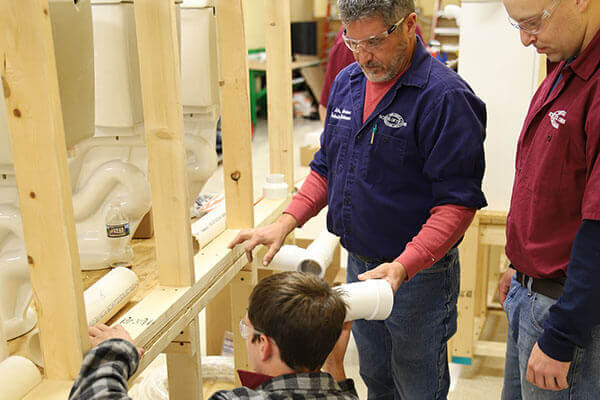
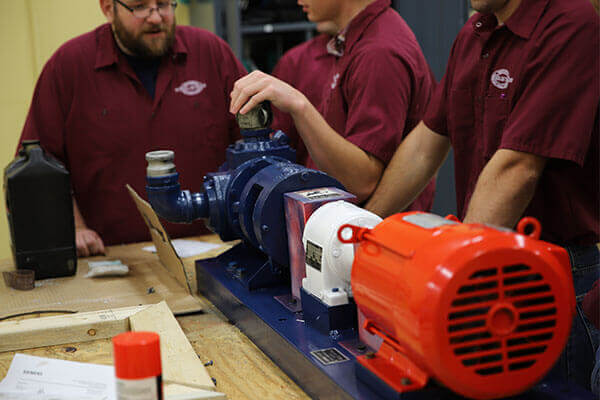
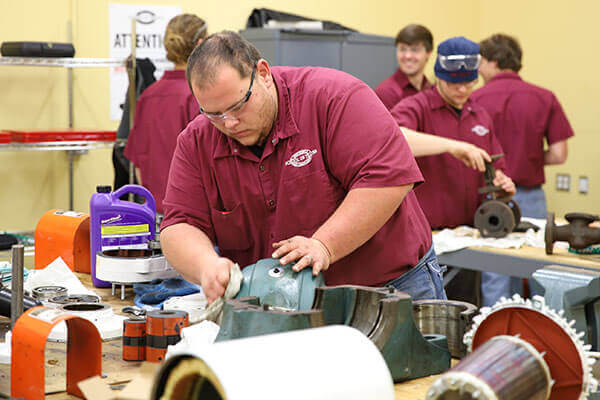
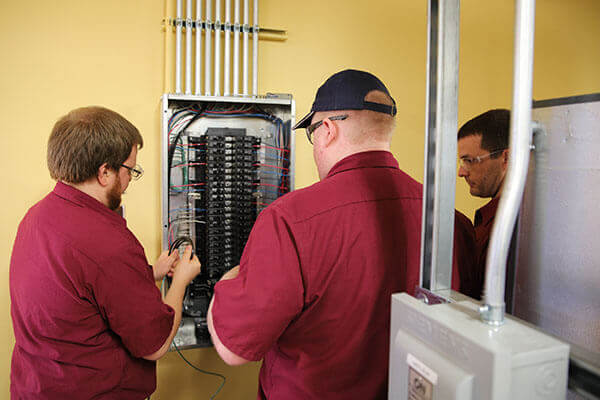
Courses in the Electrical & Industrial Maintenance program balance hands-on training with classroom instruction. Students would be working with industry-standard industrial maintenance training equipment to learn skills in electrical wiring, motor control, PLC’s, pneumatics, hydraulics, fluid control, forklift operation, and basic plumbing and welding.
Equipment. During the course of study in this program students will be exposed to conduit bending equipment, motor controls, electric motors, PLC's, test meters, service panels, precisions measuring tools, pneumatic equipment, hydraulic equipment, pumps, valves, plumbing tools, plumbing fixtures, arc and MIG welders, oxy fuel equipment and forklift.
Graduate career services. The New Castle School of Trades qualified staff offers students the following career services: Professional development advising, assistance with employment applications and resumes, cover letters, extending invitations to prospective employers and contacting potential employers.
Applicants must possess a high school diploma or General Equivalence Diploma (GED) or earned an associate degree or higher from a post-secondary school to meet the basis of admissions; and must pass an entrance evaluation. For all programs the minimum evaluation score is 75. Applicants must also demonstrate, through a personal interview, the desire to complete the course and benefit from the training. The school makes the final decision on all applicants based on the information submitted on the applicant’s qualification form, test results and the representative’s recommendation.
Online Readiness Assessment: Applicants of programs containing distance education courses are assessed for readiness during the school’s admission process. If a candidate scores in the developing range, the school will provide additional online training with the instructor in Core Competencies or be given the option to enroll in programs that do not have distance education.
Electrical & Industrial Maintenance and Refrigeration & Climate Control classes are scheduled between 8:00 A.M. - 1:30 P.M., Monday through Thursday.
The Electrical & Industrial Maintenance Program is available for daytime training at the East Liverpool Campus.
Upcoming class starts: December 9, 2026. New students may enter class no later than the third day of the quarter.
Some non-technical courses are delivered online through distance education (course codes beginning with DE). All Veterans using GI Bill Benefits are required to complete all courses in an in-person modality.
All published program lengths reflect instructional weeks and actual program lengths are typically longer due to scheduled holidays and breaks. Classes are in continuous session during all months of the calendar year.
Tuition and books. Tuition is $21,009 and books are $836 (Tuition and Fees Schedule, revised 1/1/2026). Total tuition cost for the programs includes tools/equipment and uniform shirts.
Required fees. The only required fee is the $25 Registration Fee that covers the administrative cost of enrolling a student.
Program cost and median debt. This program will cost $21,845 if completed within normal time. There may be additional costs for living expenses. Of the students who completed this program within normal time, the typical graduate leaves with $8,998 of debt (Median Loan Debt Disclosure, revised July 1, 2026).
Books and supplies. Books, kits, and supplies are available through NCST and can be rolled into the financial plan each student creates during the admissions process. The 2026 list for this program includes: Chromebook; Access to Canvas Learning Management System; Disc Exercise; Cengage Unlimited; Illustrated Guide to the National Electrical Code, 9e; Technician's Guide to Programmable Controllers, 6e; Industrial Electricity, 9e; Industrial Maintenance, 2e; Welding: Principles and Applications, 8e; Refrigeration and Air Conditioning Technology, 10e; Introductory Technical Mathematics, 7e; 21st Century Business: Customer Service, 2e; Personal Finance, 14e; Industrial Maintenance & Mechatronics W/ Lab Book; Fluid Power: Hydraulics and Pneumatics, 2e; Fluid Power: Hydraulics and Pneumatics Lab Manual, 2e; Ugly's Electrical References, 2026 Edition.
Payment. Quarterly tuition is due on the first day of class. However, a monthly payment plan is available; monthly tuition is calculated by prorating the amount of tuition owed for the quarter. The school provides a voluntary prepayment plan to help reduce the balance due upon entry, and students who take the school’s private financing plan for the balance not satisfied by Federal Student Financial Aid pay an annual interest rate of 12%.
Financial aid. Federal aid programs include the Federal Pell Grant, Federal Supplemental Education Opportunity Grant (FSEOG), Subsidized and Unsubsidized Federal Direct Loans and the Parent PLUS Federal Loan. Each student interested in receiving financial assistance must submit the Free Application for Federal Student Aid (FAFSA). NCST Federal School Code: 007780. Financial aid is available for those who qualify.
Other funding. Individuals eligible for benefits from the Veterans Administration should make an appointment to see the VA representative at the school. The Office/Bureau of Vocational Rehabilitation (OVR/BVR) provides vocational rehabilitation services to eligible individuals with disabilities. The New Castle School of Trades may be able to offer alternative loan programs to those who qualify.
| Subject # | Name | Credits |
|---|---|---|
| I170E | Electricity & Fluids | 12 |
| I171E | Rigging, Safety & Tools | 3 |
| I172E | Welding & Cutting | 9 |
| I173E | Industrial Mechanics | 15 |
| I174E | Electricity & Controls | 12 |
| I270E | HVAC | 9 |
| DEM150/M150 | Core Competencies | 3 |
| DEM205/M205 | Technical Math | 3 |
| DEM206/M206 | Applied Math | 3 |
| DER229/R229 | Service & Finance | 3 |
| DER230/R230 | Computers & Job Search | 3 |
| Totals | 75 |
The skills acquired in the program will be applicable to entry-level positions as Electricians, Maintenance Mechanics, and Industrial Maintenance technicians. These job titles are in demand at manufacturing companies, mills, industrial plants, hospitals, hotels and the gas & oil industry.
Graduation and employment rates. Per the ACCSC 2025 Annual Report, the graduation rate was 67% (35 of 52 students) and the employment rate was 61% (19 of 31 graduates); includes graduates that started the program between September 1, 2022, and August 31, 2023.
The following States do not have licensure requirements for this profession: Pennsylvania, Ohio, and West Virginia.
No ethical school can guarantee employment. Employment success is greatly influenced by the student’s attendance record, academic performance, previous employment history/record and overall attitude.
New Castle School of Trades is accredited by ACCSC (Accrediting Commission of Career Schools and Colleges). The East Liverpool Campus is a branch of New Castle School of Trades and is approved by the Ohio State Board of Career Colleges and Schools, Reg. #2101. Approved for the training of eligible veterans.
The Electrical & Industrial Maintenance program consists of 75 quarter credits. The order in which the courses are offered is at the discretion of the school.
Course descriptions.
| Subject # | Name | Credits |
|---|---|---|
| I170E | Electricity & Fluids | 12 |
| I171E | Rigging, Safety & Tools | 3 |
| I172E | Welding & Cutting | 9 |
| I173E | Industrial Mechanics | 15 |
| I174E | Electricity & Controls | 12 |
| I270E | HVAC | 9 |
| DEM150/M150 | Core Competencies | 3 |
| DEM205/M205 | Technical Math | 3 |
| DEM206/M206 | Applied Math | 3 |
| DER229/R229 | Service & Finance | 3 |
| DER230/R230 | Computers & Job Search | 3 |
| Totals | 75 |
New Castle School of Trades in East Liverpool, OH also offers these 2 programs at 129 East Fifth Street, East Liverpool, OH 43920.
Diploma
Diploma