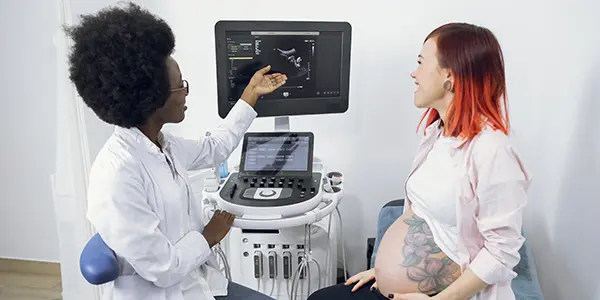
Diagnostic Medical Sonography (Track 1: Abdominal–Extended / Obstetrics and Gynecology) is an Associate Degree program offered by Keiser University in Lakeland, FL. The program takes 24 Months to complete, with tuition of $12,908 per semester.
Program Overview
Keiser University’s Associate of Science in Diagnostic Medical Sonography integrates classroom instruction, laboratory practice, and clinical experiences to prepare you for entry-level positions in the ultrasound field. The diagnostic medical sonography program emphasizes both technical competence and professional patient care skills through comprehensive training in cognitive, psychomotor, and affective learning domains. Through hands-on training with modern ultrasound technology and supervised clinical rotations at affiliated clinical sites, you gain the practical experience needed to excel as a diagnostic medical sonographer.
Students learn to perform diagnostic imaging procedures using high frequency sound waves, operate specialized ultrasound equipment, apply proper techniques for patient positioning and preparation, and recognize anatomical structures across various body systems.
Program Mission
Keiser University’s Associate of Science degree in Diagnostic Medical Sonography prepares competent graduates who are eligible for entry-level positions in the ultrasound field. The program facilitates the development of learned knowledge and skills of a graduate sonographer. The Diagnostic Medical Sonography program strives to instill the values and concepts of life-long learning to its graduates.
Program Goals
Track 1 – Abdominal – Extended/Obstetrics and Gynecology Concentration
Program Goal: To prepare competent entry-level general sonographers in the cognitive (knowledge), psychomotor (skills), and affective (behavior) learning domains for the abdominal-extended sonography and the obstetrics and gynecology sonography concentrations.
The program’s mission and goals are further defined through the following student learning outcomes, which are expanded upon to provide a clear framework for student achievement:
- SLO #1 Demonstrate knowledge, skills, and attitudes reflective of an entry level sonographer.
- SLO #2 Perform routine sonographic exams while providing quality patient care as an entry level sonographer.
- SLO #3 Exhibit professional and ethical behaviors consistent within the scope of practice of an entry level sonographer.
Track 2 – Abdominal – Extended, Obstetrics/Gynecology, and Vascular Concentration
Program Goal: To prepare competent entry-level sonographers in the cognitive (knowledge), psychomotor (skills), and affective (behavior) learning domains for the following concentration(s): abdominal sonography- extended, obstetrics and gynecology sonography, and vascular sonography.
The program’s mission and goals are further defined through the following student learning outcomes, which are expanded upon to provide a clear framework for student achievement:
- SLO #1 Demonstrate knowledge, skills, and attitudes in preparation for becoming an entry-level Abdominal-Extended, Ob/Gyn and Vascular sonographer.
- SLO #2 Display professional and ethical behaviors when communicating in the healthcare setting.
- SLO #3 Embrace life-long learning to foster professional growth in response to ever-changing healthcare needs.
Program Highlights
The Diagnostic Medical Sonography program features several distinguishing characteristics that support student success and professional development:
- Clinical Education: Students complete clinical experiences at affiliated clinical sites throughout the region, gaining hands-on experience with diverse patient populations and clinical scenarios.
- Modern Equipment: Training takes place using current ultrasound technology and imaging systems found in professional healthcare settings, allowing students to create images using industry-standard equipment.
- Multiple Specializations: Choose between two program tracks to match your career interests and goals in diagnostic medical sonography.
- Experienced Faculty: Learn from sonography professionals who bring current clinical expertise and industry knowledge to their teaching.
- National Certification Preparation: The curriculum aligns with national certification exams.
- Sequential Curriculum: Each course builds upon previous coursework, creating a logical progression from foundational concepts to advanced clinical applications.
What sets this Program apart
Gain Job-Ready Skills for a Sonography Career
- Diagnostic ultrasound imaging techniques using high frequency sound waves
- Cross-sectional anatomy recognition throughout the human body
- Acoustic physics and instrumentation
- Medical terminology and documentation
- Vascular imaging and hemodynamics (Track 2)
- Quality assurance and safety protocols in clinical settings
- Problem solving and critical thinking for medical diagnosis support
- Professional ethics and standards
- Sonographic image evaluation and diagnostic images analysis
Keiser University offers career-focused degree programs designed to support working adults, traditional students, and career changers. With on-campus learning options, experienced faculty, and comprehensive student support, Keiser helps learners achieve their personal and professional goals at all levels. The university serves as a bridge between allied health education programs and professional healthcare careers.
Admission Requirements and Process
Applicants desiring to enter Keiser University must submit an application to the Admissions Office well in advance of the start date. This permits proper scheduling and assures availability of classroom space.
For students enrolling at Keiser University, credit for courses or degrees completed at another institution is subject to approval by the Dean of Academic Affairs. These courses or degrees must be similar in content and duration to those offered in the program for which an applicant has applied. The Dean of Academic Affairs makes the final decision of accepted transfer credits from the received transcript. However, only courses listed on official transcripts receive permanent official transfer credit. (To grant such credit, Keiser University must receive official transcripts--- those mailed directly to Keiser University by the previous institution---by the end of a student’s first semester.)
Keiser University requires that, at a minimum, a student complete the final 25% of a program through the University. Active duty, reservists, and National Guard service members who are students can complete at a minimum 25% of a program at any time through the University and graduate.
Keiser University accepts transfer credits applicable to an applicant's program of study from other institutions recognized by the United States Department of Education (USDE).
Transfer credits are granted only for courses in which a grade of "C" or higher was earned (2.0 on a 4.0 scale).
General Requirements
- High School DiplomaVerification of high school graduation with a standard diploma (transcript, diploma, etc.)
- GED CompletionVerification of GED completion (GED scores or GED diploma)
- Foreign Secondary School GraduationProof of graduation from a foreign institution that is comparable to a United States secondary school, as determined by a member agency of the National Association of Credential…
- Earned Degree in Lieu of DiplomaApplicants will not be required to provide proof of high school graduation when they provide the following: Verification of an earned degree from an institution recognized by the…
- Home-Schooled ApplicantsHome-schooled applicants who have a high school diploma are considered for admission.
- Entrance ExaminationAn applicant must make arrangements to take Keiser University’s entrance examination (administered at the University) or provide results of his/her Scholastic Aptitude Test (SAT),…
- Entrance Test ExemptionCandidates seeking general admission to the University are not required to take the general admission test upon providing written proof of an associate or higher degree earned…
- Allied Health Test ExemptionCandidates providing proof of an associate or higher degree with a cumulative grade point average of 3.0 or higher from an accredited college seeking entry into the University’s…
- Allied Health Program RequirementsAll candidates must achieve the required entrance examinations scores and all other requirements for admission to specific bachelor and associate degree allied health programs.
- Background Check and Drug ScreeningBackground check and drug screening
- Prerequisite CourseworkCompletion of lower division general education courses with a minimum grade of “C” in each course. Successful completion of the following prerequisite courses: BSC2085C, BSC2086C,…
- Cumulative Grade AverageCumulative grade average of 3.0 on a 4.0 scale for general education courses
Application Process
- 1Contact an Admissions CounselorContact one of Keiser University’s admissions counselors to talk through the program and your options.
- 2Attend an Open House or Campus VisitAttend an open house or plan a campus visit. Applicants are encouraged to visit the University in person.
- 3Meet With Your Admissions CounselorSchedule a convenient time to meet with your admissions counselor to determine if Keiser University is right for you.
- 4Submit an ApplicationSubmit an application to the Admissions Office well in advance of the start date. Applications for winter, spring or fall semesters should be made as early as possible, as these entry dates are normally the time of greatest enrollment.Apply Now
Program Schedule
Keiser University students take one class at a time. Keiser University term lengths are 4-week, 8-week and 16-week.
Keiser University publishes this program as approximately 24 months and 81 credit hours.
Keiser University lists this program as available on campus.
Tuition is charged per 16-week semester according to the credit hours scheduled.
- November 23rd, 2026
- January 11th, 2027
- February 08th, 2027
- March 08th, 2027
- April 05th, 2027
- May 10th, 2027
- June 07th, 2027
- July 05th, 2027
- August 02nd, 2027
Cost of Attendance and Financial Aid Information
Keiser University charges tuition per 16-week semester according to the number of credit hours scheduled, not per program. The rates below are the university’s published Tuition and Fee Disclosure, effective Fall Semester 2026, and are subject to annual review.
| Semester credit load | Tuition per semester |
|---|---|
| Full time (12 to 17.99 credits) | $12,908.00 |
| Three-quarter time (9 to 11.99 credits) | $9,681.00 |
| Half time (6 to 8.99 credits) | $6,454.00 |
| Less than half time (0 to 5.99 credits) | $3,227.00 |
| Full time + (18 to 24 credits, approval required) | $16,135.00 |
Required fees
- Application fee — $55.00, one time on enrollment
- Registration fee — $145.00, one time on enrollment
- Education fee — $980.00 per semester, for programmatic participation and facilities resources
- Annual health insurance plan — $2,169.00 where applicable to allied health programs, waived with proof of coverage by a qualified plan
Other fees are charged per occurrence: withdrawal $100.00, re-entry $150.00, transcript $5.00, student ID replacement $15.00, returned check $35.00, late payment $10.00 and library late fee $10.00. Clinical, licensure, professional skill development and technical fees vary by program.
Financial aid
Keiser University participates in federal Title IV financial aid. Students seeking aid complete the FAFSA using the university’s federal school code, 015159.
Estimated Student Costs
Required and Optional Fees for Programs: Fees are costs set by the university in addition to tuition (and room and board, if applicable). These fees may be required for your program or optional depending on the courses you take, and they support the costs associated with completing an approved program of study. Fees are defined in the school’s catalog or supplement and listed on the school’s billing statement or invoice. Fees that are optional will not be paid using GI Bill® benefits and will be the responsibility of the student choosing these additional options. For additional guidance, please see your Program Director or Admissions Counselor.
Curriculum
Keiser University’s Associate of Science in Diagnostic Medical Sonography prepares students for entry-level sonographer positions across a range of healthcare settings including hospitals, imaging centers, and physician offices. The diagnostic medical sonography program integrates didactic coursework, laboratory practice, and supervised clinical experiences to develop technical competency in diagnostic ultrasound procedures, acoustic physics, cross-sectional anatomy, and patient care. Students choose between two program tracks based on their sonography career goals: Track 1 covers abdominal extended and obstetrics/gynecology sonography while Track 2 adds comprehensive vascular sonography training for a broader clinical scope.
Courses must be completed with a grade of “C” or higher to progress to the next course in the program.
Required Courses
| Subject # | Name | Credits |
|---|---|---|
Career Outcomes
Graduates of Keiser University’s Diagnostic Medical Sonography program are eligible for positions as skilled diagnostic medical sonographers across diverse healthcare settings. Entry-level sonographers work in hospitals alongside doctors, imaging centers, physician offices, and specialty clinics. The sonography program prepares you to perform diagnostic ultrasound procedures, provide quality patient care, and assist doctors in gathering critical diagnostic information for accurate medical diagnosis and treatment decisions.
Career Pathways in Diagnostic Medical Sonography
- Diagnostic Medical Sonographer
- Abdominal Sonographer
- Obstetric/Gynecology Sonographer
- Vascular Sonographer
- Pediatric Sonographer
- Lead Sonographer
- Ultrasound Department Supervisor
- Clinical Applications Specialist
- Ultrasound Equipment Sales Representative
- Traveling Sonographer
Placement Rate
Keiser University publishes the following in its 2025 Undergraduate Placement Rates report for AS Diagnostic Medical Sonography.
| Eligible | Placed | In Field | Related Field | %Placed | %IF/RF |
|---|---|---|---|---|---|
| 128 | 126 | 119 | 3 | 98.4% | 95.3% |
Keiser University’s notes on this report: “Does not include international campuses.” “Report as of April 2026, 16.43% has been verified through 3rd party.”
Although Keiser University provides employment placement assistance, it cannot promise or guarantee employment.
What to expect as a Keiser University student
Keiser University’s Diagnostic Medical Sonography program equips you with the technical skills, clinical experiences, and professional competencies needed for a successful sonography career in diagnostic imaging. With hands-on training using current ultrasound technology, clinical rotations at respected clinical sites alongside experienced practitioners, and instruction from experienced sonography professionals, you’ll graduate prepared to provide quality patient care and pursue national certification as a registered sonographer in your chosen specialization.
School Information
Campus Address
Why Accreditation Is Important
Keiser University is accredited by the Southern Association of Colleges and Schools Commission on Colleges (SACSCOC) to award associate, baccalaureate, masters, educational specialist, and doctorate degrees.
Keiser University’s Associate of Science in Diagnostic Medical Sonography, Daytona Beach (concentrations: abdomen-extended and obstetrics/gynecology and is seeking initial accreditation for the vascular concentration), Fort Lauderdale (concentrations: abdomen-extended, obstetrics/gynecology and vascular), Fort Myers (concentrations: abdomen-extended, obstetrics/gynecology and vascular), Melbourne (concentrations: abdomen-extended and obstetrics/gynecology) and New Port Richey (concentrations: abdomen-extended, obstetrics/gynecology and vascular) campuses, are accredited by the Commission on Accreditation of Allied Health Education Programs (CAAHEP) on recommendation of the Joint Review Committee on Education in Diagnostic Medical Sonography (JRC-DMS).
Commission on Accreditation of Allied Health Education Programs, 9355-113th St. N, #7709 Seminole FL 33775. Phone: (727) 210-2350. Website: www.caahep.org.
Joint Review Committee on Education in Diagnostic Medical Sonography (JRC-DMS), 6021 University Boulevard, Suite 500 Ellicott City, MD 21043. Phone: (443) 973-3251. Website: www.jrcdms.org.
- Eligible for federal Title IV financial aid
- Credits earned toward a respected credential
Accreditations

Testimonials

Images